

18
1 Kinematics and Statics
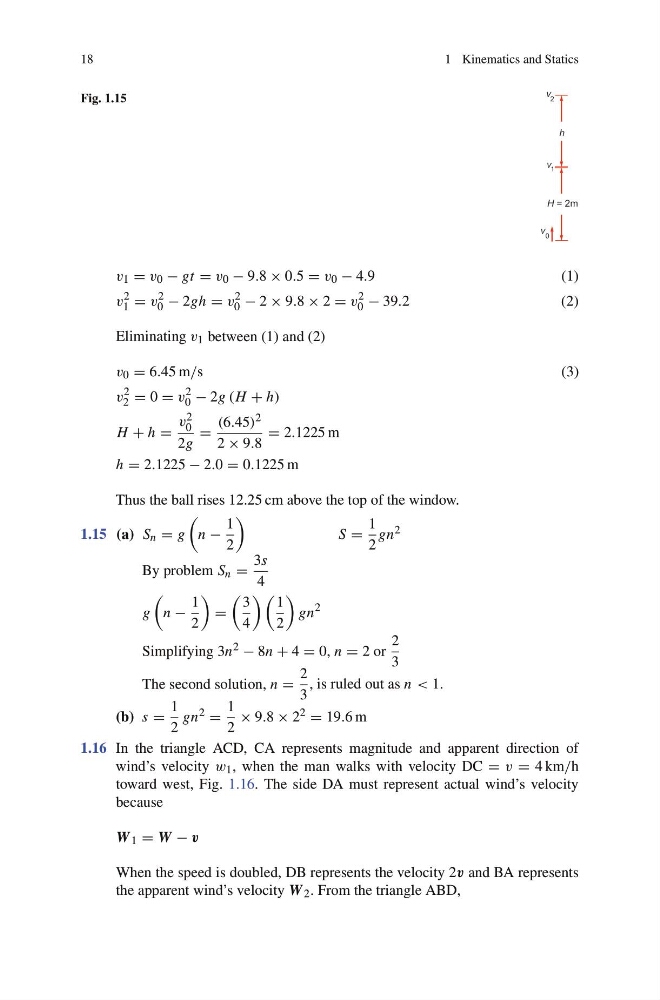
Fig. 1.15
v 1 = v 0 − gt = v 0 − 9.8 × 0.5 = v 0 − 4.9
( 1 )
v
2
1 = v
2
0 − 2gh = v
2
0 − 2 × 9.8 × 2 = v
2
0 − 39.2
( 2 )
Eliminating v 1 between (1) and (2)
v 0 = 6.45 m/s
( 3 )
v
2
2 = 0 = v
2
0 − 2g (H + h)
H + h =
v 2
0
2g
=
(6.45) 2
2 × 9.8
= 2.1225 m
h = 2.1225 − 2.0 = 0.1225 m
Thus the ball rises 12.25 cm above the top of the window.
1.15 (a) S n = g
n −
1
2
S =
1
2
gn 2
By problem S n =
3s
4
g
n −
1
2
=
3
4
1
2
gn
2
Simplifying 3n 2 − 8n + 4 = 0, n = 2 or
2
3
The second solution, n =
2
3
, is ruled out as n < 1.
(b) s =
1
2
gn 2 =
1
2
× 9.8 × 2 2 = 19.6 m
1.16 In the triangle ACD, CA represents magnitude and apparent direction of
wind’s velocity w 1 , when the man walks with velocity DC = v = 4 km/h
toward west, Fig. 1.16. The side DA must represent actual wind’s velocity
because
W 1 = W − v
When the speed is doubled, DB represents the velocity 2v and BA represents
the apparent wind’s velocity W 2 . From the triangle ABD,
1 Kinematics and Statics
Fig. 1.15
v 1 = v 0 − gt = v 0 − 9.8 × 0.5 = v 0 − 4.9
( 1 )
v
2
1 = v
2
0 − 2gh = v
2
0 − 2 × 9.8 × 2 = v
2
0 − 39.2
( 2 )
Eliminating v 1 between (1) and (2)
v 0 = 6.45 m/s
( 3 )
v
2
2 = 0 = v
2
0 − 2g (H + h)
H + h =
v 2
0
2g
=
(6.45) 2
2 × 9.8
= 2.1225 m
h = 2.1225 − 2.0 = 0.1225 m
Thus the ball rises 12.25 cm above the top of the window.
1.15 (a) S n = g
n −
1
2
S =
1
2
gn 2
By problem S n =
3s
4
g
n −
1
2
=
3
4
1
2
gn
2
Simplifying 3n 2 − 8n + 4 = 0, n = 2 or
2
3
The second solution, n =
2
3
, is ruled out as n < 1.
(b) s =
1
2
gn 2 =
1
2
× 9.8 × 2 2 = 19.6 m
1.16 In the triangle ACD, CA represents magnitude and apparent direction of
wind’s velocity w 1 , when the man walks with velocity DC = v = 4 km/h
toward west, Fig. 1.16. The side DA must represent actual wind’s velocity
because
W 1 = W − v
When the speed is doubled, DB represents the velocity 2v and BA represents
the apparent wind’s velocity W 2 . From the triangle ABD,