

7.3 Solutions
321
which yield equations of motion
2m ¨
x 1 + k(3x 1 − x 2 ) = 0
( 5 )
m ¨
x 2 − k(x 1 − x 2 ) = 0
( 6 )
(b) Let the harmonic solutions be
x 1 = A sin ωt, x 2 = B sin ωt
( 7 )
¨
x 1 = −Aω
2 sin ωt, ¨
x 2 = −Bω
2 sin ωt
( 8 )
Substituting (7) and (8) in (5) and (6) we obtain
(3k − 2mω
2
)A − k B = 0
( 9 )
k A + (mω
2
− k)B = 0
(10)
The frequency equation is obtained by equating to zero the determinant
formed by the coefficients of A and B:
(3k − 2mω 2 ) −k
k
mω 2 − k
= 0
Expanding the determinant
2m
2
ω
4
− 5km ω
2
+ 2k
2
= 0
ω 1 =
2k
m
, ω 2 =
k
2m
(c) Put ω = ω 1 =
2k
m
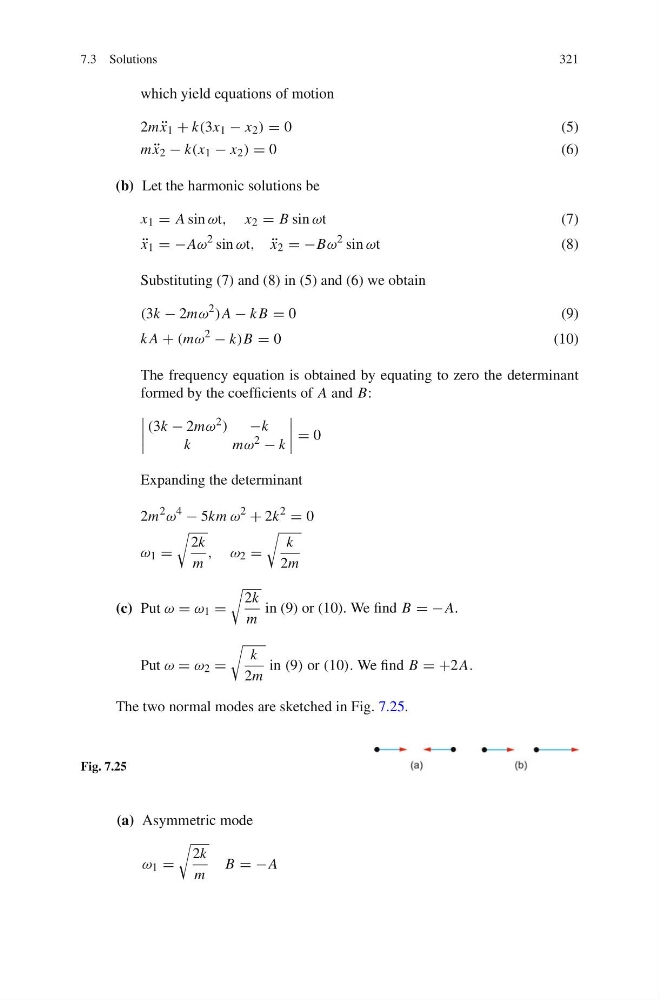
in (9) or (10). We find B = −A.
Put ω = ω 2 =
k
2m
in (9) or (10). We find B = +2A.
The two normal modes are sketched in Fig. 7.25.
Fig. 7.25
(a) Asymmetric mode
ω 1 =
2k
m
B = −A
321
which yield equations of motion
2m ¨
x 1 + k(3x 1 − x 2 ) = 0
( 5 )
m ¨
x 2 − k(x 1 − x 2 ) = 0
( 6 )
(b) Let the harmonic solutions be
x 1 = A sin ωt, x 2 = B sin ωt
( 7 )
¨
x 1 = −Aω
2 sin ωt, ¨
x 2 = −Bω
2 sin ωt
( 8 )
Substituting (7) and (8) in (5) and (6) we obtain
(3k − 2mω
2
)A − k B = 0
( 9 )
k A + (mω
2
− k)B = 0
(10)
The frequency equation is obtained by equating to zero the determinant
formed by the coefficients of A and B:
(3k − 2mω 2 ) −k
k
mω 2 − k
= 0
Expanding the determinant
2m
2
ω
4
− 5km ω
2
+ 2k
2
= 0
ω 1 =
2k
m
, ω 2 =
k
2m
(c) Put ω = ω 1 =
2k
m
in (9) or (10). We find B = −A.
Put ω = ω 2 =
k
2m
in (9) or (10). We find B = +2A.
The two normal modes are sketched in Fig. 7.25.
Fig. 7.25
(a) Asymmetric mode
ω 1 =
2k
m
B = −A