

300
7 Lagrangian and Hamiltonian Mechanics
yields
m 1 + m 2 +
I
R 2
¨
x − g(m 1 − m 2 ) = 0
or ¨
x =
(m 1 − m 2 )g
m 1 + m 2 +
I
R 2
(5)
which is identical with the one obtained by Newton’s mechanics.
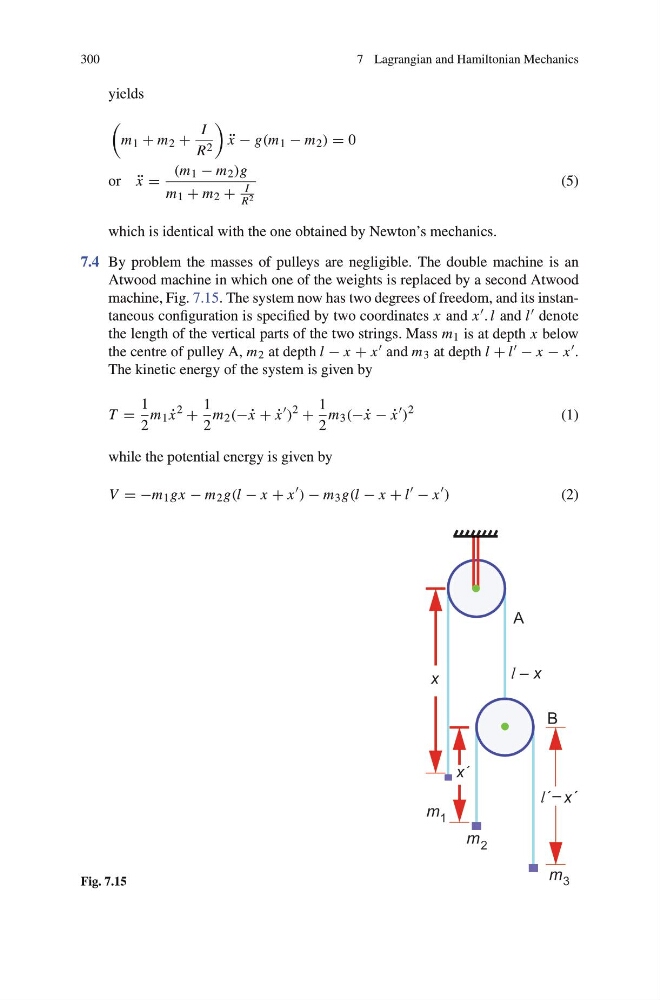
7.4 By problem the masses of pulleys are negligible. The double machine is an
Atwood machine in which one of the weights is replaced by a second Atwood
machine, Fig. 7.15. The system now has two degrees of freedom, and its instantaneous configuration is specified by two coordinates x and x . l and l denote
the length of the vertical parts of the two strings. Mass m 1 is at depth x below
the centre of pulley A, m 2 at depth l − x + x and m 3 at depth l + l − x − x .
The kinetic energy of the system is given by
T =
1
2
m 1 ˙
x
2
+
1
2
m 2 (− ˙
x + ˙
x
)
2
+
1
2
m 3 (− ˙
x − ˙
x
)
2
(1)
while the potential energy is given by
V = −m 1 gx − m 2 g(l − x + x
) − m 3 g(l − x + l
− x
)
(2)
Fig. 7.15
7 Lagrangian and Hamiltonian Mechanics
yields
m 1 + m 2 +
I
R 2
¨
x − g(m 1 − m 2 ) = 0
or ¨
x =
(m 1 − m 2 )g
m 1 + m 2 +
I
R 2
(5)
which is identical with the one obtained by Newton’s mechanics.
7.4 By problem the masses of pulleys are negligible. The double machine is an
Atwood machine in which one of the weights is replaced by a second Atwood
machine, Fig. 7.15. The system now has two degrees of freedom, and its instantaneous configuration is specified by two coordinates x and x . l and l denote
the length of the vertical parts of the two strings. Mass m 1 is at depth x below
the centre of pulley A, m 2 at depth l − x + x and m 3 at depth l + l − x − x .
The kinetic energy of the system is given by
T =
1
2
m 1 ˙
x
2
+
1
2
m 2 (− ˙
x + ˙
x
)
2
+
1
2
m 3 (− ˙
x − ˙
x
)
2
(1)
while the potential energy is given by
V = −m 1 gx − m 2 g(l − x + x
) − m 3 g(l − x + l
− x
)
(2)
Fig. 7.15