

1.3 Solutions
15
From (2),
s = 19.6 × 1 −
1
2
× 9.8 × 1
2
= 14.7 m
1.4 x = A sin π t = A sin ωt
where ω is the angular velocity, ω = π
Time period T =
2 π
ω
=
2 π
π
= 2 s
In
1
2 s (a quarter of the cycle) the distance covered is A. Therefore in 3 s the
distance covered will be 6A.
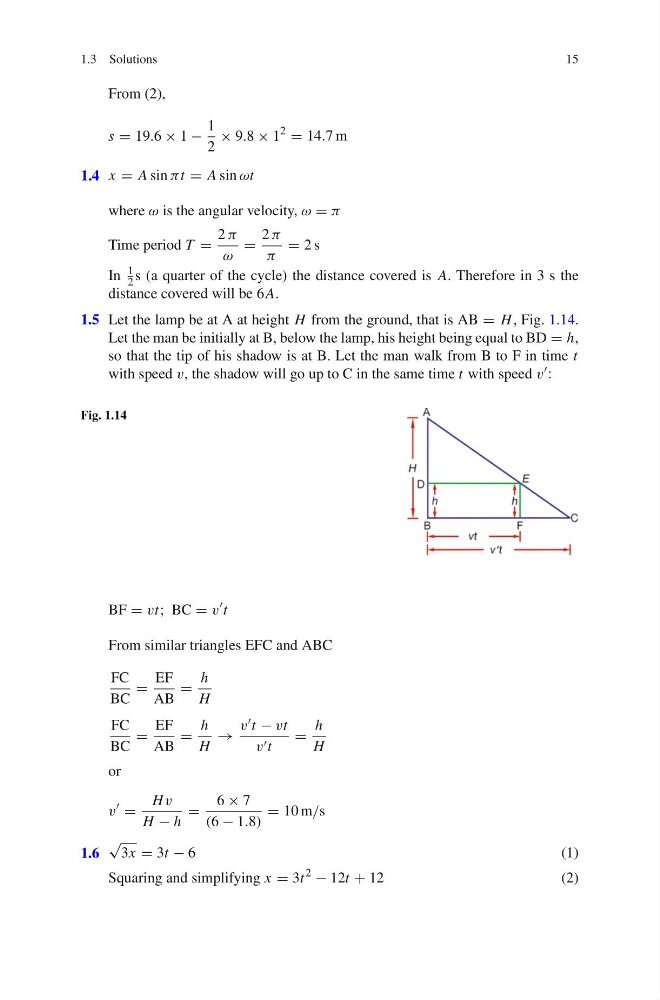
1.5 Let the lamp be at A at height H from the ground, that is AB = H , Fig. 1.14.
Let the man be initially at B, below the lamp, his height being equal to BD = h,
so that the tip of his shadow is at B. Let the man walk from B to F in time t
with speed v, the shadow will go up to C in the same time t with speed v :
Fig. 1.14
BF = vt; BC = v
t
From similar triangles EFC and ABC
FC
BC
=
EF
AB
=
h
H
FC
BC
=
EF
AB
=
h
H
→
v t − vt
v t
=
h
H
or
v
=
H v
H − h
=
6 × 7
(6 − 1.8)
= 10 m/s
1.6
√
3x = 3t − 6
( 1 )
Squaring and simplifying x = 3t
2
− 12t + 12
(2)
15
From (2),
s = 19.6 × 1 −
1
2
× 9.8 × 1
2
= 14.7 m
1.4 x = A sin π t = A sin ωt
where ω is the angular velocity, ω = π
Time period T =
2 π
ω
=
2 π
π
= 2 s
In
1
2 s (a quarter of the cycle) the distance covered is A. Therefore in 3 s the
distance covered will be 6A.
1.5 Let the lamp be at A at height H from the ground, that is AB = H , Fig. 1.14.
Let the man be initially at B, below the lamp, his height being equal to BD = h,
so that the tip of his shadow is at B. Let the man walk from B to F in time t
with speed v, the shadow will go up to C in the same time t with speed v :
Fig. 1.14
BF = vt; BC = v
t
From similar triangles EFC and ABC
FC
BC
=
EF
AB
=
h
H
FC
BC
=
EF
AB
=
h
H
→
v t − vt
v t
=
h
H
or
v
=
H v
H − h
=
6 × 7
(6 − 1.8)
= 10 m/s
1.6
√
3x = 3t − 6
( 1 )
Squaring and simplifying x = 3t
2
− 12t + 12
(2)