

7.2 Problems
289
7.10 Consider a pendulum consisting of a small mass m attached to one end of an
inextensible cord of length l rotating about the other end which is fixed. The
pendulum moves on a spherical surface. Hence the name spherical pendulum.
The inclination angle ϕ in the xy-plane can change independently.
(a) Obtain the equations of motion for the spherical pendulum.
(b) Discuss the conditions for which the motion of a spherical pendulum is
converted into that of (i) simple pendulum and (ii) conical pendulum.
7.11 Two blocks of mass m and M connected by a massless spring of spring constant k are placed on a smooth horizontal table. Determine the equations of
motion using Lagrangian mechanics.
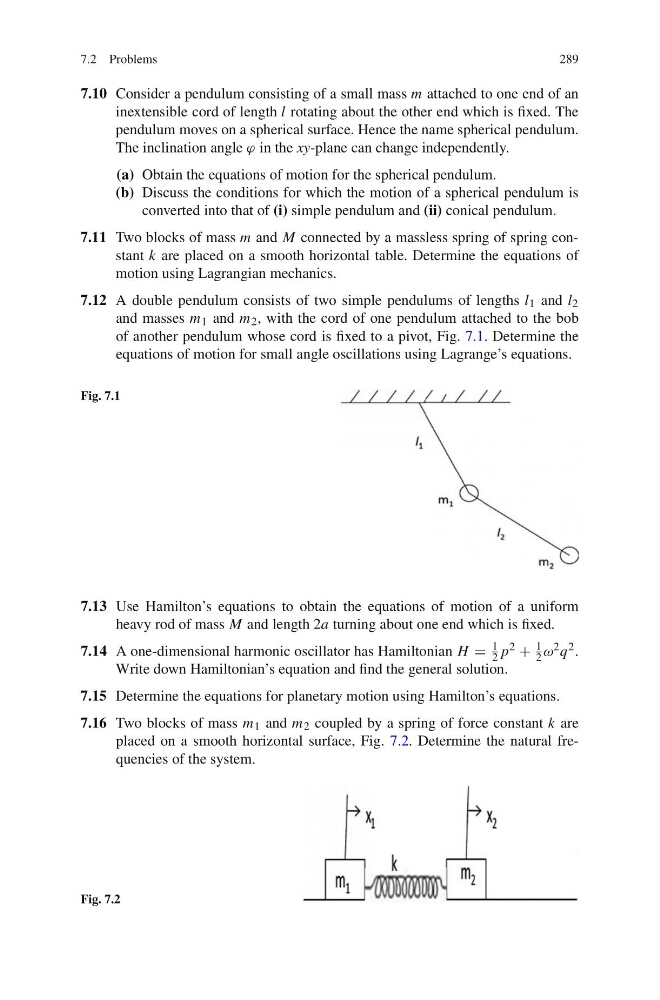
7.12 A double pendulum consists of two simple pendulums of lengths l 1 and l 2
and masses m 1 and m 2 , with the cord of one pendulum attached to the bob
of another pendulum whose cord is fixed to a pivot, Fig. 7.1. Determine the
equations of motion for small angle oscillations using Lagrange’s equations.
Fig. 7.1
7.13 Use Hamilton’s equations to obtain the equations of motion of a uniform
heavy rod of mass M and length 2a turning about one end which is fixed.
7.14 A one-dimensional harmonic oscillator has Hamiltonian H =
1
2 p 2 +
1
2 ω 2 q 2 .
Write down Hamiltonian’s equation and find the general solution.
7.15 Determine the equations for planetary motion using Hamilton’s equations.
7.16 Two blocks of mass m 1 and m 2 coupled by a spring of force constant k are
placed on a smooth horizontal surface, Fig. 7.2. Determine the natural frequencies of the system.
Fig. 7.2
289
7.10 Consider a pendulum consisting of a small mass m attached to one end of an
inextensible cord of length l rotating about the other end which is fixed. The
pendulum moves on a spherical surface. Hence the name spherical pendulum.
The inclination angle ϕ in the xy-plane can change independently.
(a) Obtain the equations of motion for the spherical pendulum.
(b) Discuss the conditions for which the motion of a spherical pendulum is
converted into that of (i) simple pendulum and (ii) conical pendulum.
7.11 Two blocks of mass m and M connected by a massless spring of spring constant k are placed on a smooth horizontal table. Determine the equations of
motion using Lagrangian mechanics.
7.12 A double pendulum consists of two simple pendulums of lengths l 1 and l 2
and masses m 1 and m 2 , with the cord of one pendulum attached to the bob
of another pendulum whose cord is fixed to a pivot, Fig. 7.1. Determine the
equations of motion for small angle oscillations using Lagrange’s equations.
Fig. 7.1
7.13 Use Hamilton’s equations to obtain the equations of motion of a uniform
heavy rod of mass M and length 2a turning about one end which is fixed.
7.14 A one-dimensional harmonic oscillator has Hamiltonian H =
1
2 p 2 +
1
2 ω 2 q 2 .
Write down Hamiltonian’s equation and find the general solution.
7.15 Determine the equations for planetary motion using Hamilton’s equations.
7.16 Two blocks of mass m 1 and m 2 coupled by a spring of force constant k are
placed on a smooth horizontal surface, Fig. 7.2. Determine the natural frequencies of the system.
Fig. 7.2