

12
1 Kinematics and Statics
1.56 Particles of masses m, 2m, 3m . . . nm are collinear at distances L, 2L,
3L . . . nL, respectively, from a fixed point. Locate the centre of mass from
the fixed point.
1.57 A semicircular disc of radius R has density ρ which varies as ρ = cr 2 , where
r is the distance from the centre of the base and cis a constant. The centre of
mass will lie along the y-axis for reasons of symmetry (Fig. 1.11). Locate the
centre of mass from O, the centre of the base.
Fig. 1.11
1.58 Locate the centre of mass of a water molecule, given that the OH bond has
length 1.77 Å and angle HOH is 105 ◦ .
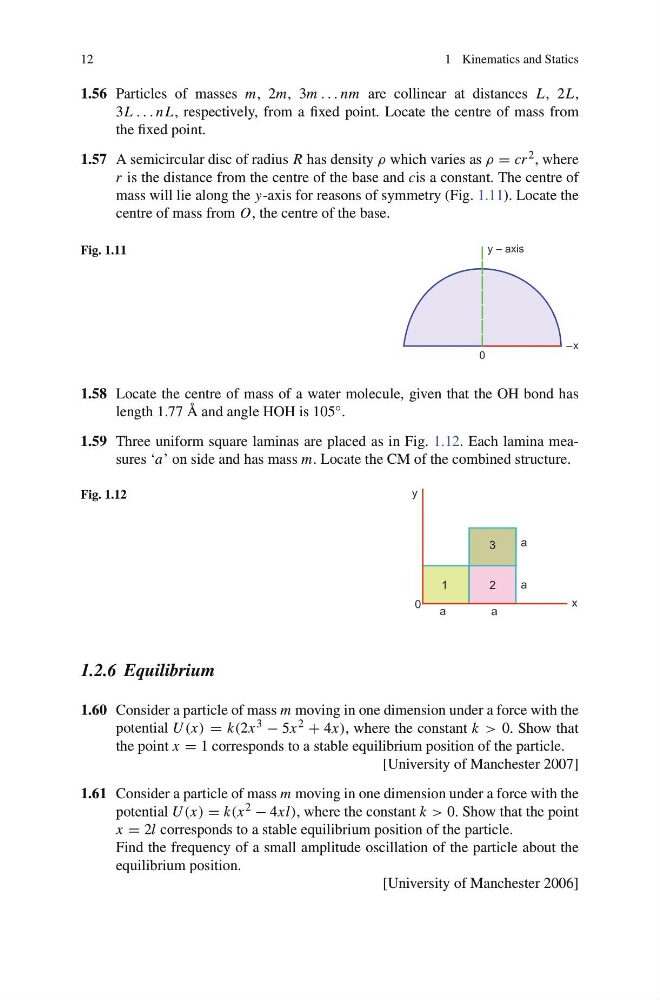
1.59 Three uniform square laminas are placed as in Fig. 1.12. Each lamina measures ‘a’ on side and has mass m. Locate the CM of the combined structure.
Fig. 1.12
1.2.6 Equilibrium
1.60 Consider a particle of mass m moving in one dimension under a force with the
potential U (x) = k(2x 3 − 5x 2 + 4x), where the constant k > 0. Show that
the point x = 1 corresponds to a stable equilibrium position of the particle.
[University of Manchester 2007]
1.61 Consider a particle of mass m moving in one dimension under a force with the
potential U (x) = k(x 2 − 4xl), where the constant k > 0. Show that the point
x = 2l corresponds to a stable equilibrium position of the particle.
Find the frequency of a small amplitude oscillation of the particle about the
equilibrium position.
[University of Manchester 2006]
1 Kinematics and Statics
1.56 Particles of masses m, 2m, 3m . . . nm are collinear at distances L, 2L,
3L . . . nL, respectively, from a fixed point. Locate the centre of mass from
the fixed point.
1.57 A semicircular disc of radius R has density ρ which varies as ρ = cr 2 , where
r is the distance from the centre of the base and cis a constant. The centre of
mass will lie along the y-axis for reasons of symmetry (Fig. 1.11). Locate the
centre of mass from O, the centre of the base.
Fig. 1.11
1.58 Locate the centre of mass of a water molecule, given that the OH bond has
length 1.77 Å and angle HOH is 105 ◦ .
1.59 Three uniform square laminas are placed as in Fig. 1.12. Each lamina measures ‘a’ on side and has mass m. Locate the CM of the combined structure.
Fig. 1.12
1.2.6 Equilibrium
1.60 Consider a particle of mass m moving in one dimension under a force with the
potential U (x) = k(2x 3 − 5x 2 + 4x), where the constant k > 0. Show that
the point x = 1 corresponds to a stable equilibrium position of the particle.
[University of Manchester 2007]
1.61 Consider a particle of mass m moving in one dimension under a force with the
potential U (x) = k(x 2 − 4xl), where the constant k > 0. Show that the point
x = 2l corresponds to a stable equilibrium position of the particle.
Find the frequency of a small amplitude oscillation of the particle about the
equilibrium position.
[University of Manchester 2006]