

260
6 Oscillations
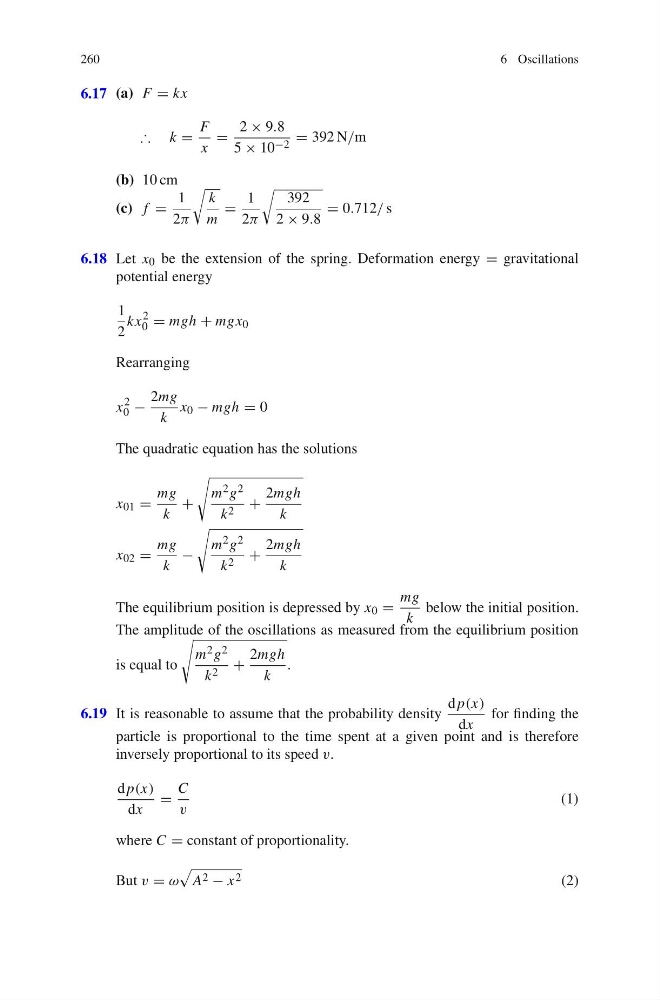
6.17 (a) F = kx
∴ k =
F
x
=
2 × 9.8
5 × 10 −2 = 392 N/m
(b) 10 cm
(c) f =
1
2π
k
m
=
1
2π
392
2 × 9.8
= 0.712/ s
6.18 Let x 0 be the extension of the spring. Deformation energy = gravitational
potential energy
1
2
kx
2
0 = mgh + mgx 0
Rearranging
x
2
0 −
2mg
k
x 0 − mgh = 0
The quadratic equation has the solutions
x 01 =
mg
k
+
m 2 g 2
k 2 +
2mgh
k
x 02 =
mg
k
−
m 2 g 2
k 2 +
2mgh
k
The equilibrium position is depressed by x 0 =
mg
k
below the initial position.
The amplitude of the oscillations as measured from the equilibrium position
is equal to
m 2 g 2
k 2 +
2mgh
k
.
6.19 It is reasonable to assume that the probability density
d p(x)
dx
for finding the
particle is proportional to the time spent at a given point and is therefore
inversely proportional to its speed v.
d p(x)
dx
=
C
v
(1)
where C = constant of proportionality.
But v = ω
A 2 − x 2
(2)
6 Oscillations
6.17 (a) F = kx
∴ k =
F
x
=
2 × 9.8
5 × 10 −2 = 392 N/m
(b) 10 cm
(c) f =
1
2π
k
m
=
1
2π
392
2 × 9.8
= 0.712/ s
6.18 Let x 0 be the extension of the spring. Deformation energy = gravitational
potential energy
1
2
kx
2
0 = mgh + mgx 0
Rearranging
x
2
0 −
2mg
k
x 0 − mgh = 0
The quadratic equation has the solutions
x 01 =
mg
k
+
m 2 g 2
k 2 +
2mgh
k
x 02 =
mg
k
−
m 2 g 2
k 2 +
2mgh
k
The equilibrium position is depressed by x 0 =
mg
k
below the initial position.
The amplitude of the oscillations as measured from the equilibrium position
is equal to
m 2 g 2
k 2 +
2mgh
k
.
6.19 It is reasonable to assume that the probability density
d p(x)
dx
for finding the
particle is proportional to the time spent at a given point and is therefore
inversely proportional to its speed v.
d p(x)
dx
=
C
v
(1)
where C = constant of proportionality.
But v = ω
A 2 − x 2
(2)