

256
6 Oscillations
∴
π
4
+ ε = 0 ε = −
π
4
Now v =
dx
dt
= Aω cos(ωt + ε)
When t = 4, v = 4.
∴ 4 =
Aπ
8
cos
π
8
4 −
π
4
∴ A =
32
√
2
π
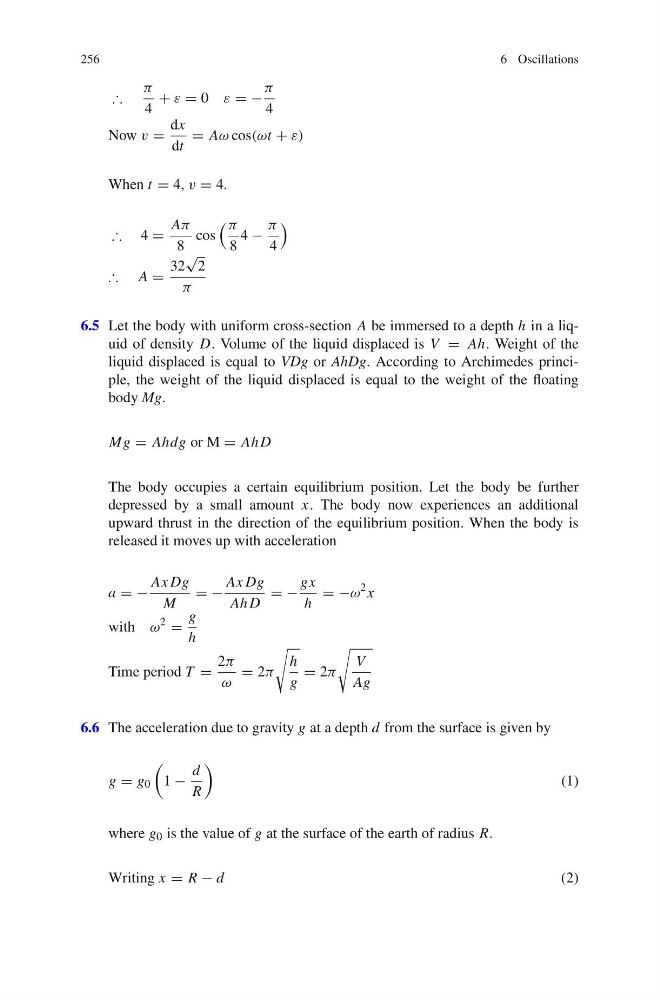
6.5 Let the body with uniform cross-section A be immersed to a depth h in a liquid of density D. Volume of the liquid displaced is V = Ah. Weight of the
liquid displaced is equal to VDg or AhDg. According to Archimedes principle, the weight of the liquid displaced is equal to the weight of the floating
body Mg.
Mg = Ahdg or M = Ah D
The body occupies a certain equilibrium position. Let the body be further
depressed by a small amount x. The body now experiences an additional
upward thrust in the direction of the equilibrium position. When the body is
released it moves up with acceleration
a = −
Ax Dg
M
= −
Ax Dg
Ah D
= −
gx
h
= −ω
2 x
with ω
2
=
g
h
Time period T =
2π
ω
= 2π
h
g
= 2π
V
Ag
6.6 The acceleration due to gravity g at a depth d from the surface is given by
g = g 0
1 −
d
R
(1)
where g 0 is the value of g at the surface of the earth of radius R.
Writing x = R − d
(2)
6 Oscillations
∴
π
4
+ ε = 0 ε = −
π
4
Now v =
dx
dt
= Aω cos(ωt + ε)
When t = 4, v = 4.
∴ 4 =
Aπ
8
cos
π
8
4 −
π
4
∴ A =
32
√
2
π
6.5 Let the body with uniform cross-section A be immersed to a depth h in a liquid of density D. Volume of the liquid displaced is V = Ah. Weight of the
liquid displaced is equal to VDg or AhDg. According to Archimedes principle, the weight of the liquid displaced is equal to the weight of the floating
body Mg.
Mg = Ahdg or M = Ah D
The body occupies a certain equilibrium position. Let the body be further
depressed by a small amount x. The body now experiences an additional
upward thrust in the direction of the equilibrium position. When the body is
released it moves up with acceleration
a = −
Ax Dg
M
= −
Ax Dg
Ah D
= −
gx
h
= −ω
2 x
with ω
2
=
g
h
Time period T =
2π
ω
= 2π
h
g
= 2π
V
Ag
6.6 The acceleration due to gravity g at a depth d from the surface is given by
g = g 0
1 −
d
R
(1)
where g 0 is the value of g at the surface of the earth of radius R.
Writing x = R − d
(2)