

6.2 Problems
251
6.2.3 Coupled Systems of Masses and Springs
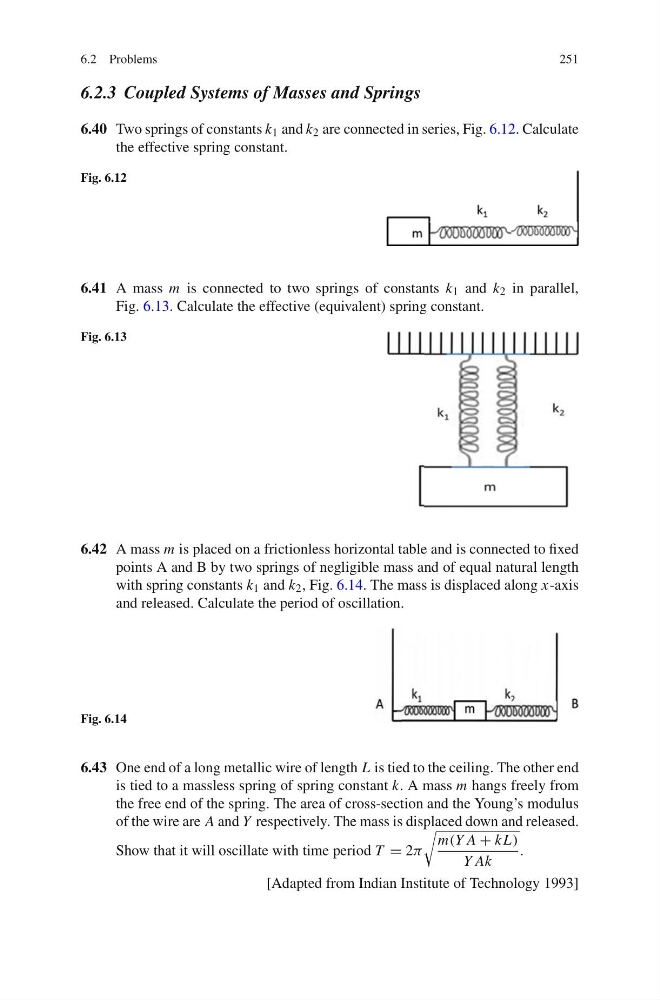
6.40 Two springs of constants k 1 and k 2 are connected in series, Fig. 6.12. Calculate
the effective spring constant.
Fig. 6.12
6.41 A mass m is connected to two springs of constants k 1 and k 2 in parallel,
Fig. 6.13. Calculate the effective (equivalent) spring constant.
Fig. 6.13
6.42 A mass m is placed on a frictionless horizontal table and is connected to fixed
points A and B by two springs of negligible mass and of equal natural length
with spring constants k 1 and k 2 , Fig. 6.14. The mass is displaced along x-axis
and released. Calculate the period of oscillation.
Fig. 6.14
6.43 One end of a long metallic wire of length L is tied to the ceiling. The other end
is tied to a massless spring of spring constant k. A mass m hangs freely from
the free end of the spring. The area of cross-section and the Young’s modulus
of the wire are A and Y respectively. The mass is displaced down and released.
Show that it will oscillate with time period T = 2π
m(Y A + k L)
Y Ak
.
[Adapted from Indian Institute of Technology 1993]
251
6.2.3 Coupled Systems of Masses and Springs
6.40 Two springs of constants k 1 and k 2 are connected in series, Fig. 6.12. Calculate
the effective spring constant.
Fig. 6.12
6.41 A mass m is connected to two springs of constants k 1 and k 2 in parallel,
Fig. 6.13. Calculate the effective (equivalent) spring constant.
Fig. 6.13
6.42 A mass m is placed on a frictionless horizontal table and is connected to fixed
points A and B by two springs of negligible mass and of equal natural length
with spring constants k 1 and k 2 , Fig. 6.14. The mass is displaced along x-axis
and released. Calculate the period of oscillation.
Fig. 6.14
6.43 One end of a long metallic wire of length L is tied to the ceiling. The other end
is tied to a massless spring of spring constant k. A mass m hangs freely from
the free end of the spring. The area of cross-section and the Young’s modulus
of the wire are A and Y respectively. The mass is displaced down and released.
Show that it will oscillate with time period T = 2π
m(Y A + k L)
Y Ak
.
[Adapted from Indian Institute of Technology 1993]