

6.2 Problems
245
ω 0 being the resonance frequency.
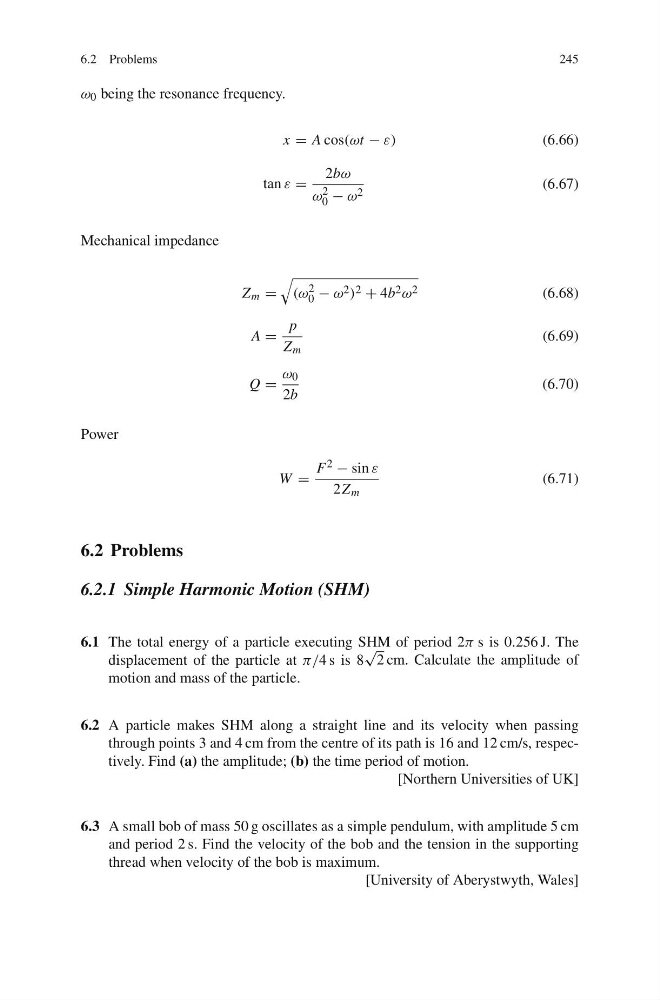
x = A cos(ωt − ε)
(6.66)
tan ε =
2bω
ω 2
0 − ω 2
(6.67)
Mechanical impedance
Z m =
(ω 2
0 − ω 2 ) 2 + 4b 2 ω 2
(6.68)
A =
p
Z m
(6.69)
Q =
ω 0
2b
(6.70)
Power
W =
F 2 − sin ε
2Z m
(6.71)
6.2 Problems
6.2.1 Simple Harmonic Motion (SHM)
6.1 The total energy of a particle executing SHM of period 2π s is 0.256 J. The
displacement of the particle at π/4 s is 8
√
2 cm. Calculate the amplitude of
motion and mass of the particle.
6.2 A particle makes SHM along a straight line and its velocity when passing
through points 3 and 4 cm from the centre of its path is 16 and 12 cm/s, respectively. Find (a) the amplitude; (b) the time period of motion.
[Northern Universities of UK]
6.3 A small bob of mass 50 g oscillates as a simple pendulum, with amplitude 5 cm
and period 2 s. Find the velocity of the bob and the tension in the supporting
thread when velocity of the bob is maximum.
[University of Aberystwyth, Wales]
245
ω 0 being the resonance frequency.
x = A cos(ωt − ε)
(6.66)
tan ε =
2bω
ω 2
0 − ω 2
(6.67)
Mechanical impedance
Z m =
(ω 2
0 − ω 2 ) 2 + 4b 2 ω 2
(6.68)
A =
p
Z m
(6.69)
Q =
ω 0
2b
(6.70)
Power
W =
F 2 − sin ε
2Z m
(6.71)
6.2 Problems
6.2.1 Simple Harmonic Motion (SHM)
6.1 The total energy of a particle executing SHM of period 2π s is 0.256 J. The
displacement of the particle at π/4 s is 8
√
2 cm. Calculate the amplitude of
motion and mass of the particle.
6.2 A particle makes SHM along a straight line and its velocity when passing
through points 3 and 4 cm from the centre of its path is 16 and 12 cm/s, respectively. Find (a) the amplitude; (b) the time period of motion.
[Northern Universities of UK]
6.3 A small bob of mass 50 g oscillates as a simple pendulum, with amplitude 5 cm
and period 2 s. Find the velocity of the bob and the tension in the supporting
thread when velocity of the bob is maximum.
[University of Aberystwyth, Wales]