

5.3 Solutions
225
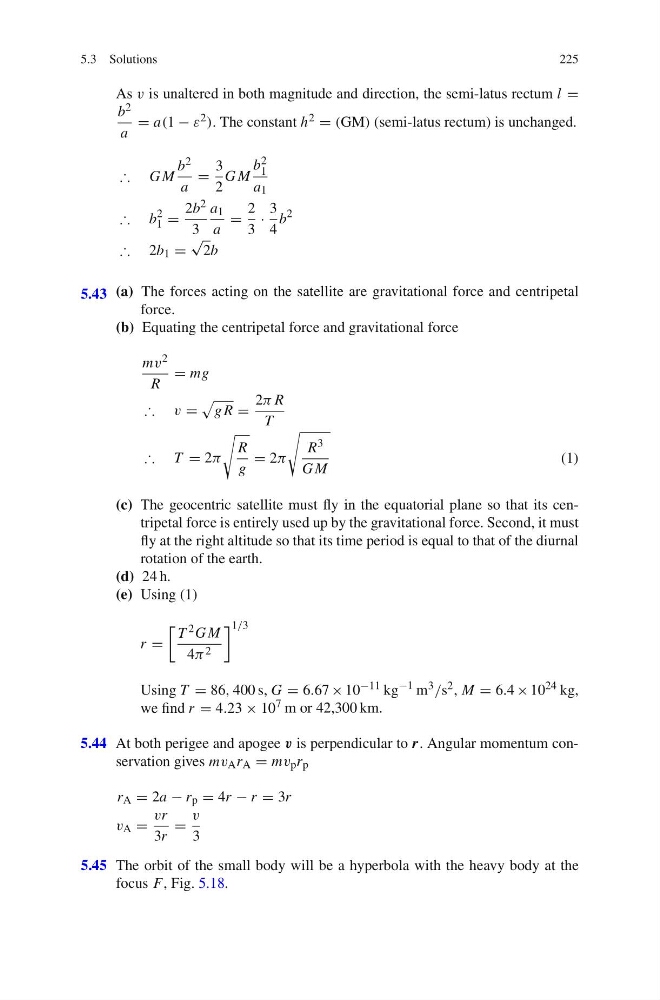
As v is unaltered in both magnitude and direction, the semi-latus rectum l =
b 2
a
= a(1 − ε 2 ). The constant h 2 = (GM) (semi-latus rectum) is unchanged.
∴ G M
b 2
a
=
3
2
G M
b 2
1
a 1
∴ b
2
1 =
2b 2
3
a 1
a
=
2
3
·
3
4
b
2
∴ 2b 1 =
√
2b
5.43 (a) The forces acting on the satellite are gravitational force and centripetal
force.
(b) Equating the centripetal force and gravitational force
mv 2
R
= mg
∴ v =
g R =
2π R
T
∴ T = 2π
R
g
= 2π
R 3
G M
(1)
(c) The geocentric satellite must fly in the equatorial plane so that its centripetal force is entirely used up by the gravitational force. Second, it must
fly at the right altitude so that its time period is equal to that of the diurnal
rotation of the earth.
(d) 24 h.
(e) Using (1)
r =
T 2 G M
4π 2
1/3
Using T = 86, 400 s, G = 6.67 × 10 −11 kg
−1 m 3 /s 2 , M = 6.4 × 10 24 kg,
we find r = 4.23 × 10 7 m or 42,300 km.
5.44 At both perigee and apogee v is perpendicular to r. Angular momentum conservation gives mv A r A = mv p r p
r A = 2a − r p = 4r − r = 3r
v A =
vr
3r
=
v
3
5.45 The orbit of the small body will be a hyperbola with the heavy body at the
focus F, Fig. 5.18.
225
As v is unaltered in both magnitude and direction, the semi-latus rectum l =
b 2
a
= a(1 − ε 2 ). The constant h 2 = (GM) (semi-latus rectum) is unchanged.
∴ G M
b 2
a
=
3
2
G M
b 2
1
a 1
∴ b
2
1 =
2b 2
3
a 1
a
=
2
3
·
3
4
b
2
∴ 2b 1 =
√
2b
5.43 (a) The forces acting on the satellite are gravitational force and centripetal
force.
(b) Equating the centripetal force and gravitational force
mv 2
R
= mg
∴ v =
g R =
2π R
T
∴ T = 2π
R
g
= 2π
R 3
G M
(1)
(c) The geocentric satellite must fly in the equatorial plane so that its centripetal force is entirely used up by the gravitational force. Second, it must
fly at the right altitude so that its time period is equal to that of the diurnal
rotation of the earth.
(d) 24 h.
(e) Using (1)
r =
T 2 G M
4π 2
1/3
Using T = 86, 400 s, G = 6.67 × 10 −11 kg
−1 m 3 /s 2 , M = 6.4 × 10 24 kg,
we find r = 4.23 × 10 7 m or 42,300 km.
5.44 At both perigee and apogee v is perpendicular to r. Angular momentum conservation gives mv A r A = mv p r p
r A = 2a − r p = 4r − r = 3r
v A =
vr
3r
=
v
3
5.45 The orbit of the small body will be a hyperbola with the heavy body at the
focus F, Fig. 5.18.