

5.3 Solutions
223
1
T
dt
r
=
1
a
(7)
(b)
1
T
v
2 dt =
G M
T
2
r
−
1
a
dt
= 2G M
1
T
dt
r
−
G M
T a
dt =
2G M
a
−
G M
a
=
G M
a
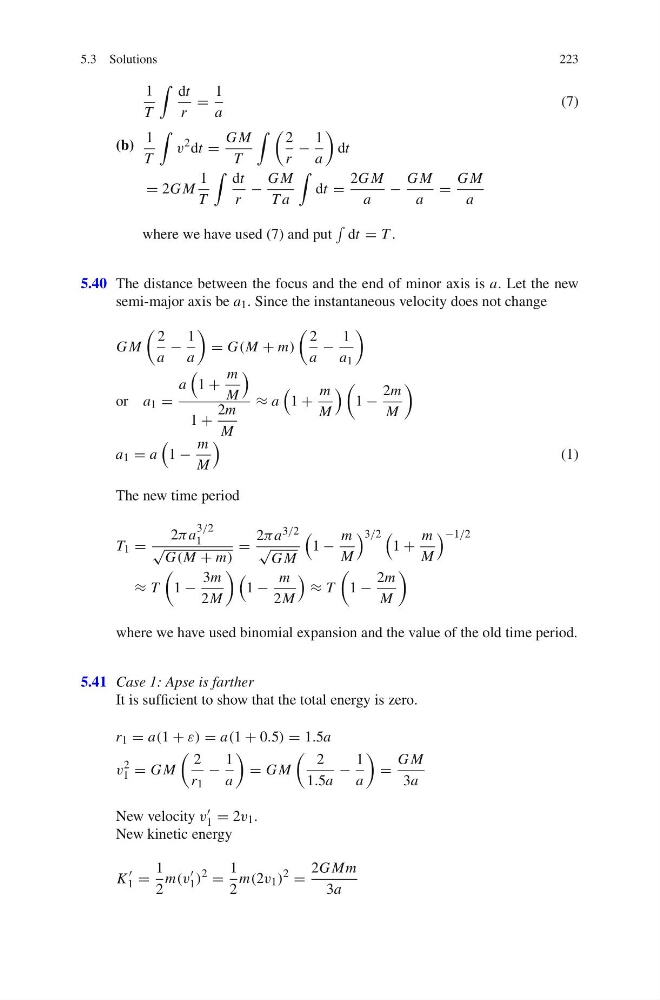
where we have used (7) and put
dt = T .
5.40 The distance between the focus and the end of minor axis is a. Let the new
semi-major axis be a 1 . Since the instantaneous velocity does not change
G M
2
a
−
1
a
= G(M + m)
2
a
−
1
a 1
or a 1 =
a
1 +
m
M
1 +
2m
M
≈ a
1 +
m
M
1 −
2m
M
a 1 = a
1 −
m
M
(1)
The new time period
T 1 =
2πa
3/2
1
√
G(M + m)
=
2πa 3/2
√
G M
1 −
m
M
3/2
1 +
m
M
−1/2
≈ T
1 −
3m
2M
1 −
m
2M
≈ T
1 −
2m
M
where we have used binomial expansion and the value of the old time period.
5.41 Case 1: Apse is farther
It is sufficient to show that the total energy is zero.
r 1 = a(1 + ε) = a(1 + 0.5) = 1.5a
v
2
1 = G M
2
r 1
−
1
a
= G M
2
1.5a
−
1
a
=
G M
3a
New velocity v
1 = 2v 1 .
New kinetic energy
K
1 =
1
2
m(v
1 )
2
=
1
2
m(2v 1 )
2
=
2G Mm
3a
223
1
T
dt
r
=
1
a
(7)
(b)
1
T
v
2 dt =
G M
T
2
r
−
1
a
dt
= 2G M
1
T
dt
r
−
G M
T a
dt =
2G M
a
−
G M
a
=
G M
a
where we have used (7) and put
dt = T .
5.40 The distance between the focus and the end of minor axis is a. Let the new
semi-major axis be a 1 . Since the instantaneous velocity does not change
G M
2
a
−
1
a
= G(M + m)
2
a
−
1
a 1
or a 1 =
a
1 +
m
M
1 +
2m
M
≈ a
1 +
m
M
1 −
2m
M
a 1 = a
1 −
m
M
(1)
The new time period
T 1 =
2πa
3/2
1
√
G(M + m)
=
2πa 3/2
√
G M
1 −
m
M
3/2
1 +
m
M
−1/2
≈ T
1 −
3m
2M
1 −
m
2M
≈ T
1 −
2m
M
where we have used binomial expansion and the value of the old time period.
5.41 Case 1: Apse is farther
It is sufficient to show that the total energy is zero.
r 1 = a(1 + ε) = a(1 + 0.5) = 1.5a
v
2
1 = G M
2
r 1
−
1
a
= G M
2
1.5a
−
1
a
=
G M
3a
New velocity v
1 = 2v 1 .
New kinetic energy
K
1 =
1
2
m(v
1 )
2
=
1
2
m(2v 1 )
2
=
2G Mm
3a