

5.3 Solutions
209
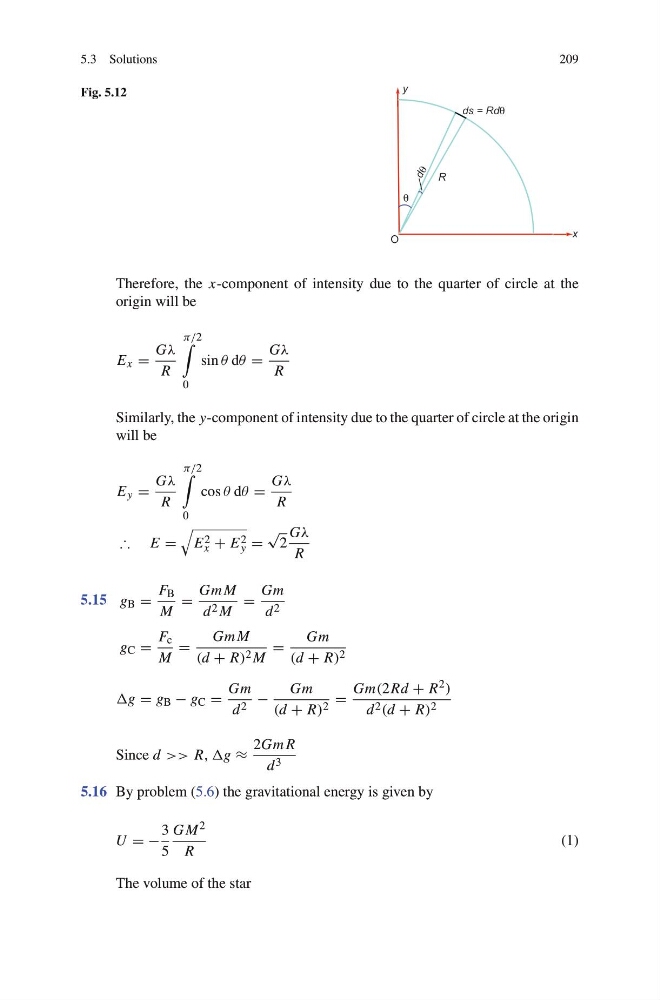
Fig. 5.12
Therefore, the x-component of intensity due to the quarter of circle at the
origin will be
E x =
Gλ
R
π/2
0
sin θ dθ =
Gλ
R
Similarly, the y-component of intensity due to the quarter of circle at the origin
will be
E y =
Gλ
R
π/2
0
cos θ dθ =
Gλ
R
∴ E =
E 2
x + E 2
y =
√
2
Gλ
R
5.15 g B =
F B
M
=
Gm M
d 2 M
=
Gm
d 2
g C =
F c
M
=
Gm M
(d + R) 2 M
=
Gm
(d + R) 2
g = g B − g C =
Gm
d 2 −
Gm
(d + R) 2 =
Gm(2Rd + R 2 )
d 2 (d + R) 2
Since d >> R, g ≈
2Gm R
d 3
5.16 By problem (5.6) the gravitational energy is given by
U = −
3
5
G M 2
R
(1)
The volume of the star
209
Fig. 5.12
Therefore, the x-component of intensity due to the quarter of circle at the
origin will be
E x =
Gλ
R
π/2
0
sin θ dθ =
Gλ
R
Similarly, the y-component of intensity due to the quarter of circle at the origin
will be
E y =
Gλ
R
π/2
0
cos θ dθ =
Gλ
R
∴ E =
E 2
x + E 2
y =
√
2
Gλ
R
5.15 g B =
F B
M
=
Gm M
d 2 M
=
Gm
d 2
g C =
F c
M
=
Gm M
(d + R) 2 M
=
Gm
(d + R) 2
g = g B − g C =
Gm
d 2 −
Gm
(d + R) 2 =
Gm(2Rd + R 2 )
d 2 (d + R) 2
Since d >> R, g ≈
2Gm R
d 3
5.16 By problem (5.6) the gravitational energy is given by
U = −
3
5
G M 2
R
(1)
The volume of the star