

204
5 Gravitation
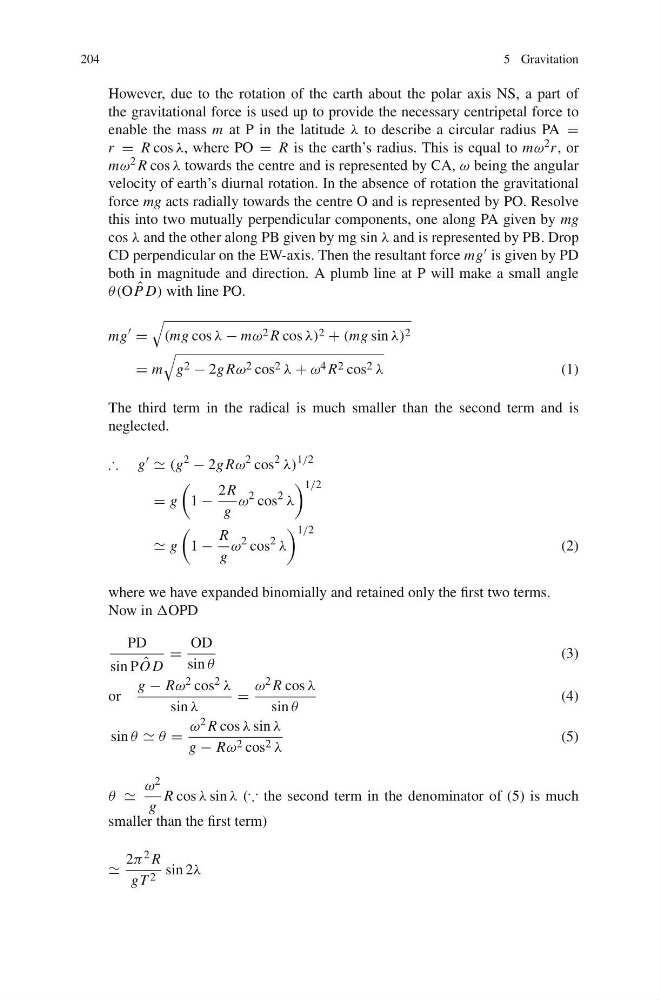
However, due to the rotation of the earth about the polar axis NS, a part of
the gravitational force is used up to provide the necessary centripetal force to
enable the mass m at P in the latitude λ to describe a circular radius PA =
r = R cos λ, where PO = R is the earth’s radius. This is equal to mω 2 r , or
mω 2 R cos λ towards the centre and is represented by CA, ω being the angular
velocity of earth’s diurnal rotation. In the absence of rotation the gravitational
force mg acts radially towards the centre O and is represented by PO. Resolve
this into two mutually perpendicular components, one along PA given by mg
cos λ and the other along PB given by mg sin λ and is represented by PB. Drop
CD perpendicular on the EW-axis. Then the resultant force mg is given by PD
both in magnitude and direction. A plumb line at P will make a small angle
θ(O ˆ
P D) with line PO.
mg
=
(mg cos λ − mω 2 R cos λ) 2 + (mg sin λ) 2
= m
g 2 − 2g Rω 2 cos 2 λ + ω 4 R 2 cos 2 λ
(1)
The third term in the radical is much smaller than the second term and is
neglected.
∴ g
(g
2
− 2g Rω
2 cos
2
λ)
1/2
= g
1 −
2R
g
ω
2 cos
2
λ
1/2
g
1 −
R
g
ω
2 cos
2
λ
1/2
(2)
where we have expanded binomially and retained only the first two terms.
Now in OPD
PD
sin P ˆ
O D
=
OD
sin θ
(3)
or
g − Rω 2 cos 2 λ
sin λ
=
ω 2 R cos λ
sin θ
(4)
sin θ θ =
ω 2 R cos λ sin λ
g − Rω 2 cos 2 λ
(5)
θ
ω 2
g
R cos λ sin λ (∵ the second term in the denominator of (5) is much
smaller than the first term)
2π 2 R
gT 2 sin 2λ
5 Gravitation
However, due to the rotation of the earth about the polar axis NS, a part of
the gravitational force is used up to provide the necessary centripetal force to
enable the mass m at P in the latitude λ to describe a circular radius PA =
r = R cos λ, where PO = R is the earth’s radius. This is equal to mω 2 r , or
mω 2 R cos λ towards the centre and is represented by CA, ω being the angular
velocity of earth’s diurnal rotation. In the absence of rotation the gravitational
force mg acts radially towards the centre O and is represented by PO. Resolve
this into two mutually perpendicular components, one along PA given by mg
cos λ and the other along PB given by mg sin λ and is represented by PB. Drop
CD perpendicular on the EW-axis. Then the resultant force mg is given by PD
both in magnitude and direction. A plumb line at P will make a small angle
θ(O ˆ
P D) with line PO.
mg
=
(mg cos λ − mω 2 R cos λ) 2 + (mg sin λ) 2
= m
g 2 − 2g Rω 2 cos 2 λ + ω 4 R 2 cos 2 λ
(1)
The third term in the radical is much smaller than the second term and is
neglected.
∴ g
(g
2
− 2g Rω
2 cos
2
λ)
1/2
= g
1 −
2R
g
ω
2 cos
2
λ
1/2
g
1 −
R
g
ω
2 cos
2
λ
1/2
(2)
where we have expanded binomially and retained only the first two terms.
Now in OPD
PD
sin P ˆ
O D
=
OD
sin θ
(3)
or
g − Rω 2 cos 2 λ
sin λ
=
ω 2 R cos λ
sin θ
(4)
sin θ θ =
ω 2 R cos λ sin λ
g − Rω 2 cos 2 λ
(5)
θ
ω 2
g
R cos λ sin λ (∵ the second term in the denominator of (5) is much
smaller than the first term)
2π 2 R
gT 2 sin 2λ