

186
4 Rotational Dynamics
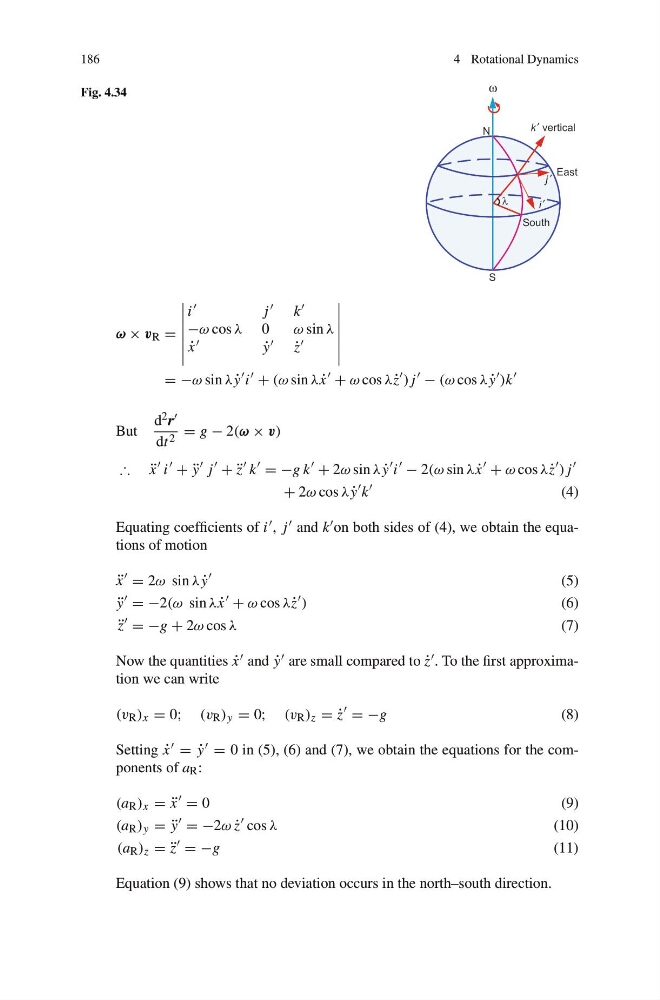
Fig. 4.34
ω × v R =
i
j k
−ω cos λ 0
ω sin λ
˙
x
˙
y ˙
z
= −ω sin λ ˙
y
i
+ (ω sin λ ˙
x
+ ω cos λ˙ z
) j
− (ω cos λ ˙
y
)k
But
d 2 r
dt 2 = g − 2(ω × v)
∴ ¨
x
i
+ ¨
y
j
+ ¨
z
k
= −g k
+ 2ω sin λ ˙
y
i
− 2(ω sin λ ˙
x
+ ω cos λ˙ z
) j
+ 2ω cos λ ˙
y
k
(4)
Equating coefficients of i , j and k on both sides of (4), we obtain the equations of motion
¨
x
= 2ω sin λ ˙
y
(5)
¨
y
= −2(ω sin λ ˙
x
+ ω cos λ˙ z
)
(6)
¨
z
= −g + 2ω cos λ
(7)
Now the quantities ˙
x and ˙
y are small compared to ˙
z . To the first approximation we can write
(v R ) x = 0; (v R ) y = 0; (v R ) z = ˙
z
= −g
(8)
Setting ˙
x = ˙
y = 0 in (5), (6) and (7), we obtain the equations for the components of a R :
(a R ) x = ¨
x
= 0
( 9 )
(a R ) y = ¨
y
= −2ω ˙
z
cos λ
(10)
(a R ) z = ¨
z
= −g
(11)
Equation (9) shows that no deviation occurs in the north–south direction.
4 Rotational Dynamics
Fig. 4.34
ω × v R =
i
j k
−ω cos λ 0
ω sin λ
˙
x
˙
y ˙
z
= −ω sin λ ˙
y
i
+ (ω sin λ ˙
x
+ ω cos λ˙ z
) j
− (ω cos λ ˙
y
)k
But
d 2 r
dt 2 = g − 2(ω × v)
∴ ¨
x
i
+ ¨
y
j
+ ¨
z
k
= −g k
+ 2ω sin λ ˙
y
i
− 2(ω sin λ ˙
x
+ ω cos λ˙ z
) j
+ 2ω cos λ ˙
y
k
(4)
Equating coefficients of i , j and k on both sides of (4), we obtain the equations of motion
¨
x
= 2ω sin λ ˙
y
(5)
¨
y
= −2(ω sin λ ˙
x
+ ω cos λ˙ z
)
(6)
¨
z
= −g + 2ω cos λ
(7)
Now the quantities ˙
x and ˙
y are small compared to ˙
z . To the first approximation we can write
(v R ) x = 0; (v R ) y = 0; (v R ) z = ˙
z
= −g
(8)
Setting ˙
x = ˙
y = 0 in (5), (6) and (7), we obtain the equations for the components of a R :
(a R ) x = ¨
x
= 0
( 9 )
(a R ) y = ¨
y
= −2ω ˙
z
cos λ
(10)
(a R ) z = ¨
z
= −g
(11)
Equation (9) shows that no deviation occurs in the north–south direction.