

4.3 Solutions
171
∴ α = C 1
√
ω
where C 1 = constant
α =
dω
dt
= C 1
√ ω
∴ dt =
dω
C 1
√ ω
(2)
Using (2) in (1)
< ω >=
ω 0
0
√ ωdω
ω 0
0
dω
√
ω
=
ω 0
3
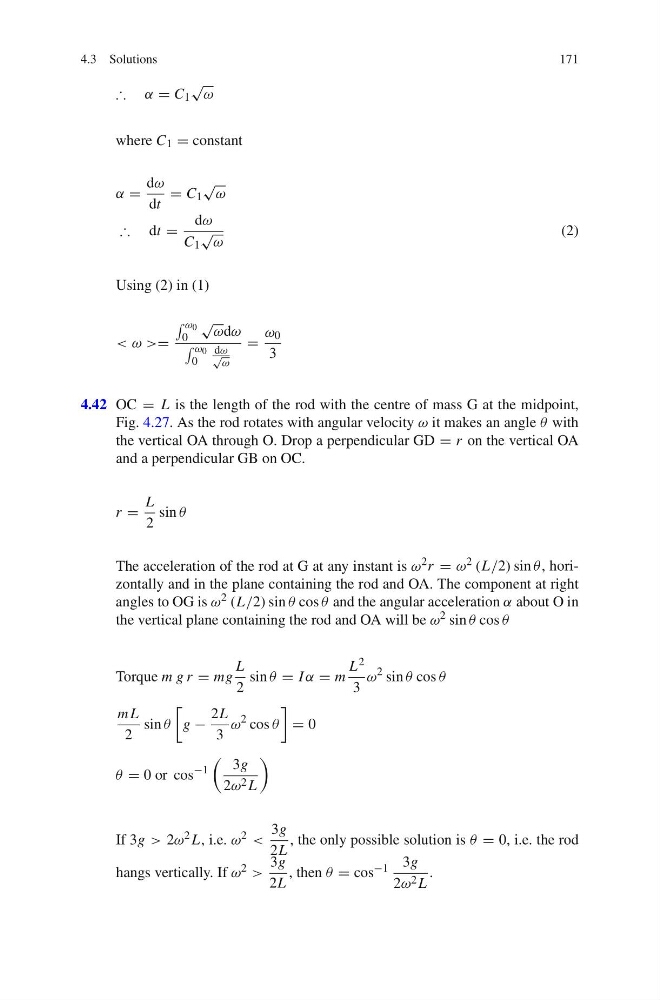
4.42 OC = L is the length of the rod with the centre of mass G at the midpoint,
Fig. 4.27. As the rod rotates with angular velocity ω it makes an angle θ with
the vertical OA through O. Drop a perpendicular GD = r on the vertical OA
and a perpendicular GB on OC.
r =
L
2
sin θ
The acceleration of the rod at G at any instant is ω 2 r = ω 2 (L/2) sin θ , horizontally and in the plane containing the rod and OA. The component at right
angles to OG is ω 2 (L/2) sin θ cos θ and the angular acceleration α about O in
the vertical plane containing the rod and OA will be ω 2 sin θ cos θ
Torque m g r = mg
L
2
sin θ = I α = m
L 2
3
ω
2 sin θ cos θ
m L
2
sin θ
g −
2L
3
ω
2 cos θ
= 0
θ = 0 or cos
−1
3g
2ω 2 L
If 3g > 2ω 2 L, i.e. ω 2 <
3g
2L
, the only possible solution is θ = 0, i.e. the rod
hangs vertically. If ω 2 >
3g
2L
, then θ = cos −1 3g
2ω 2 L
.
171
∴ α = C 1
√
ω
where C 1 = constant
α =
dω
dt
= C 1
√ ω
∴ dt =
dω
C 1
√ ω
(2)
Using (2) in (1)
< ω >=
ω 0
0
√ ωdω
ω 0
0
dω
√
ω
=
ω 0
3
4.42 OC = L is the length of the rod with the centre of mass G at the midpoint,
Fig. 4.27. As the rod rotates with angular velocity ω it makes an angle θ with
the vertical OA through O. Drop a perpendicular GD = r on the vertical OA
and a perpendicular GB on OC.
r =
L
2
sin θ
The acceleration of the rod at G at any instant is ω 2 r = ω 2 (L/2) sin θ , horizontally and in the plane containing the rod and OA. The component at right
angles to OG is ω 2 (L/2) sin θ cos θ and the angular acceleration α about O in
the vertical plane containing the rod and OA will be ω 2 sin θ cos θ
Torque m g r = mg
L
2
sin θ = I α = m
L 2
3
ω
2 sin θ cos θ
m L
2
sin θ
g −
2L
3
ω
2 cos θ
= 0
θ = 0 or cos
−1
3g
2ω 2 L
If 3g > 2ω 2 L, i.e. ω 2 <
3g
2L
, the only possible solution is θ = 0, i.e. the rod
hangs vertically. If ω 2 >
3g
2L
, then θ = cos −1 3g
2ω 2 L
.