

4.3 Solutions
165
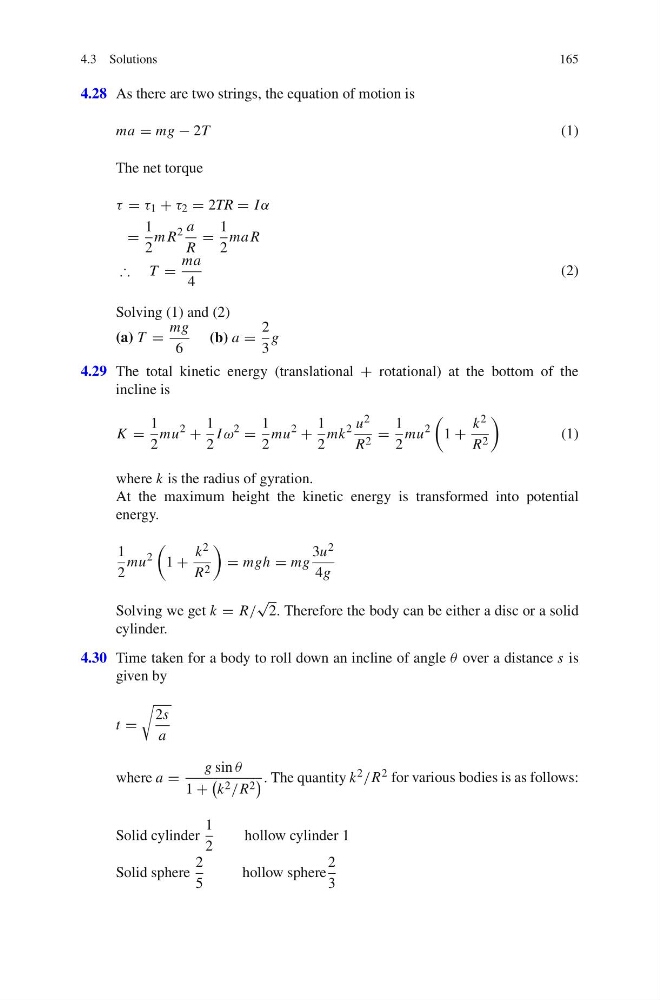
4.28 As there are two strings, the equation of motion is
ma = mg − 2T
(1)
The net torque
τ = τ 1 + τ 2 = 2TR = I α
=
1
2
m R
2 a
R
=
1
2
ma R
∴ T =
ma
4
(2)
Solving (1) and (2)
(a) T =
mg
6
(b) a =
2
3
g
4.29 The total kinetic energy (translational + rotational) at the bottom of the
incline is
K =
1
2
mu
2
+
1
2
I ω
2
=
1
2
mu
2
+
1
2
mk
2 u 2
R 2 =
1
2
mu
2
1 +
k 2
R 2
(1)
where k is the radius of gyration.
At the maximum height the kinetic energy is transformed into potential
energy.
1
2
mu
2
1 +
k 2
R 2
= mgh = mg
3u 2
4g
Solving we get k = R/
√
2. Therefore the body can be either a disc or a solid
cylinder.
4.30 Time taken for a body to roll down an incline of angle θ over a distance s is
given by
t =
2s
a
where a =
g sin θ
1 +
k 2 /R 2
. The quantity k 2 /R 2 for various bodies is as follows:
Solid cylinder
1
2
hollow cylinder 1
Solid sphere
2
5
hollow sphere
2
3
165
4.28 As there are two strings, the equation of motion is
ma = mg − 2T
(1)
The net torque
τ = τ 1 + τ 2 = 2TR = I α
=
1
2
m R
2 a
R
=
1
2
ma R
∴ T =
ma
4
(2)
Solving (1) and (2)
(a) T =
mg
6
(b) a =
2
3
g
4.29 The total kinetic energy (translational + rotational) at the bottom of the
incline is
K =
1
2
mu
2
+
1
2
I ω
2
=
1
2
mu
2
+
1
2
mk
2 u 2
R 2 =
1
2
mu
2
1 +
k 2
R 2
(1)
where k is the radius of gyration.
At the maximum height the kinetic energy is transformed into potential
energy.
1
2
mu
2
1 +
k 2
R 2
= mgh = mg
3u 2
4g
Solving we get k = R/
√
2. Therefore the body can be either a disc or a solid
cylinder.
4.30 Time taken for a body to roll down an incline of angle θ over a distance s is
given by
t =
2s
a
where a =
g sin θ
1 +
k 2 /R 2
. The quantity k 2 /R 2 for various bodies is as follows:
Solid cylinder
1
2
hollow cylinder 1
Solid sphere
2
5
hollow sphere
2
3