

4.3 Solutions
163
T 1
T 2
=
m 1 (4m 2 + M)
m 2 (4m 1 + M)
4.22 (a) Conservation of angular momentum gives
I 1 ω 1 + I 2 ω 2 = I ω = (I 1 + I 2 )ω
The two moments of inertia I 1 and I 2 are additive because of common
axis of rotation.
∴ ω =
I 1 ω 1 + I 2 ω 2
I 1 + I 2
(b) Work done = loss of energy
W =
1
2
(I 1 + I 2 )ω
2
−
1
2
I 1 ω
2
1 +
1
2
I 2 ω
2
2
=
1
2
(I 1 + I 2 )
(I 1 ω 1 + I 2 ω 2 )
2
(I 1 + I 2 )
2
−
1
2
I 1 ω
2
1 −
1
2
I 2 ω
2
2
= −
1
2
I 1 I 2 (ω 1 − ω 2 ) 2
(I 1 + I 2 )
4.23 (a) Measure the potential energy from the bottom of the rod in the upright
position, the height through which it falls is the distance of the centre of
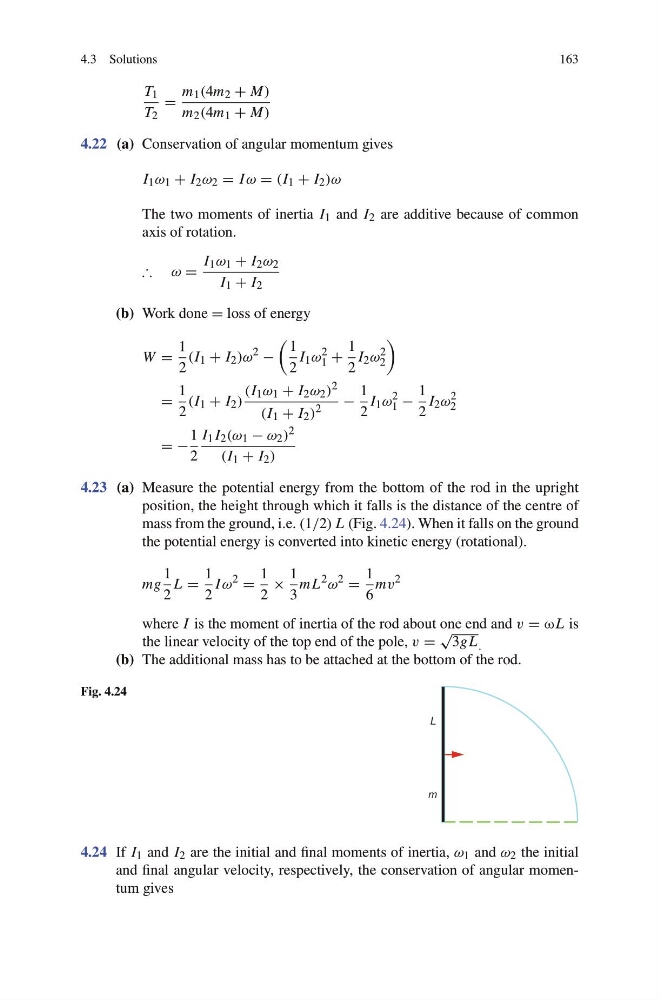
mass from the ground, i.e. (1/2) L (Fig. 4.24). When it falls on the ground
the potential energy is converted into kinetic energy (rotational).
mg
1
2
L =
1
2
I ω
2
=
1
2
×
1
3
m L
2
ω
2
=
1
6
mv
2
where I is the moment of inertia of the rod about one end and v = ωL is
the linear velocity of the top end of the pole, v =
√
3gL .
(b) The additional mass has to be attached at the bottom of the rod.
Fig. 4.24
4.24 If I 1 and I 2 are the initial and final moments of inertia, ω 1 and ω 2 the initial
and final angular velocity, respectively, the conservation of angular momentum gives
163
T 1
T 2
=
m 1 (4m 2 + M)
m 2 (4m 1 + M)
4.22 (a) Conservation of angular momentum gives
I 1 ω 1 + I 2 ω 2 = I ω = (I 1 + I 2 )ω
The two moments of inertia I 1 and I 2 are additive because of common
axis of rotation.
∴ ω =
I 1 ω 1 + I 2 ω 2
I 1 + I 2
(b) Work done = loss of energy
W =
1
2
(I 1 + I 2 )ω
2
−
1
2
I 1 ω
2
1 +
1
2
I 2 ω
2
2
=
1
2
(I 1 + I 2 )
(I 1 ω 1 + I 2 ω 2 )
2
(I 1 + I 2 )
2
−
1
2
I 1 ω
2
1 −
1
2
I 2 ω
2
2
= −
1
2
I 1 I 2 (ω 1 − ω 2 ) 2
(I 1 + I 2 )
4.23 (a) Measure the potential energy from the bottom of the rod in the upright
position, the height through which it falls is the distance of the centre of
mass from the ground, i.e. (1/2) L (Fig. 4.24). When it falls on the ground
the potential energy is converted into kinetic energy (rotational).
mg
1
2
L =
1
2
I ω
2
=
1
2
×
1
3
m L
2
ω
2
=
1
6
mv
2
where I is the moment of inertia of the rod about one end and v = ωL is
the linear velocity of the top end of the pole, v =
√
3gL .
(b) The additional mass has to be attached at the bottom of the rod.
Fig. 4.24
4.24 If I 1 and I 2 are the initial and final moments of inertia, ω 1 and ω 2 the initial
and final angular velocity, respectively, the conservation of angular momentum gives