

160
4 Rotational Dynamics
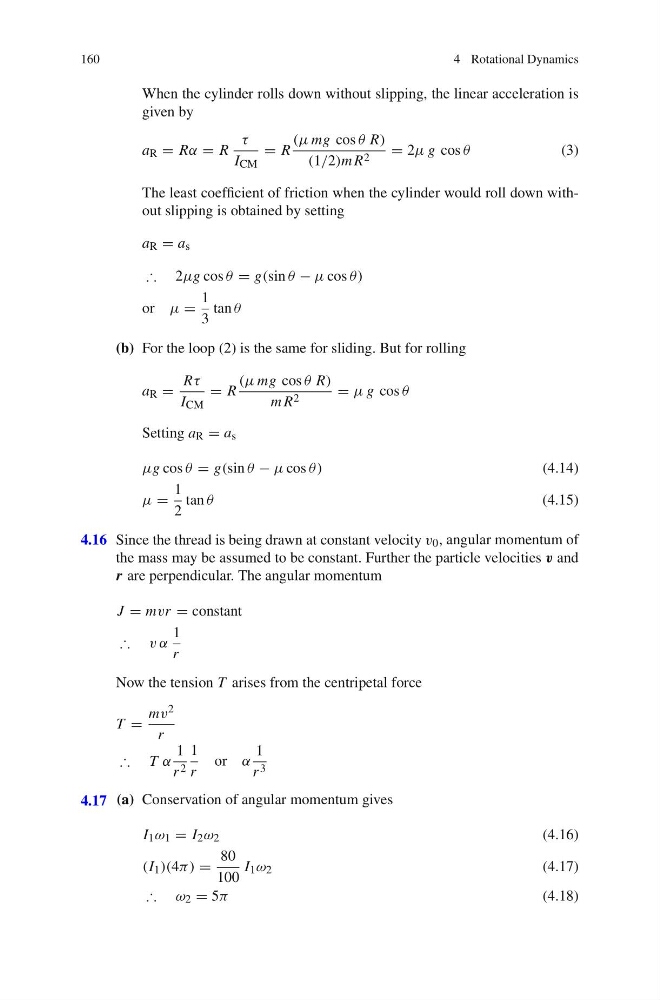
When the cylinder rolls down without slipping, the linear acceleration is
given by
a R = Rα = R
τ
I CM
= R
(μ mg cos θ R)
(1/2)m R 2 = 2μ g cos θ
(3)
The least coefficient of friction when the cylinder would roll down without slipping is obtained by setting
a R = a s
∴ 2μg cos θ = g(sin θ − μ cos θ)
or μ =
1
3
tan θ
(b) For the loop (2) is the same for sliding. But for rolling
a R =
Rτ
I CM
= R
(μ mg cos θ R)
m R 2
= μ g cos θ
Setting a R = a s
μg cos θ = g(sin θ − μ cos θ)
(4.14)
μ =
1
2
tan θ
(4.15)
4.16 Since the thread is being drawn at constant velocity v 0 , angular momentum of
the mass may be assumed to be constant. Further the particle velocities v and
r are perpendicular. The angular momentum
J = mvr = constant
∴ v α
1
r
Now the tension T arises from the centripetal force
T =
mv 2
r
∴ T α
1
r 2
1
r
or α
1
r 3
4.17 (a) Conservation of angular momentum gives
I 1 ω 1 = I 2 ω 2
(4.16)
(I 1 )(4π) =
80
100
I 1 ω 2
(4.17)
∴ ω 2 = 5π
(4.18)
4 Rotational Dynamics
When the cylinder rolls down without slipping, the linear acceleration is
given by
a R = Rα = R
τ
I CM
= R
(μ mg cos θ R)
(1/2)m R 2 = 2μ g cos θ
(3)
The least coefficient of friction when the cylinder would roll down without slipping is obtained by setting
a R = a s
∴ 2μg cos θ = g(sin θ − μ cos θ)
or μ =
1
3
tan θ
(b) For the loop (2) is the same for sliding. But for rolling
a R =
Rτ
I CM
= R
(μ mg cos θ R)
m R 2
= μ g cos θ
Setting a R = a s
μg cos θ = g(sin θ − μ cos θ)
(4.14)
μ =
1
2
tan θ
(4.15)
4.16 Since the thread is being drawn at constant velocity v 0 , angular momentum of
the mass may be assumed to be constant. Further the particle velocities v and
r are perpendicular. The angular momentum
J = mvr = constant
∴ v α
1
r
Now the tension T arises from the centripetal force
T =
mv 2
r
∴ T α
1
r 2
1
r
or α
1
r 3
4.17 (a) Conservation of angular momentum gives
I 1 ω 1 = I 2 ω 2
(4.16)
(I 1 )(4π) =
80
100
I 1 ω 2
(4.17)
∴ ω 2 = 5π
(4.18)