

158
4 Rotational Dynamics
K =
1
2
mv
2
+
1
2
I ω
2
=
1
2
mv
2
+
1
2
×
1
2
m R
2 v 2
R 2 =
3
4
mv
2
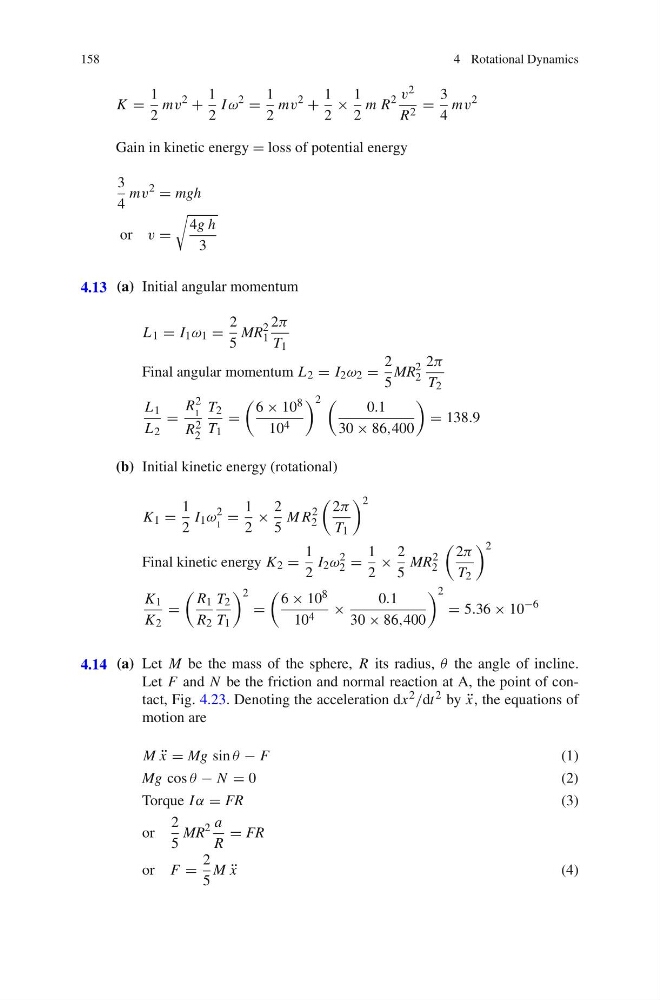
Gain in kinetic energy = loss of potential energy
3
4
mv
2
= mgh
or v =
4g h
3
4.13 (a) Initial angular momentum
L 1 = I 1 ω 1 =
2
5
MR
2
1
2π
T 1
Final angular momentum L 2 = I 2 ω 2 =
2
5
MR
2
2
2π
T 2
L 1
L 2
=
R 2
1
R 2
2
T 2
T 1
=
6 × 10 8
10 4
2
0.1
30 × 86,400
= 138.9
(b) Initial kinetic energy (rotational)
K 1 =
1
2
I 1 ω
2
1
=
1
2
×
2
5
M R
2
2
2π
T 1
2
Final kinetic energy K 2 =
1
2
I 2 ω
2
2 =
1
2
×
2
5
MR
2
2
2π
T 2
2
K 1
K 2
=
R 1
R 2
T 2
T 1
2
=
6 × 10 8
10 4 ×
0.1
30 × 86,400
2
= 5.36 × 10
−6
4.14 (a) Let M be the mass of the sphere, R its radius, θ the angle of incline.
Let F and N be the friction and normal reaction at A, the point of contact, Fig. 4.23. Denoting the acceleration dx 2 /dt 2 by ¨
x, the equations of
motion are
M ¨
x = Mg sin θ − F
(1)
Mg cos θ − N = 0
( 2 )
Torque I α = FR
(3)
or
2
5
MR
2 a
R
= FR
or F =
2
5
M ¨
x
(4)
4 Rotational Dynamics
K =
1
2
mv
2
+
1
2
I ω
2
=
1
2
mv
2
+
1
2
×
1
2
m R
2 v 2
R 2 =
3
4
mv
2
Gain in kinetic energy = loss of potential energy
3
4
mv
2
= mgh
or v =
4g h
3
4.13 (a) Initial angular momentum
L 1 = I 1 ω 1 =
2
5
MR
2
1
2π
T 1
Final angular momentum L 2 = I 2 ω 2 =
2
5
MR
2
2
2π
T 2
L 1
L 2
=
R 2
1
R 2
2
T 2
T 1
=
6 × 10 8
10 4
2
0.1
30 × 86,400
= 138.9
(b) Initial kinetic energy (rotational)
K 1 =
1
2
I 1 ω
2
1
=
1
2
×
2
5
M R
2
2
2π
T 1
2
Final kinetic energy K 2 =
1
2
I 2 ω
2
2 =
1
2
×
2
5
MR
2
2
2π
T 2
2
K 1
K 2
=
R 1
R 2
T 2
T 1
2
=
6 × 10 8
10 4 ×
0.1
30 × 86,400
2
= 5.36 × 10
−6
4.14 (a) Let M be the mass of the sphere, R its radius, θ the angle of incline.
Let F and N be the friction and normal reaction at A, the point of contact, Fig. 4.23. Denoting the acceleration dx 2 /dt 2 by ¨
x, the equations of
motion are
M ¨
x = Mg sin θ − F
(1)
Mg cos θ − N = 0
( 2 )
Torque I α = FR
(3)
or
2
5
MR
2 a
R
= FR
or F =
2
5
M ¨
x
(4)