

4.2 Problems
149
4.59 A uniform thin rod of mass m and length L is rotating on a smooth horizontal
surface with one end fixed. Initially it has an angular velocity and the motion
slows down only because of air resistance which is k dx times the square of
the velocity on each element of the rod of length dx. Find the angular velocity
ω after time t.
4.60 A sphere of radius a oscillates at the bottom of a hollow cylinder of radius b
in a plane at right angles to the axis which is horizontal. If the cylinder is fixed
and the sphere does not slide, find T , the time period of oscillations in terms
of a, b and g, the acceleration due to gravity.
4.61 (a) Show that the moment of inertia of a disc of radius R and mass M about
an axis through the centre perpendicular to its plane is
I =
1
2
MR
2
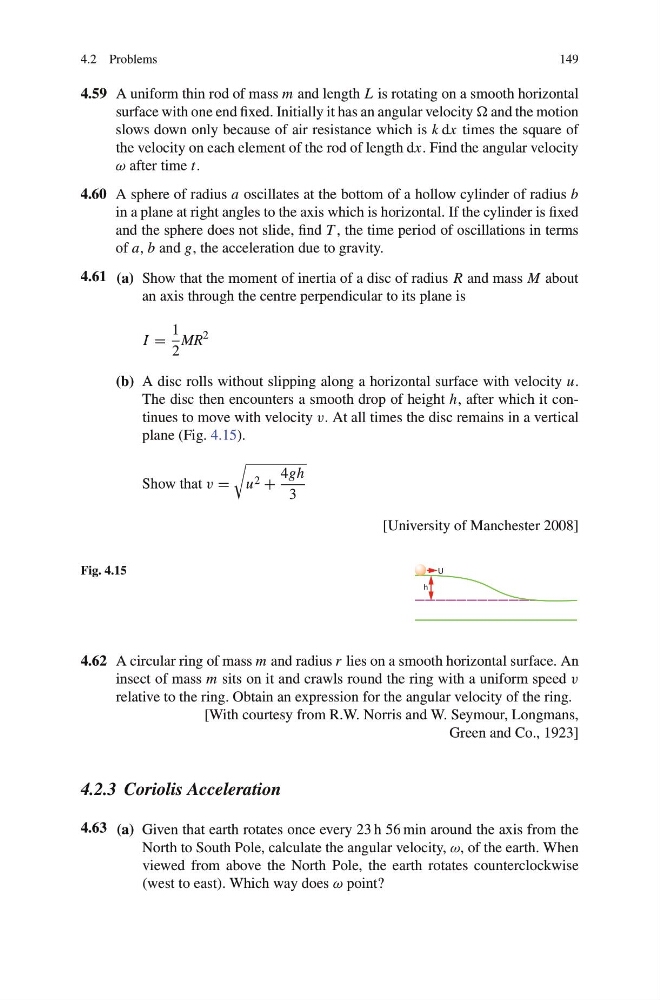
(b) A disc rolls without slipping along a horizontal surface with velocity u.
The disc then encounters a smooth drop of height h, after which it continues to move with velocity v. At all times the disc remains in a vertical
plane (Fig. 4.15).
Show that v =
u 2 +
4gh
3
[University of Manchester 2008]
Fig. 4.15
4.62 A circular ring of mass m and radius r lies on a smooth horizontal surface. An
insect of mass m sits on it and crawls round the ring with a uniform speed v
relative to the ring. Obtain an expression for the angular velocity of the ring.
[With courtesy from R.W. Norris and W. Seymour, Longmans,
Green and Co., 1923]
4.2.3 Coriolis Acceleration
4.63 (a) Given that earth rotates once every 23 h 56 min around the axis from the
North to South Pole, calculate the angular velocity, ω, of the earth. When
viewed from above the North Pole, the earth rotates counterclockwise
(west to east). Which way does ω point?
149
4.59 A uniform thin rod of mass m and length L is rotating on a smooth horizontal
surface with one end fixed. Initially it has an angular velocity and the motion
slows down only because of air resistance which is k dx times the square of
the velocity on each element of the rod of length dx. Find the angular velocity
ω after time t.
4.60 A sphere of radius a oscillates at the bottom of a hollow cylinder of radius b
in a plane at right angles to the axis which is horizontal. If the cylinder is fixed
and the sphere does not slide, find T , the time period of oscillations in terms
of a, b and g, the acceleration due to gravity.
4.61 (a) Show that the moment of inertia of a disc of radius R and mass M about
an axis through the centre perpendicular to its plane is
I =
1
2
MR
2
(b) A disc rolls without slipping along a horizontal surface with velocity u.
The disc then encounters a smooth drop of height h, after which it continues to move with velocity v. At all times the disc remains in a vertical
plane (Fig. 4.15).
Show that v =
u 2 +
4gh
3
[University of Manchester 2008]
Fig. 4.15
4.62 A circular ring of mass m and radius r lies on a smooth horizontal surface. An
insect of mass m sits on it and crawls round the ring with a uniform speed v
relative to the ring. Obtain an expression for the angular velocity of the ring.
[With courtesy from R.W. Norris and W. Seymour, Longmans,
Green and Co., 1923]
4.2.3 Coriolis Acceleration
4.63 (a) Given that earth rotates once every 23 h 56 min around the axis from the
North to South Pole, calculate the angular velocity, ω, of the earth. When
viewed from above the North Pole, the earth rotates counterclockwise
(west to east). Which way does ω point?