

4.2 Problems
147
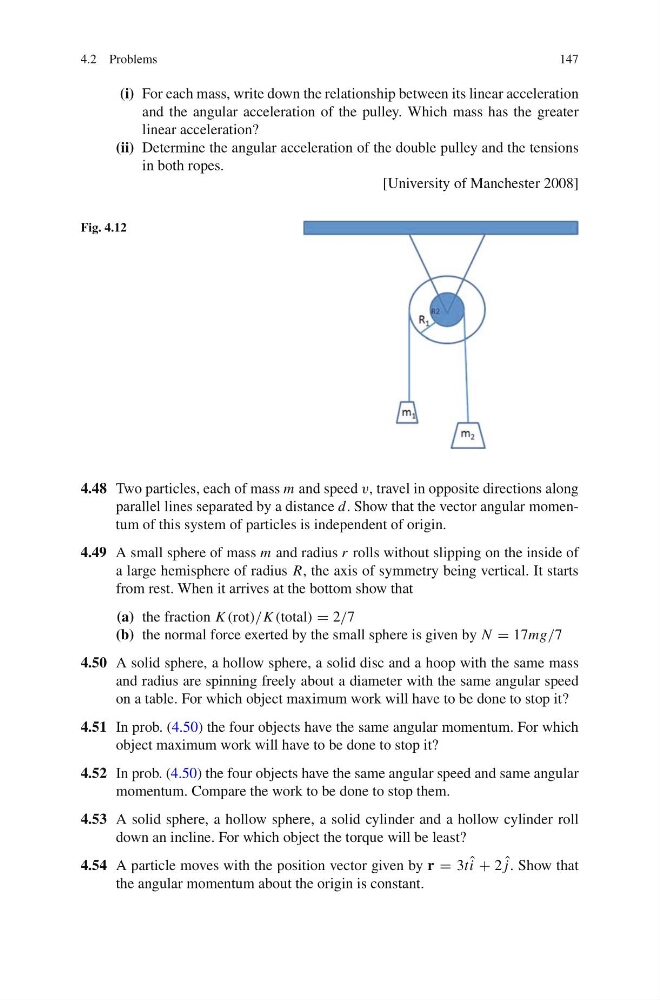
(i) For each mass, write down the relationship between its linear acceleration
and the angular acceleration of the pulley. Which mass has the greater
linear acceleration?
(ii) Determine the angular acceleration of the double pulley and the tensions
in both ropes.
[University of Manchester 2008]
Fig. 4.12
4.48 Two particles, each of mass m and speed v, travel in opposite directions along
parallel lines separated by a distance d. Show that the vector angular momentum of this system of particles is independent of origin.
4.49 A small sphere of mass m and radius r rolls without slipping on the inside of
a large hemisphere of radius R, the axis of symmetry being vertical. It starts
from rest. When it arrives at the bottom show that
(a) the fraction K (rot)/K (total) = 2/7
(b) the normal force exerted by the small sphere is given by N = 17mg/7
4.50 A solid sphere, a hollow sphere, a solid disc and a hoop with the same mass
and radius are spinning freely about a diameter with the same angular speed
on a table. For which object maximum work will have to be done to stop it?
4.51 In prob. (4.50) the four objects have the same angular momentum. For which
object maximum work will have to be done to stop it?
4.52 In prob. (4.50) the four objects have the same angular speed and same angular
momentum. Compare the work to be done to stop them.
4.53 A solid sphere, a hollow sphere, a solid cylinder and a hollow cylinder roll
down an incline. For which object the torque will be least?
4.54 A particle moves with the position vector given by r = 3t ˆ
i + 2 ˆ
j. Show that
the angular momentum about the origin is constant.
147
(i) For each mass, write down the relationship between its linear acceleration
and the angular acceleration of the pulley. Which mass has the greater
linear acceleration?
(ii) Determine the angular acceleration of the double pulley and the tensions
in both ropes.
[University of Manchester 2008]
Fig. 4.12
4.48 Two particles, each of mass m and speed v, travel in opposite directions along
parallel lines separated by a distance d. Show that the vector angular momentum of this system of particles is independent of origin.
4.49 A small sphere of mass m and radius r rolls without slipping on the inside of
a large hemisphere of radius R, the axis of symmetry being vertical. It starts
from rest. When it arrives at the bottom show that
(a) the fraction K (rot)/K (total) = 2/7
(b) the normal force exerted by the small sphere is given by N = 17mg/7
4.50 A solid sphere, a hollow sphere, a solid disc and a hoop with the same mass
and radius are spinning freely about a diameter with the same angular speed
on a table. For which object maximum work will have to be done to stop it?
4.51 In prob. (4.50) the four objects have the same angular momentum. For which
object maximum work will have to be done to stop it?
4.52 In prob. (4.50) the four objects have the same angular speed and same angular
momentum. Compare the work to be done to stop them.
4.53 A solid sphere, a hollow sphere, a solid cylinder and a hollow cylinder roll
down an incline. For which object the torque will be least?
4.54 A particle moves with the position vector given by r = 3t ˆ
i + 2 ˆ
j. Show that
the angular momentum about the origin is constant.