

3.3 Solutions
127
Measure potential energy with respect to A, the equilibrium position. At the
point B, at height L the mechanical energy is entirely potential energy as the
bob is at rest. As the vertical height is L, the potential energy will be mgL.
When the bob is released, at the point A, the energy is entirely kinetic, potential energy being zero, and is equal to
1
2 mv 2
A .
Conservation of mechanical energy requires that
1
2
mv
2
A = mgL
or v
2
A = 2 gL
(2)
Using (2) in (1)
T A = 2mg + mg = 3mg
Thus the minimum strength of the string that it may not break upon passing
through the lowest point is three times the weight of the bob.
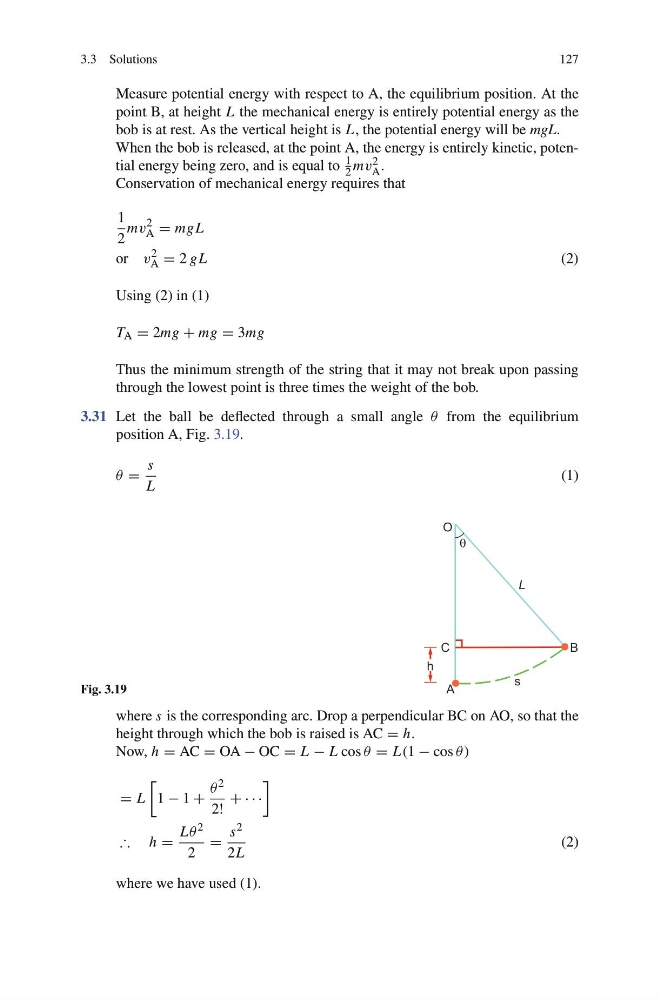
3.31 Let the ball be deflected through a small angle θ from the equilibrium
position A, Fig. 3.19.
θ =
s
L
(1)
Fig. 3.19
where s is the corresponding arc. Drop a perpendicular BC on AO, so that the
height through which the bob is raised is AC = h.
Now, h = AC = OA − OC = L − L cos θ = L(1 − cos θ)
= L
1 − 1 +
θ 2
2!
+ · · ·
∴ h =
Lθ 2
2
=
s 2
2L
(2)
where we have used (1).
127
Measure potential energy with respect to A, the equilibrium position. At the
point B, at height L the mechanical energy is entirely potential energy as the
bob is at rest. As the vertical height is L, the potential energy will be mgL.
When the bob is released, at the point A, the energy is entirely kinetic, potential energy being zero, and is equal to
1
2 mv 2
A .
Conservation of mechanical energy requires that
1
2
mv
2
A = mgL
or v
2
A = 2 gL
(2)
Using (2) in (1)
T A = 2mg + mg = 3mg
Thus the minimum strength of the string that it may not break upon passing
through the lowest point is three times the weight of the bob.
3.31 Let the ball be deflected through a small angle θ from the equilibrium
position A, Fig. 3.19.
θ =
s
L
(1)
Fig. 3.19
where s is the corresponding arc. Drop a perpendicular BC on AO, so that the
height through which the bob is raised is AC = h.
Now, h = AC = OA − OC = L − L cos θ = L(1 − cos θ)
= L
1 − 1 +
θ 2
2!
+ · · ·
∴ h =
Lθ 2
2
=
s 2
2L
(2)
where we have used (1).