

3.3 Solutions
125
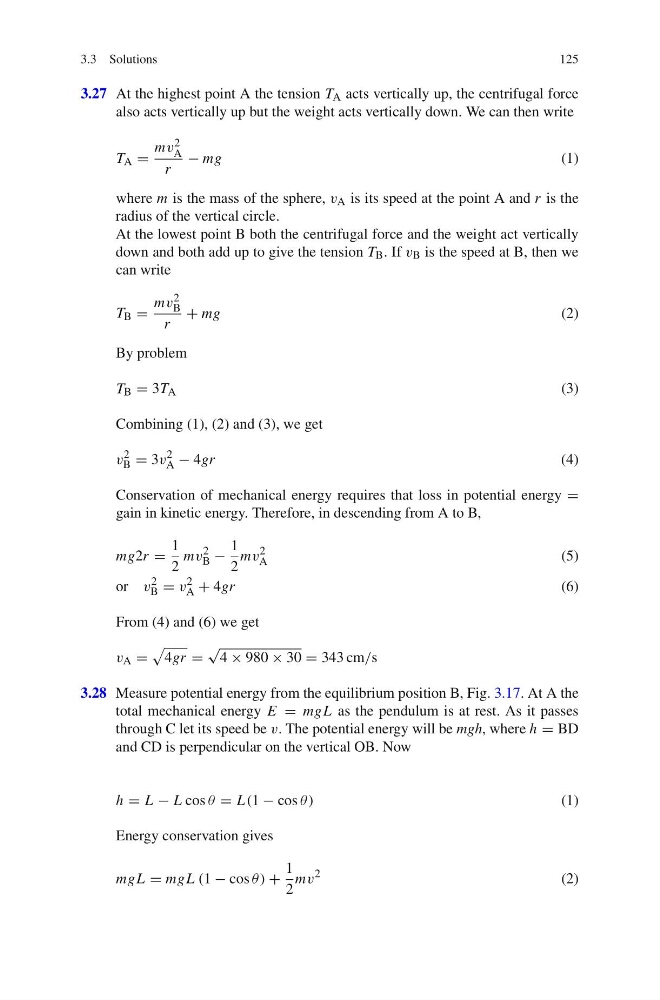
3.27 At the highest point A the tension T A acts vertically up, the centrifugal force
also acts vertically up but the weight acts vertically down. We can then write
T A =
mv 2
A
r
− mg
(1)
where m is the mass of the sphere, v A is its speed at the point A and r is the
radius of the vertical circle.
At the lowest point B both the centrifugal force and the weight act vertically
down and both add up to give the tension T B . If v B is the speed at B, then we
can write
T B =
mv 2
B
r
+ mg
(2)
By problem
T B = 3T A
(3)
Combining (1), (2) and (3), we get
v
2
B = 3v
2
A − 4gr
(4)
Conservation of mechanical energy requires that loss in potential energy =
gain in kinetic energy. Therefore, in descending from A to B,
mg2r =
1
2
mv
2
B −
1
2
mv
2
A
(5)
or v
2
B = v
2
A + 4gr
(6)
From (4) and (6) we get
v A =
4gr =
√
4 × 980 × 30 = 343 cm/s
3.28 Measure potential energy from the equilibrium position B, Fig. 3.17. At A the
total mechanical energy E = mgL as the pendulum is at rest. As it passes
through C let its speed be v. The potential energy will be mgh, where h = BD
and CD is perpendicular on the vertical OB. Now
h = L − L cos θ = L(1 − cos θ)
(1)
Energy conservation gives
mgL = mgL (1 − cos θ) +
1
2
mv
2
(2)
125
3.27 At the highest point A the tension T A acts vertically up, the centrifugal force
also acts vertically up but the weight acts vertically down. We can then write
T A =
mv 2
A
r
− mg
(1)
where m is the mass of the sphere, v A is its speed at the point A and r is the
radius of the vertical circle.
At the lowest point B both the centrifugal force and the weight act vertically
down and both add up to give the tension T B . If v B is the speed at B, then we
can write
T B =
mv 2
B
r
+ mg
(2)
By problem
T B = 3T A
(3)
Combining (1), (2) and (3), we get
v
2
B = 3v
2
A − 4gr
(4)
Conservation of mechanical energy requires that loss in potential energy =
gain in kinetic energy. Therefore, in descending from A to B,
mg2r =
1
2
mv
2
B −
1
2
mv
2
A
(5)
or v
2
B = v
2
A + 4gr
(6)
From (4) and (6) we get
v A =
4gr =
√
4 × 980 × 30 = 343 cm/s
3.28 Measure potential energy from the equilibrium position B, Fig. 3.17. At A the
total mechanical energy E = mgL as the pendulum is at rest. As it passes
through C let its speed be v. The potential energy will be mgh, where h = BD
and CD is perpendicular on the vertical OB. Now
h = L − L cos θ = L(1 − cos θ)
(1)
Energy conservation gives
mgL = mgL (1 − cos θ) +
1
2
mv
2
(2)