

3.3 Solutions
123
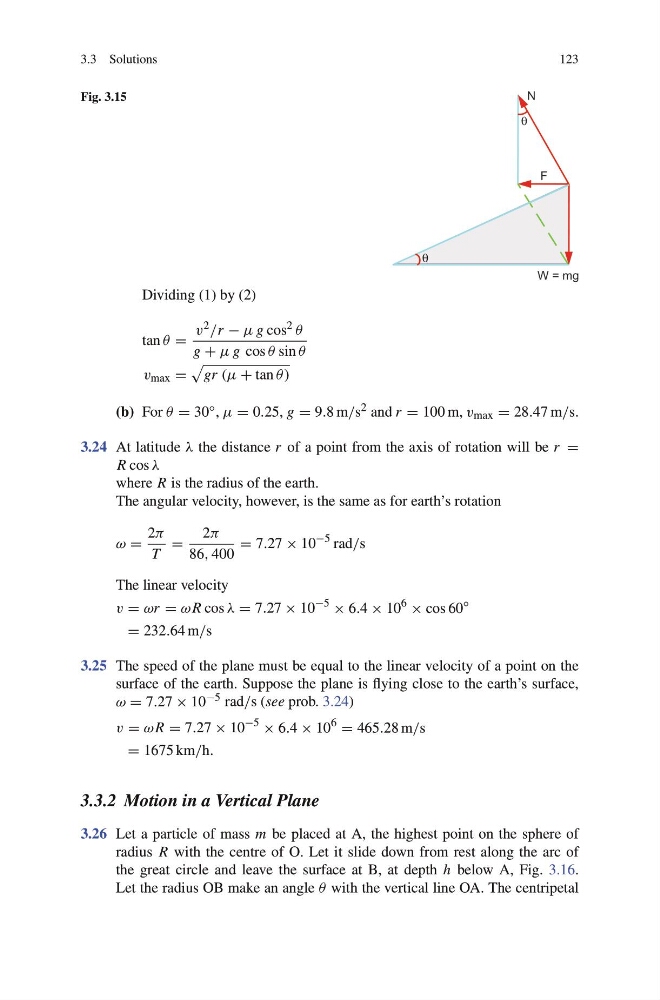
Fig. 3.15
Dividing (1) by (2)
tan θ =
v 2 /r − μ g cos 2 θ
g + μ g cos θ sin θ
v max =
gr (μ + tan θ)
(b) For θ = 30 ◦ , μ = 0.25, g = 9.8 m/s 2 and r = 100 m, v max = 28.47 m/s.
3.24 At latitude λ the distance r of a point from the axis of rotation will be r =
R cos λ
where R is the radius of the earth.
The angular velocity, however, is the same as for earth’s rotation
ω =
2π
T
=
2π
86, 400
= 7.27 × 10
−5 rad/s
The linear velocity
v = ωr = ω R cos λ = 7.27 × 10
−5
× 6.4 × 10
6
× cos 60
◦
= 232.64 m/s
3.25 The speed of the plane must be equal to the linear velocity of a point on the
surface of the earth. Suppose the plane is flying close to the earth’s surface,
ω = 7.27 × 10 −5 rad/s (see prob. 3.24)
v = ω R = 7.27 × 10
−5
× 6.4 × 10
6
= 465.28 m/s
= 1675 km/h.
3.3.2 Motion in a Vertical Plane
3.26 Let a particle of mass m be placed at A, the highest point on the sphere of
radius R with the centre of O. Let it slide down from rest along the arc of
the great circle and leave the surface at B, at depth h below A, Fig. 3.16.
Let the radius OB make an angle θ with the vertical line OA. The centripetal
123
Fig. 3.15
Dividing (1) by (2)
tan θ =
v 2 /r − μ g cos 2 θ
g + μ g cos θ sin θ
v max =
gr (μ + tan θ)
(b) For θ = 30 ◦ , μ = 0.25, g = 9.8 m/s 2 and r = 100 m, v max = 28.47 m/s.
3.24 At latitude λ the distance r of a point from the axis of rotation will be r =
R cos λ
where R is the radius of the earth.
The angular velocity, however, is the same as for earth’s rotation
ω =
2π
T
=
2π
86, 400
= 7.27 × 10
−5 rad/s
The linear velocity
v = ωr = ω R cos λ = 7.27 × 10
−5
× 6.4 × 10
6
× cos 60
◦
= 232.64 m/s
3.25 The speed of the plane must be equal to the linear velocity of a point on the
surface of the earth. Suppose the plane is flying close to the earth’s surface,
ω = 7.27 × 10 −5 rad/s (see prob. 3.24)
v = ω R = 7.27 × 10
−5
× 6.4 × 10
6
= 465.28 m/s
= 1675 km/h.
3.3.2 Motion in a Vertical Plane
3.26 Let a particle of mass m be placed at A, the highest point on the sphere of
radius R with the centre of O. Let it slide down from rest along the arc of
the great circle and leave the surface at B, at depth h below A, Fig. 3.16.
Let the radius OB make an angle θ with the vertical line OA. The centripetal