

3.3 Solutions
119
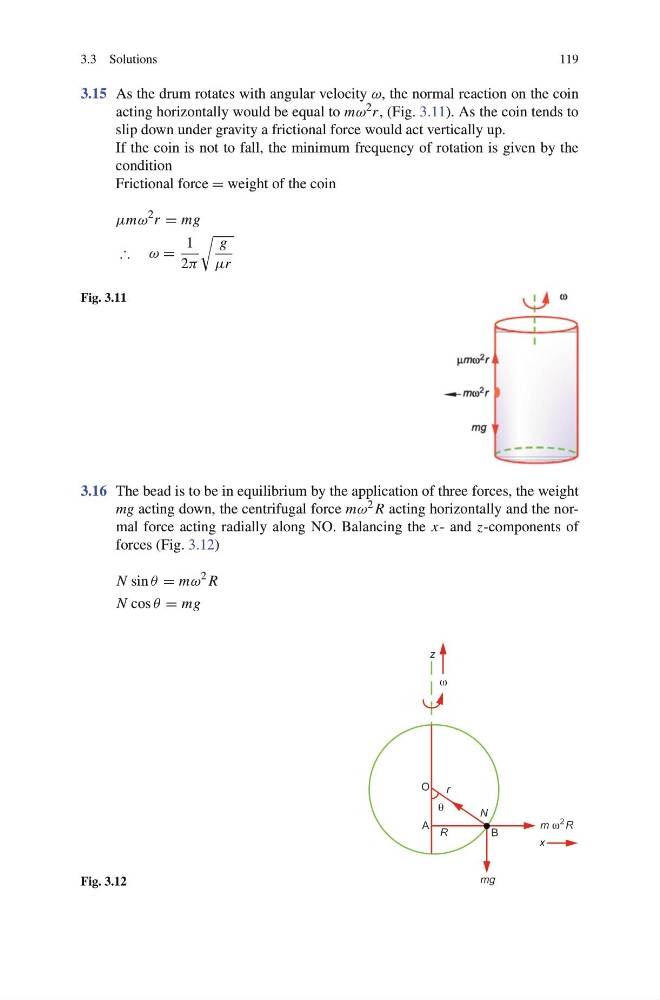
3.15 As the drum rotates with angular velocity ω, the normal reaction on the coin
acting horizontally would be equal to mω 2 r , (Fig. 3.11). As the coin tends to
slip down under gravity a frictional force would act vertically up.
If the coin is not to fall, the minimum frequency of rotation is given by the
condition
Frictional force = weight of the coin
μmω
2 r = mg
∴ ω =
1
2π
g
μr
Fig. 3.11
3.16 The bead is to be in equilibrium by the application of three forces, the weight
mg acting down, the centrifugal force mω 2 R acting horizontally and the normal force acting radially along NO. Balancing the x- and z-components of
forces (Fig. 3.12)
N sin θ = mω
2 R
N cos θ = mg
Fig. 3.12
119
3.15 As the drum rotates with angular velocity ω, the normal reaction on the coin
acting horizontally would be equal to mω 2 r , (Fig. 3.11). As the coin tends to
slip down under gravity a frictional force would act vertically up.
If the coin is not to fall, the minimum frequency of rotation is given by the
condition
Frictional force = weight of the coin
μmω
2 r = mg
∴ ω =
1
2π
g
μr
Fig. 3.11
3.16 The bead is to be in equilibrium by the application of three forces, the weight
mg acting down, the centrifugal force mω 2 R acting horizontally and the normal force acting radially along NO. Balancing the x- and z-components of
forces (Fig. 3.12)
N sin θ = mω
2 R
N cos θ = mg
Fig. 3.12