

3.3 Solutions
115
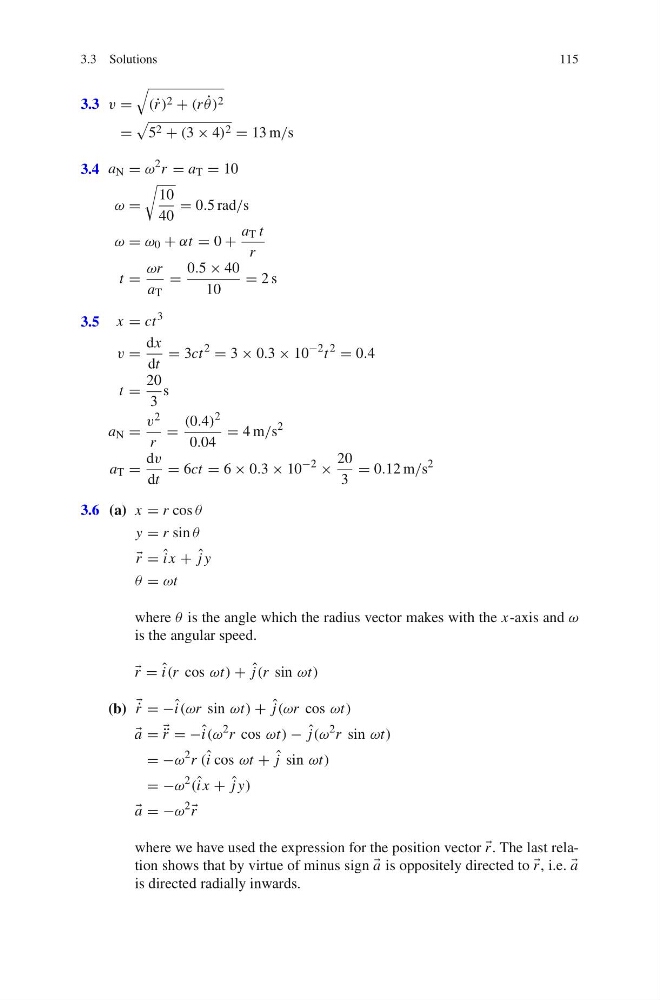
3.3 v =
(˙ r ) 2 + (r ˙
θ) 2
=
5 2 + (3 × 4) 2 = 13 m/s
3.4 a N = ω
2 r = a T = 10
ω =
10
40
= 0.5 rad/s
ω = ω 0 + αt = 0 +
a T t
r
t =
ωr
a T
=
0.5 × 40
10
= 2 s
3.5 x = ct
3
v =
dx
dt
= 3ct
2
= 3 × 0.3 × 10
−2 t
2
= 0.4
t =
20
3
s
a N =
v 2
r
=
(0.4)
2
0.04
= 4 m/s
2
a T =
dv
dt
= 6ct = 6 × 0.3 × 10
−2
×
20
3
= 0.12 m/s
2
3.6 (a) x = r cos θ
y = r sin θ
r = ˆ
i x + ˆ
j y
θ = ωt
where θ is the angle which the radius vector makes with the x-axis and ω
is the angular speed.
r = ˆ
i(r cos ωt) + ˆ
j(r sin ωt)
(b) ˙
r = − ˆ
i(ωr sin ωt) + ˆ
j(ωr cos ωt)
a = ¨
r = − ˆ
i(ω
2 r cos ωt) − ˆ
j(ω
2 r sin ωt)
= −ω
2 r ( ˆ
i cos ωt + ˆ
j sin ωt)
= −ω
2
( ˆ
i x + ˆ
j y)
a = −ω
2
r
where we have used the expression for the position vector
r . The last relation shows that by virtue of minus sign
a is oppositely directed to
r , i.e.
a
is directed radially inwards.
115
3.3 v =
(˙ r ) 2 + (r ˙
θ) 2
=
5 2 + (3 × 4) 2 = 13 m/s
3.4 a N = ω
2 r = a T = 10
ω =
10
40
= 0.5 rad/s
ω = ω 0 + αt = 0 +
a T t
r
t =
ωr
a T
=
0.5 × 40
10
= 2 s
3.5 x = ct
3
v =
dx
dt
= 3ct
2
= 3 × 0.3 × 10
−2 t
2
= 0.4
t =
20
3
s
a N =
v 2
r
=
(0.4)
2
0.04
= 4 m/s
2
a T =
dv
dt
= 6ct = 6 × 0.3 × 10
−2
×
20
3
= 0.12 m/s
2
3.6 (a) x = r cos θ
y = r sin θ
r = ˆ
i x + ˆ
j y
θ = ωt
where θ is the angle which the radius vector makes with the x-axis and ω
is the angular speed.
r = ˆ
i(r cos ωt) + ˆ
j(r sin ωt)
(b) ˙
r = − ˆ
i(ωr sin ωt) + ˆ
j(ωr cos ωt)
a = ¨
r = − ˆ
i(ω
2 r cos ωt) − ˆ
j(ω
2 r sin ωt)
= −ω
2 r ( ˆ
i cos ωt + ˆ
j sin ωt)
= −ω
2
( ˆ
i x + ˆ
j y)
a = −ω
2
r
where we have used the expression for the position vector
r . The last relation shows that by virtue of minus sign
a is oppositely directed to
r , i.e.
a
is directed radially inwards.