

3.2 Problems
113
3.35 A block of 2 g when released on an inclined plane describes a circle of radius
12 cm in the vertical plane on reaching the bottom. What is the minimum
height of the incline?
3.36 A particle slides down an incline from rest and enters the loop-the-loop. If the
particle starts from a point that is level with the highest point on the circular
track then find the point where the particle leaves the circular groove above
the lowest point.
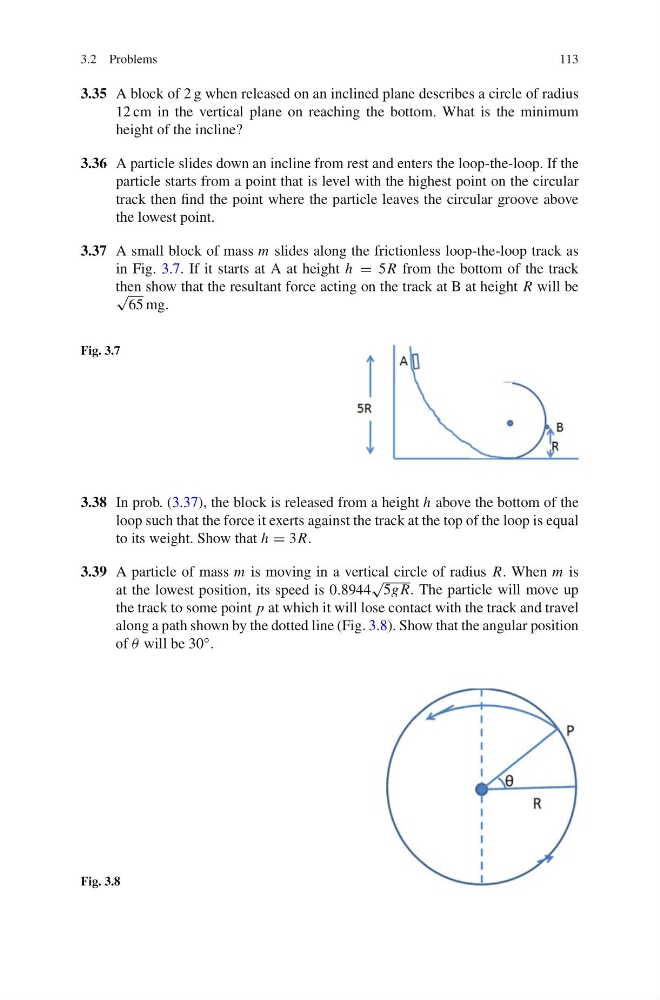
3.37 A small block of mass m slides along the frictionless loop-the-loop track as
in Fig. 3.7. If it starts at A at height h = 5R from the bottom of the track
then show that the resultant force acting on the track at B at height R will be
√
65 mg.
Fig. 3.7
3.38 In prob. (3.37), the block is released from a height h above the bottom of the
loop such that the force it exerts against the track at the top of the loop is equal
to its weight. Show that h = 3R.
3.39 A particle of mass m is moving in a vertical circle of radius R. When m is
at the lowest position, its speed is 0.8944
√
5g R. The particle will move up
the track to some point p at which it will lose contact with the track and travel
along a path shown by the dotted line (Fig. 3.8). Show that the angular position
of θ will be 30 ◦ .
Fig. 3.8
113
3.35 A block of 2 g when released on an inclined plane describes a circle of radius
12 cm in the vertical plane on reaching the bottom. What is the minimum
height of the incline?
3.36 A particle slides down an incline from rest and enters the loop-the-loop. If the
particle starts from a point that is level with the highest point on the circular
track then find the point where the particle leaves the circular groove above
the lowest point.
3.37 A small block of mass m slides along the frictionless loop-the-loop track as
in Fig. 3.7. If it starts at A at height h = 5R from the bottom of the track
then show that the resultant force acting on the track at B at height R will be
√
65 mg.
Fig. 3.7
3.38 In prob. (3.37), the block is released from a height h above the bottom of the
loop such that the force it exerts against the track at the top of the loop is equal
to its weight. Show that h = 3R.
3.39 A particle of mass m is moving in a vertical circle of radius R. When m is
at the lowest position, its speed is 0.8944
√
5g R. The particle will move up
the track to some point p at which it will lose contact with the track and travel
along a path shown by the dotted line (Fig. 3.8). Show that the angular position
of θ will be 30 ◦ .
Fig. 3.8