

104
3 Rotational Kinematics
Rotation with Constant Angular Acceleration
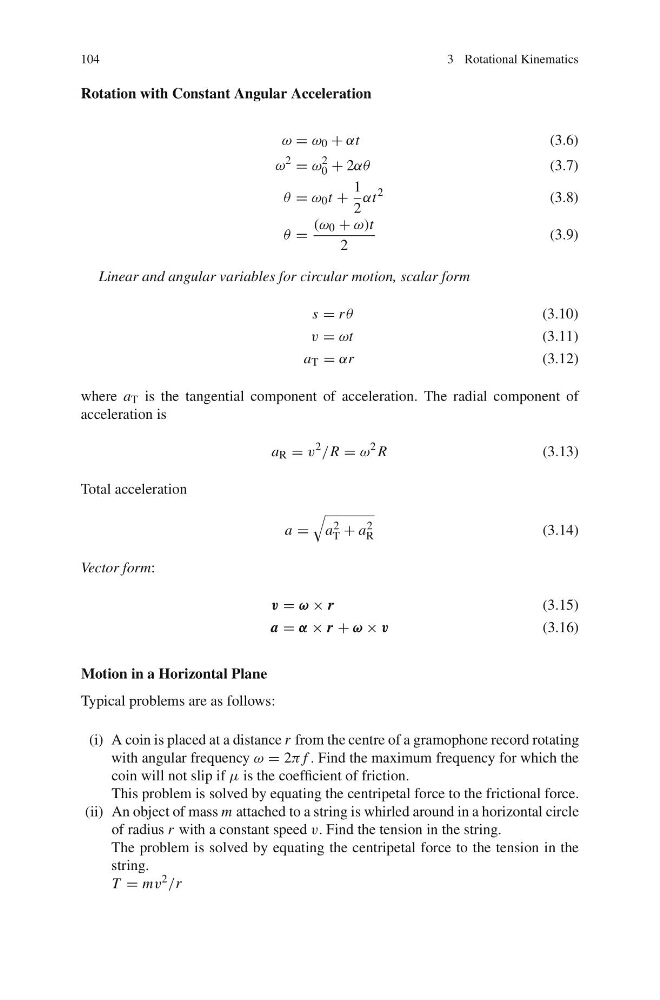
ω = ω 0 + αt
(3.6)
ω
2
= ω
2
0 + 2αθ
(3.7)
θ = ω 0 t +
1
2
αt
2
(3.8)
θ =
(ω 0 + ω)t
2
(3.9)
Linear and angular variables for circular motion, scalar form
s = r θ
(3.10)
v = ωt
(3.11)
a T = αr
(3.12)
where a T is the tangential component of acceleration. The radial component of
acceleration is
a R = v
2
/R = ω
2 R
(3.13)
Total acceleration
a =
a 2
T + a 2
R
(3.14)
Vector form:
v = ω × r
(3.15)
a = α × r + ω × v
(3.16)
Motion in a Horizontal Plane
Typical problems are as follows:
(i) A coin is placed at a distance r from the centre of a gramophone record rotating
with angular frequency ω = 2π f . Find the maximum frequency for which the
coin will not slip if μ is the coefficient of friction.
This problem is solved by equating the centripetal force to the frictional force.
(ii) An object of mass m attached to a string is whirled around in a horizontal circle
of radius r with a constant speed v. Find the tension in the string.
The problem is solved by equating the centripetal force to the tension in the
string.
T = mv 2 /r
3 Rotational Kinematics
Rotation with Constant Angular Acceleration
ω = ω 0 + αt
(3.6)
ω
2
= ω
2
0 + 2αθ
(3.7)
θ = ω 0 t +
1
2
αt
2
(3.8)
θ =
(ω 0 + ω)t
2
(3.9)
Linear and angular variables for circular motion, scalar form
s = r θ
(3.10)
v = ωt
(3.11)
a T = αr
(3.12)
where a T is the tangential component of acceleration. The radial component of
acceleration is
a R = v
2
/R = ω
2 R
(3.13)
Total acceleration
a =
a 2
T + a 2
R
(3.14)
Vector form:
v = ω × r
(3.15)
a = α × r + ω × v
(3.16)
Motion in a Horizontal Plane
Typical problems are as follows:
(i) A coin is placed at a distance r from the centre of a gramophone record rotating
with angular frequency ω = 2π f . Find the maximum frequency for which the
coin will not slip if μ is the coefficient of friction.
This problem is solved by equating the centripetal force to the frictional force.
(ii) An object of mass m attached to a string is whirled around in a horizontal circle
of radius r with a constant speed v. Find the tension in the string.
The problem is solved by equating the centripetal force to the tension in the
string.
T = mv 2 /r