

2.3 Solutions
95
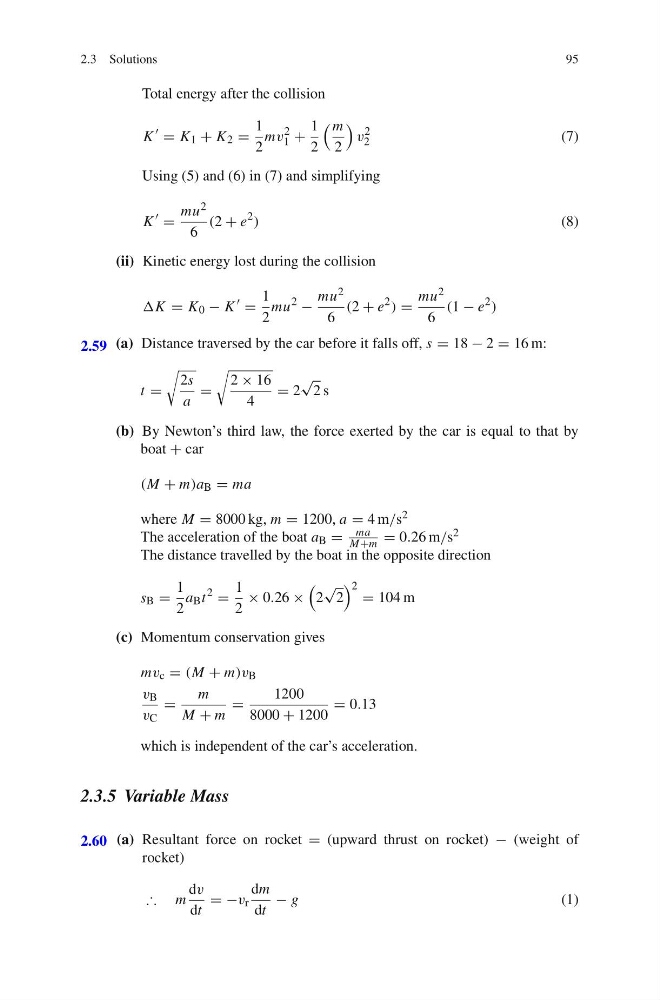
Total energy after the collision
K
= K 1 + K 2 =
1
2
mv
2
1 +
1
2
m
2
v
2
2
(7)
Using (5) and (6) in (7) and simplifying
K
=
mu 2
6
(2 + e
2
)
(8)
(ii) Kinetic energy lost during the collision
K = K 0 − K
=
1
2
mu
2
−
mu 2
6
(2 + e
2
) =
mu 2
6
(1 − e
2
)
2.59 (a) Distance traversed by the car before it falls off, s = 18 − 2 = 16 m:
t =
2s
a
=
2 × 16
4
= 2
√
2 s
(b) By Newton’s third law, the force exerted by the car is equal to that by
boat + car
(M + m)a B = ma
where M = 8000 kg, m = 1200, a = 4 m/s 2
The acceleration of the boat a B =
ma
M+m = 0.26 m/s 2
The distance travelled by the boat in the opposite direction
s B =
1
2
a B t
2
=
1
2
× 0.26 ×
2
√
2
2 = 104 m
(c) Momentum conservation gives
mv c = (M + m)v B
v B
v C
=
m
M + m
=
1200
8000 + 1200
= 0.13
which is independent of the car’s acceleration.
2.3.5 Variable Mass
2.60 (a) Resultant force on rocket = (upward thrust on rocket) − (weight of
rocket)
∴ m
dv
dt
= −v r
dm
dt
− g
(1)
95
Total energy after the collision
K
= K 1 + K 2 =
1
2
mv
2
1 +
1
2
m
2
v
2
2
(7)
Using (5) and (6) in (7) and simplifying
K
=
mu 2
6
(2 + e
2
)
(8)
(ii) Kinetic energy lost during the collision
K = K 0 − K
=
1
2
mu
2
−
mu 2
6
(2 + e
2
) =
mu 2
6
(1 − e
2
)
2.59 (a) Distance traversed by the car before it falls off, s = 18 − 2 = 16 m:
t =
2s
a
=
2 × 16
4
= 2
√
2 s
(b) By Newton’s third law, the force exerted by the car is equal to that by
boat + car
(M + m)a B = ma
where M = 8000 kg, m = 1200, a = 4 m/s 2
The acceleration of the boat a B =
ma
M+m = 0.26 m/s 2
The distance travelled by the boat in the opposite direction
s B =
1
2
a B t
2
=
1
2
× 0.26 ×
2
√
2
2 = 104 m
(c) Momentum conservation gives
mv c = (M + m)v B
v B
v C
=
m
M + m
=
1200
8000 + 1200
= 0.13
which is independent of the car’s acceleration.
2.3.5 Variable Mass
2.60 (a) Resultant force on rocket = (upward thrust on rocket) − (weight of
rocket)
∴ m
dv
dt
= −v r
dm
dt
− g
(1)