

2.3 Solutions
87
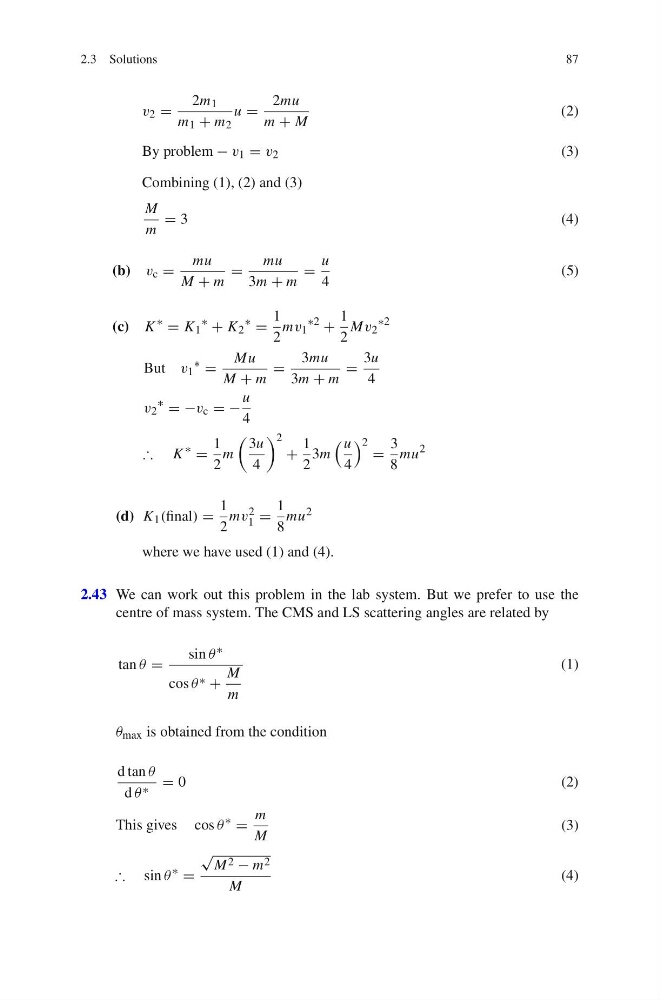
v 2 =
2m 1
m 1 + m 2
u =
2mu
m + M
(2)
By problem − v 1 = v 2
(3)
Combining (1), (2) and (3)
M
m
= 3
( 4 )
(b) v c =
mu
M + m
=
mu
3m + m
=
u
4
(5)
(c) K
∗
= K 1
∗
+ K 2
∗
=
1
2
mv 1
∗2
+
1
2
Mv 2
∗2
But v 1
∗
=
Mu
M + m
=
3mu
3m + m
=
3u
4
v 2
∗
= −v c = −
u
4
∴ K
∗
=
1
2
m
3u
4
2
+
1
2
3m
u
4
2 =
3
8
mu
2
(d) K 1 (final) =
1
2
mv 2
1 =
1
8
mu 2
where we have used (1) and (4).
2.43 We can work out this problem in the lab system. But we prefer to use the
centre of mass system. The CMS and LS scattering angles are related by
tan θ =
sin θ ∗
cos θ ∗ +
M
m
(1)
θ max is obtained from the condition
d tan θ
d θ ∗ = 0
( 2 )
This gives cos θ
∗
=
m
M
(3)
∴ sin θ
∗
=
√
M 2 − m 2
M
(4)
87
v 2 =
2m 1
m 1 + m 2
u =
2mu
m + M
(2)
By problem − v 1 = v 2
(3)
Combining (1), (2) and (3)
M
m
= 3
( 4 )
(b) v c =
mu
M + m
=
mu
3m + m
=
u
4
(5)
(c) K
∗
= K 1
∗
+ K 2
∗
=
1
2
mv 1
∗2
+
1
2
Mv 2
∗2
But v 1
∗
=
Mu
M + m
=
3mu
3m + m
=
3u
4
v 2
∗
= −v c = −
u
4
∴ K
∗
=
1
2
m
3u
4
2
+
1
2
3m
u
4
2 =
3
8
mu
2
(d) K 1 (final) =
1
2
mv 2
1 =
1
8
mu 2
where we have used (1) and (4).
2.43 We can work out this problem in the lab system. But we prefer to use the
centre of mass system. The CMS and LS scattering angles are related by
tan θ =
sin θ ∗
cos θ ∗ +
M
m
(1)
θ max is obtained from the condition
d tan θ
d θ ∗ = 0
( 2 )
This gives cos θ
∗
=
m
M
(3)
∴ sin θ
∗
=
√
M 2 − m 2
M
(4)