

84
2 Particle Dynamics
AC = 2AD = 2AB cos φ
∴ v = 2v
∗ cos φ =
2mu cos φ
M + m
Fig. 2.32
2.37 (a) Kinetic energy of A before collision K A =
1
2
(2m)u 2 = mu 2 . Since B
is initially stationary, its kinetic energy K B = 0. Hence before collision,
total kinetic energy K 0 = mu 2 + 0 = mu 2 .
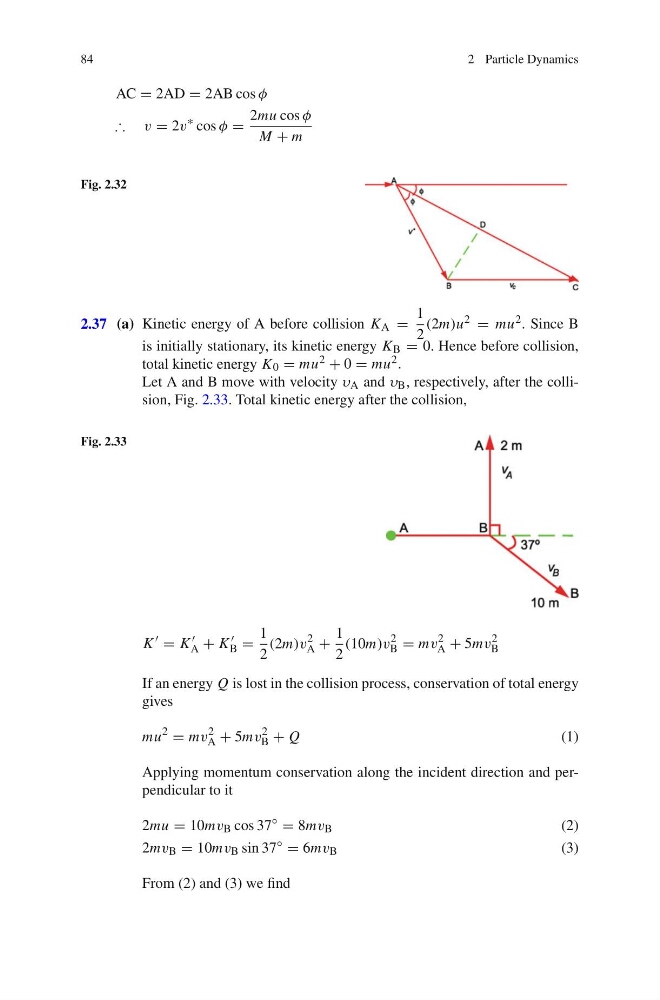
Let A and B move with velocity υ A and υ B , respectively, after the collision, Fig. 2.33. Total kinetic energy after the collision,
Fig. 2.33
K
= K
A + K
B =
1
2
(2m)v
2
A +
1
2
(10m)v
2
B = mv
2
A + 5mv
2
B
If an energy Q is lost in the collision process, conservation of total energy
gives
mu
2
= mv
2
A + 5mv
2
B + Q
(1)
Applying momentum conservation along the incident direction and perpendicular to it
2mu = 10mv B cos 37
◦
= 8mv B
(2)
2mv B = 10mv B sin 37
◦
= 6mv B
(3)
From (2) and (3) we find
2 Particle Dynamics
AC = 2AD = 2AB cos φ
∴ v = 2v
∗ cos φ =
2mu cos φ
M + m
Fig. 2.32
2.37 (a) Kinetic energy of A before collision K A =
1
2
(2m)u 2 = mu 2 . Since B
is initially stationary, its kinetic energy K B = 0. Hence before collision,
total kinetic energy K 0 = mu 2 + 0 = mu 2 .
Let A and B move with velocity υ A and υ B , respectively, after the collision, Fig. 2.33. Total kinetic energy after the collision,
Fig. 2.33
K
= K
A + K
B =
1
2
(2m)v
2
A +
1
2
(10m)v
2
B = mv
2
A + 5mv
2
B
If an energy Q is lost in the collision process, conservation of total energy
gives
mu
2
= mv
2
A + 5mv
2
B + Q
(1)
Applying momentum conservation along the incident direction and perpendicular to it
2mu = 10mv B cos 37
◦
= 8mv B
(2)
2mv B = 10mv B sin 37
◦
= 6mv B
(3)
From (2) and (3) we find