

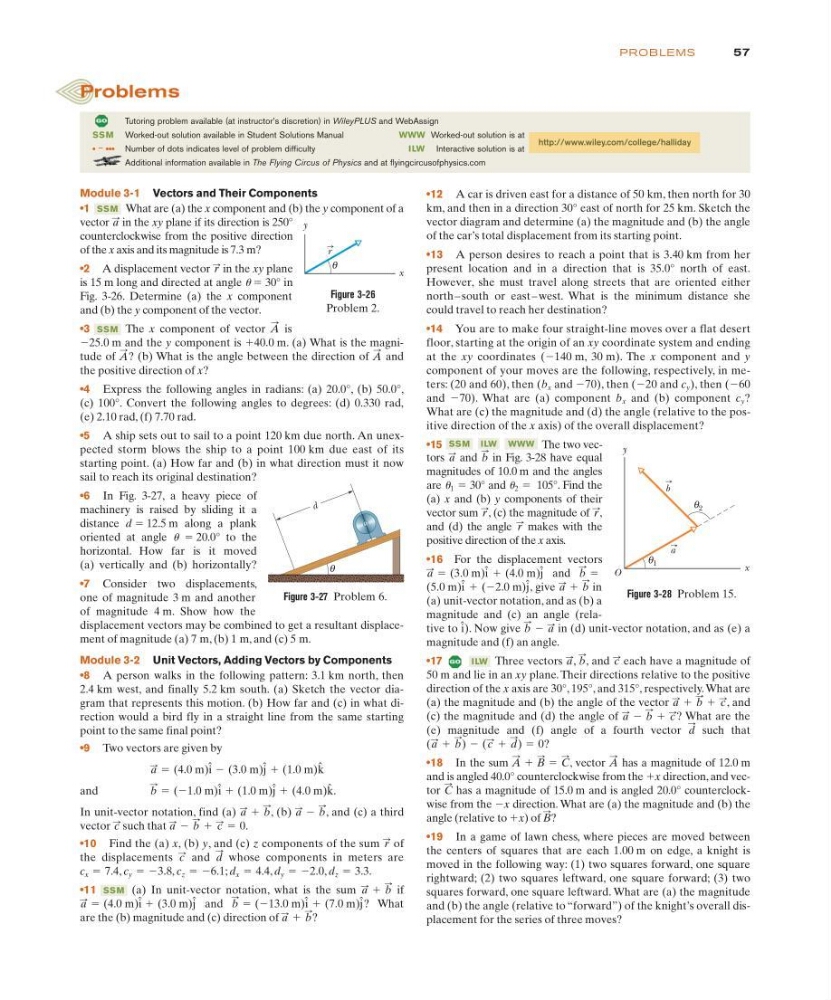
tors and in Fig. 3-28 have equal
magnitudes of 10.0 m and the angles
are
30° and
105°. Find the
(a) x and (b) y components of their
vector sum , (c) the magnitude of ,
and (d) the angle makes with the
positive direction of the x axis.
•16 For the displacement vectors
and
, give
in
(a) unit-vector notation, and as (b) a
magnitude and (c) an angle (relative to ). Now give
in (d) unit-vector notation, and as (e) a
magnitude and (f) an angle.
•17
Three vectors , , and each have a magnitude of
50 m and lie in an xy plane. Their directions relative to the positive
direction of the x axis are 30°, 195°, and 315°, respectively. What are
(a) the magnitude and (b) the angle of the vector
, and
(c) the magnitude and (d) the angle of
? What are the
(e) magnitude and (f) angle of a fourth vector
such that
?
•18 In the sum
, vector has a magnitude of 12.0 m
and is angled 40.0° counterclockwise from the
direction, and vector has a magnitude of 15.0 m and is angled 20.0° counterclockwise from the
direction. What are (a) the magnitude and (b) the
angle (relative to
) of ?
•19 In a game of lawn chess, where pieces are moved between
the centers of squares that are each 1.00 m on edge, a knight is
moved in the following way: (1) two squares forward, one square
rightward; (2) two squares leftward, one square forward; (3) two
squares forward, one square leftward. What are (a) the magnitude
and (b) the angle (relative to “forward”) of the knight’s overall displacement for the series of three moves?
B
:
ϩx
Ϫx
C
:
ϩx
A
:
A
: ϩ B
: ϭ C
:
(a
: ϩ b
: ) Ϫ ( c
: ϩ d
:
) ϭ 0
d
:
a
: Ϫ b
: ϩ c
:
a
: ϩ b
: ϩ c
:
c
:
b
:
a
:
ILW
b
: Ϫ a
:
i
ˆ
a
: ϩ b
:
(5.0 m)i ˆ ϩ (Ϫ2.0 m)j ˆ
b
: ϭ
a
: ϭ (3.0 m)i ˆ ϩ (4.0 m)j ˆ
r
:
r
:
r
:
2 ϭ
1 ϭ
b
:
a
:
Module 3-1 Vectors and Their Components
•1
What are (a) the x component and (b) the y component of a
vector in the xy plane if its direction is 250°
counterclockwise from the positive direction
of the x axis and its magnitude is 7.3 m?
•2 A displacement vector in the xy plane
is 15 m long and directed at angle u ϭ 30° in
Fig. 3-26. Determine (a) the x component
and (b) the y component of the vector.
•3
The x component of vector
is
25.0 m and the y component is 40.0 m. (a) What is the magnitude of ? (b) What is the angle between the direction of and
the positive direction of x?
•4 Express the following angles in radians: (a) 20.0°, (b) 50.0°,
(c) 100°. Convert the following angles to degrees: (d) 0.330 rad,
(e) 2.10 rad, (f) 7.70 rad.
•5 A ship sets out to sail to a point 120 km due north. An unexpected storm blows the ship to a point 100 km due east of its
starting point. (a) How far and (b) in what direction must it now
sail to reach its original destination?
•6 In Fig. 3-27, a heavy piece of
machinery is raised by sliding it a
distance d ϭ 12.5 m along a plank
oriented at angle u ϭ 20.0° to the
horizontal. How far is it moved
(a) vertically and (b) horizontally?
•7 Consider two displacements,
one of magnitude 3 m and another
of magnitude 4 m. Show how the
displacement vectors may be combined to get a resultant displacement of magnitude (a) 7 m, (b) 1 m, and (c) 5 m.
Module 3-2 Unit Vectors, Adding Vectors by Components
•8 A person walks in the following pattern: 3.1 km north, then
2.4 km west, and finally 5.2 km south. (a) Sketch the vector diagram that represents this motion. (b) How far and (c) in what direction would a bird fly in a straight line from the same starting
point to the same final point?
•9 Two vectors are given by
and
.
In unit-vector notation, find (a)
, (b)
, and (c) a third
vector such that
.
•10 Find the (a) x, (b) y, and (c) z components of the sum of
the displacements
and
whose components in meters are
c x 7.4, c y
3.8, c z
6.1; d x 4.4, d y
2.0, d z 3.3.
•11
(a) In unit-vector notation, what is the sum
if
(4.0 m)
(3.0 m) and
( 13.0 m)
(7.0 m) ? What
are the (b) magnitude and (c) direction of
?
a
: ϩ b
:
j
ˆ
ϩ
i
ˆ
Ϫ
ϭ
b
:
j
ˆ
ϩ
i
ˆ
ϭ
a
:
a
: ϩ b
:
SSM
ϭ
ϭ Ϫ
ϭ
ϭ Ϫ
ϭ Ϫ
ϭ
d
:
c
:
r
:
a
: Ϫ b
: ϩ c
: ϭ 0
c
:
a
: Ϫ b
:
a
: ϩ b
:
b
: ϭ (Ϫ1.0 m)i ˆ ϩ (1.0 m)j ˆ ϩ (4.0 m)k ˆ
a
: ϭ (4.0 m)i ˆ Ϫ (3.0 m)j ˆ ϩ (1.0 m)k ˆ
A
:
A
:
ϩ
Ϫ
A
:
SSM
r
:
a
:
SSM
57
PROB LE M S
θ
d
Figure 3-27 Problem 6.
•12 A car is driven east for a distance of 50 km, then north for 30
km, and then in a direction 30° east of north for 25 km. Sketch the
vector diagram and determine (a) the magnitude and (b) the angle
of the car’s total displacement from its starting point.
•13 A person desires to reach a point that is 3.40 km from her
present location and in a direction that is 35.0° north of east.
However, she must travel along streets that are oriented either
north – south or east – west. What is the minimum distance she
could travel to reach her destination?
•14 You are to make four straight-line moves over a flat desert
floor, starting at the origin of an xy coordinate system and ending
at the xy coordinates (Ϫ140 m, 30 m). The x component and y
component of your moves are the following, respectively, in meters: (20 and 60), then (b x and Ϫ70), then (Ϫ20 and c y ), then (Ϫ60
and Ϫ70). What are (a) component b x and (b) component c y ?
What are (c) the magnitude and (d) the angle (relative to the positive direction of the x axis) of the overall displacement?
•15
The two vecWWW
ILW
SSM
θ
x
y
r
Figure 3-26
Problem 2.
θ
O
x
y
2
θ 1
a
b
Figure 3-28 Problem 15.
Tutoring problem available (at instructor’s discretion) in WileyPLUS and WebAssign
SSM Worked-out solution available in Student Solutions Manual
• – ••• Number of dots indicates level of problem difficulty
Additional information available in The Flying Circus of Physics and at flyingcircusofphysics.com
WWW Worked-out solution is at
ILW Interactive solution is at
http://www.wiley.com/college/halliday
Problems
magnitudes of 10.0 m and the angles
are
30° and
105°. Find the
(a) x and (b) y components of their
vector sum , (c) the magnitude of ,
and (d) the angle makes with the
positive direction of the x axis.
•16 For the displacement vectors
and
, give
in
(a) unit-vector notation, and as (b) a
magnitude and (c) an angle (relative to ). Now give
in (d) unit-vector notation, and as (e) a
magnitude and (f) an angle.
•17
Three vectors , , and each have a magnitude of
50 m and lie in an xy plane. Their directions relative to the positive
direction of the x axis are 30°, 195°, and 315°, respectively. What are
(a) the magnitude and (b) the angle of the vector
, and
(c) the magnitude and (d) the angle of
? What are the
(e) magnitude and (f) angle of a fourth vector
such that
?
•18 In the sum
, vector has a magnitude of 12.0 m
and is angled 40.0° counterclockwise from the
direction, and vector has a magnitude of 15.0 m and is angled 20.0° counterclockwise from the
direction. What are (a) the magnitude and (b) the
angle (relative to
) of ?
•19 In a game of lawn chess, where pieces are moved between
the centers of squares that are each 1.00 m on edge, a knight is
moved in the following way: (1) two squares forward, one square
rightward; (2) two squares leftward, one square forward; (3) two
squares forward, one square leftward. What are (a) the magnitude
and (b) the angle (relative to “forward”) of the knight’s overall displacement for the series of three moves?
B
:
ϩx
Ϫx
C
:
ϩx
A
:
A
: ϩ B
: ϭ C
:
(a
: ϩ b
: ) Ϫ ( c
: ϩ d
:
) ϭ 0
d
:
a
: Ϫ b
: ϩ c
:
a
: ϩ b
: ϩ c
:
c
:
b
:
a
:
ILW
b
: Ϫ a
:
i
ˆ
a
: ϩ b
:
(5.0 m)i ˆ ϩ (Ϫ2.0 m)j ˆ
b
: ϭ
a
: ϭ (3.0 m)i ˆ ϩ (4.0 m)j ˆ
r
:
r
:
r
:
2 ϭ
1 ϭ
b
:
a
:
Module 3-1 Vectors and Their Components
•1
What are (a) the x component and (b) the y component of a
vector in the xy plane if its direction is 250°
counterclockwise from the positive direction
of the x axis and its magnitude is 7.3 m?
•2 A displacement vector in the xy plane
is 15 m long and directed at angle u ϭ 30° in
Fig. 3-26. Determine (a) the x component
and (b) the y component of the vector.
•3
The x component of vector
is
25.0 m and the y component is 40.0 m. (a) What is the magnitude of ? (b) What is the angle between the direction of and
the positive direction of x?
•4 Express the following angles in radians: (a) 20.0°, (b) 50.0°,
(c) 100°. Convert the following angles to degrees: (d) 0.330 rad,
(e) 2.10 rad, (f) 7.70 rad.
•5 A ship sets out to sail to a point 120 km due north. An unexpected storm blows the ship to a point 100 km due east of its
starting point. (a) How far and (b) in what direction must it now
sail to reach its original destination?
•6 In Fig. 3-27, a heavy piece of
machinery is raised by sliding it a
distance d ϭ 12.5 m along a plank
oriented at angle u ϭ 20.0° to the
horizontal. How far is it moved
(a) vertically and (b) horizontally?
•7 Consider two displacements,
one of magnitude 3 m and another
of magnitude 4 m. Show how the
displacement vectors may be combined to get a resultant displacement of magnitude (a) 7 m, (b) 1 m, and (c) 5 m.
Module 3-2 Unit Vectors, Adding Vectors by Components
•8 A person walks in the following pattern: 3.1 km north, then
2.4 km west, and finally 5.2 km south. (a) Sketch the vector diagram that represents this motion. (b) How far and (c) in what direction would a bird fly in a straight line from the same starting
point to the same final point?
•9 Two vectors are given by
and
.
In unit-vector notation, find (a)
, (b)
, and (c) a third
vector such that
.
•10 Find the (a) x, (b) y, and (c) z components of the sum of
the displacements
and
whose components in meters are
c x 7.4, c y
3.8, c z
6.1; d x 4.4, d y
2.0, d z 3.3.
•11
(a) In unit-vector notation, what is the sum
if
(4.0 m)
(3.0 m) and
( 13.0 m)
(7.0 m) ? What
are the (b) magnitude and (c) direction of
?
a
: ϩ b
:
j
ˆ
ϩ
i
ˆ
Ϫ
ϭ
b
:
j
ˆ
ϩ
i
ˆ
ϭ
a
:
a
: ϩ b
:
SSM
ϭ
ϭ Ϫ
ϭ
ϭ Ϫ
ϭ Ϫ
ϭ
d
:
c
:
r
:
a
: Ϫ b
: ϩ c
: ϭ 0
c
:
a
: Ϫ b
:
a
: ϩ b
:
b
: ϭ (Ϫ1.0 m)i ˆ ϩ (1.0 m)j ˆ ϩ (4.0 m)k ˆ
a
: ϭ (4.0 m)i ˆ Ϫ (3.0 m)j ˆ ϩ (1.0 m)k ˆ
A
:
A
:
ϩ
Ϫ
A
:
SSM
r
:
a
:
SSM
57
PROB LE M S
θ
d
Figure 3-27 Problem 6.
•12 A car is driven east for a distance of 50 km, then north for 30
km, and then in a direction 30° east of north for 25 km. Sketch the
vector diagram and determine (a) the magnitude and (b) the angle
of the car’s total displacement from its starting point.
•13 A person desires to reach a point that is 3.40 km from her
present location and in a direction that is 35.0° north of east.
However, she must travel along streets that are oriented either
north – south or east – west. What is the minimum distance she
could travel to reach her destination?
•14 You are to make four straight-line moves over a flat desert
floor, starting at the origin of an xy coordinate system and ending
at the xy coordinates (Ϫ140 m, 30 m). The x component and y
component of your moves are the following, respectively, in meters: (20 and 60), then (b x and Ϫ70), then (Ϫ20 and c y ), then (Ϫ60
and Ϫ70). What are (a) component b x and (b) component c y ?
What are (c) the magnitude and (d) the angle (relative to the positive direction of the x axis) of the overall displacement?
•15
The two vecWWW
ILW
SSM
θ
x
y
r
Figure 3-26
Problem 2.
θ
O
x
y
2
θ 1
a
b
Figure 3-28 Problem 15.
Tutoring problem available (at instructor’s discretion) in WileyPLUS and WebAssign
SSM Worked-out solution available in Student Solutions Manual
• – ••• Number of dots indicates level of problem difficulty
Additional information available in The Flying Circus of Physics and at flyingcircusofphysics.com
WWW Worked-out solution is at
ILW Interactive solution is at
http://www.wiley.com/college/halliday
Problems