

Equation 27-39 tells us that q decreases exponentially with time, at a rate that
is set by the capacitive time constant t ϭ RC. At time t ϭ t, the capacitor’s
charge has been reduced to q 0 e
Ϫ1
, or about 37% of the initial value. Note that a
greater t means a greater discharge time.
Differentiating Eq. 27-39 gives us the current i(t):
(discharging a capacitor).
(27-40)
This tells us that the current also decreases exponentially with time, at a rate set
by t. The initial current i 0 is equal to q 0 /RC. Note that you can find i 0 by simply
applying the loop rule to the circuit at t ϭ 0; just then the capacitor’s initial potential V 0 is connected across the resistance R, so the current must be i 0 ϭ V 0 /R ϭ
(q 0 /C)/R ϭ q 0 /RC. The minus sign in Eq. 27-40 can be ignored; it merely means
that the capacitor’s charge q is decreasing.
Derivation of Eq. 27-33
To solve Eq. 27-32, we first rewrite it as
(27-41)
The general solution to this differential equation is of the form
q ϭ q p ϩ Ke
Ϫat
,
( 2 7 - 4 2 )
where q p is a particular solution of the differential equation, K is a constant to
be evaluated from the initial conditions, and a ϭ 1/RC is the coefficient of q in
Eq. 27-41. To find q p , we set dq/dt ϭ 0 in Eq. 27-41 (corresponding to the final
condition of no further charging), let q ϭ q p , and solve, obtaining
q p ϭ C Ᏹ.
( 2 7 - 4 3 )
To evaluate K, we first substitute this into Eq. 27-42 to get
q ϭ C Ᏹ ϩ Ke
Ϫat
.
Then substituting the initial conditions q ϭ 0 and t ϭ 0 yields
0 ϭ C Ᏹ ϩ K,
or K ϭ ϪC Ᏹ. Finally, with the values of q p , a, and K inserted, Eq. 27-42 becomes
q ϭ C Ᏹ Ϫ C Ᏹe
Ϫt/RC
,
which, with a slight modification, is Eq. 27-33.
dq
dt
ϩ
q
RC
ϭ
Ᏹ
R
.
i ϭ
dq
dt
ϭ Ϫ
q 0
RC e
Ϫt/RC
791
27-4 RC CI RCU ITS
Checkpoint 5
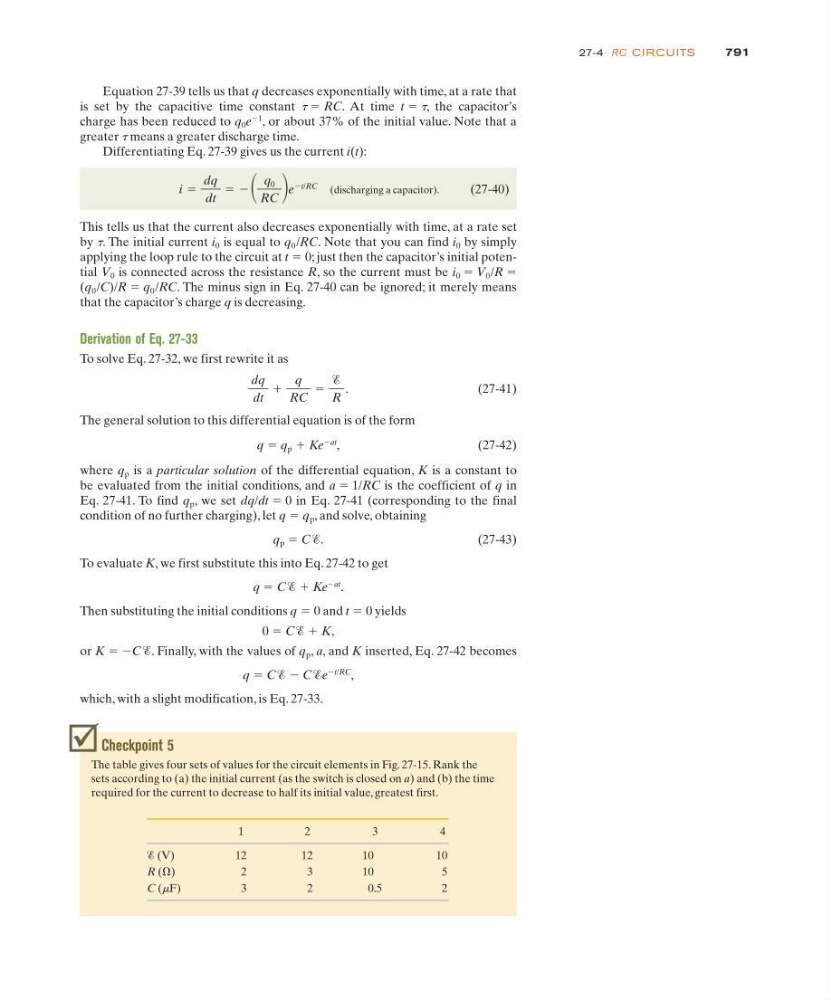
The table gives four sets of values for the circuit elements in Fig. 27-15. Rank the
sets according to (a) the initial current (as the switch is closed on a) and (b) the time
required for the current to decrease to half its initial value, greatest first.
1
2
3
4
Ᏹ (V)
12
12
10
10
R (⍀)
2
3
10
5
C (mF)
3
2
0.5
2