

777
27-1 SI NG LE-LOOP CI RCU ITS
When a potential difference V is applied across resistances connected in series,
the resistances have identical currents i. The sum of the potential differences
across the resistances is equal to the applied potential difference V.
Resistances connected in series can be replaced with an equivalent resistance R eq
that has the same current i and the same total potential difference V as the actual
resistances.
Checkpoint 2
In Fig. 27-5a, if R 1 Ͼ R 2 Ͼ R 3 , rank the three resistances according to (a) the current
through them and (b) the potential difference across them, greatest first.
You might remember that R eq and all the actual series resistances have the same
current i with the nonsense word “ser-i.” Figure 27-5b shows the equivalent resistance R eq that can replace the three resistances of Fig. 27-5a.
To derive an expression for R eq in Fig. 27-5b, we apply the loop rule to both
circuits. For Fig. 27-5a, starting at a and going clockwise around the circuit, we
find
Ᏹ Ϫ iR 1 Ϫ iR 2 Ϫ iR 3 ϭ 0,
or
(27-5)
For Fig. 27-5b, with the three resistances replaced with a single equivalent resistance R eq , we find
Ᏹ Ϫ iR eq ϭ 0,
or
(27-6)
Comparison of Eqs. 27-5 and 27-6 shows that
R eq ϭ R 1 ϩ R 2 ϩ R 3 .
The extension to n resistances is straightforward and is
(n resistances in series).
(27-7)
Note that when resistances are in series, their equivalent resistance is greater
than any of the individual resistances.
R eq ϭ ͚
n
jϭ1
R j
i ϭ
Ᏹ
R eq
.
i ϭ
Ᏹ
R 1 ϩ R 2 ϩ R 3
.
Potential Difference Between Two Points
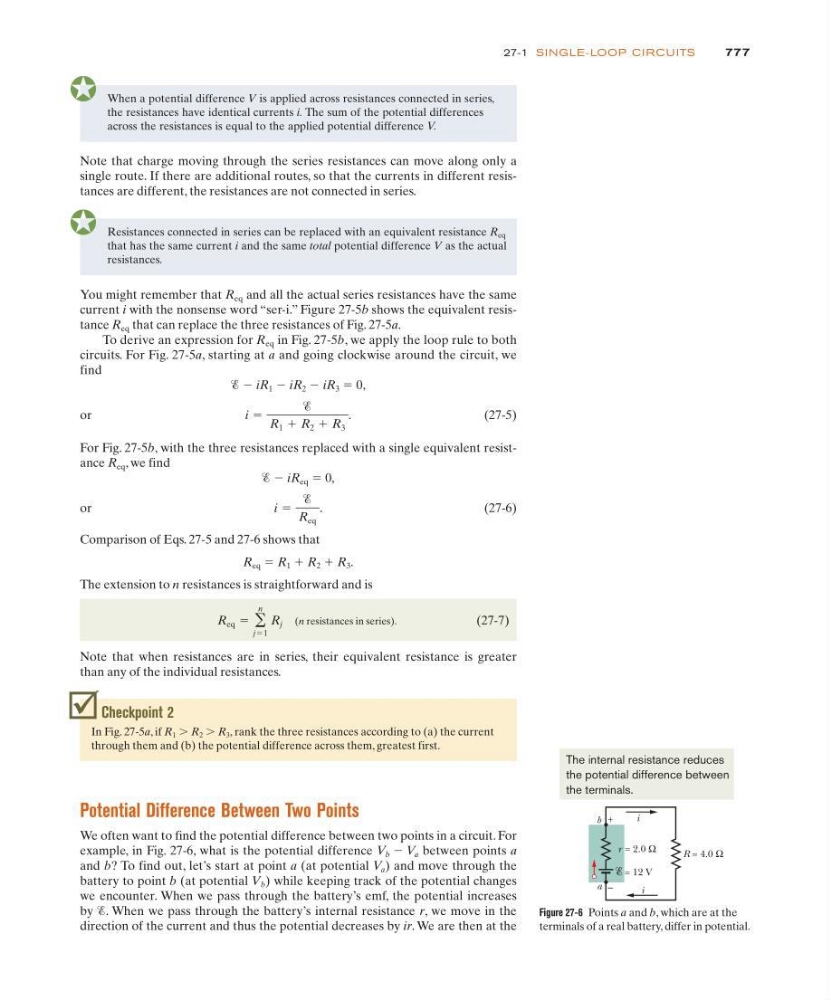
We often want to find the potential difference between two points in a circuit. For
example, in Fig. 27-6, what is the potential difference V b Ϫ V a between points a
and b? To find out, let’s start at point a (at potential V a ) and move through the
battery to point b (at potential V b ) while keeping track of the potential changes
we encounter. When we pass through the battery’s emf, the potential increases
by Ᏹ. When we pass through the battery’s internal resistance r, we move in the
direction of the current and thus the potential decreases by ir. We are then at the
Figure 27-6 Points a and b, which are at the
terminals of a real battery, differ in potential.
R = 4.0 Ω
i
r = 2.0 Ω
= 12 V
i
a
b +
–
The internal resistance reduces
the potential difference between
the terminals.
Note that charge moving through the series resistances can move along only a
single route. If there are additional routes, so that the currents in different resistances are different, the resistances are not connected in series.