

767
PROB LE M S
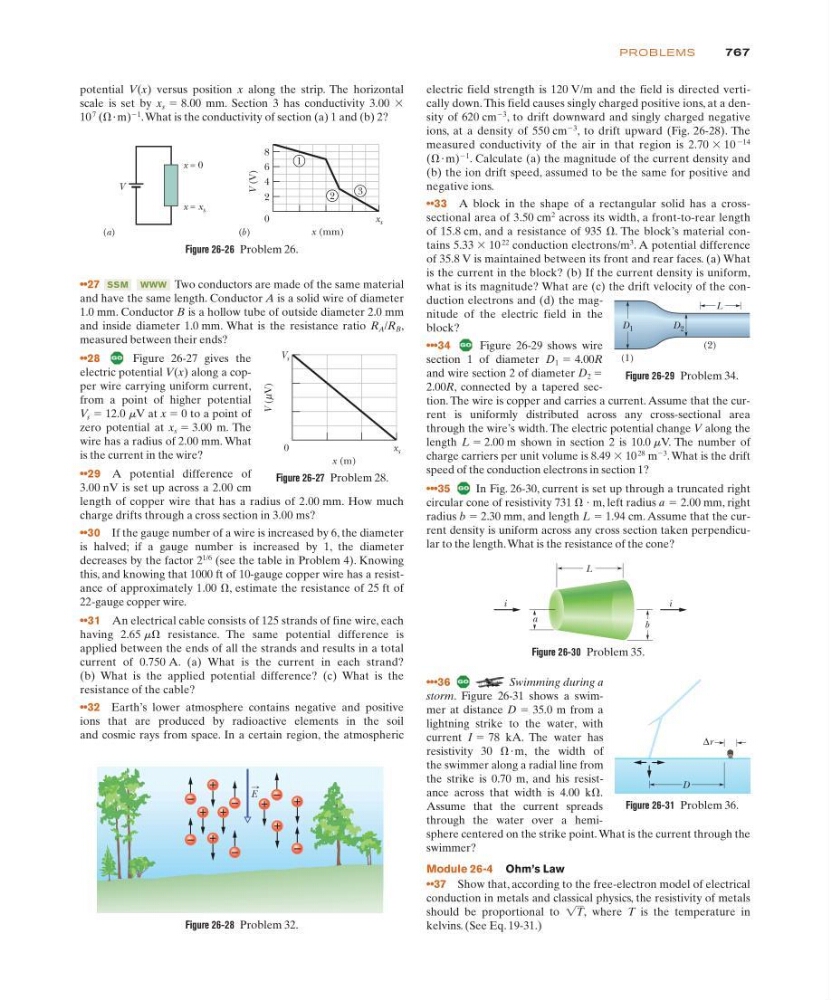
electric field strength is 120 V/m and the field is directed vertically down. This field causes singly charged positive ions, at a density of 620 cm
Ϫ3
, to drift downward and singly charged negative
ions, at a density of 550 cm
Ϫ3
, to drift upward (Fig. 26-28). The
measured conductivity of the air in that region is 2.70 ϫ 10
Ϫ14
(⍀иm)
Ϫ1
. Calculate (a) the magnitude of the current density and
(b) the ion drift speed, assumed to be the same for positive and
negative ions.
••33 A block in the shape of a rectangular solid has a crosssectional area of 3.50 cm
2
across its width, a front-to-rear length
of 15.8 cm, and a resistance of 935 ⍀. The block’s material contains 5.33 ϫ 10
22
conduction electrons/m
3
. A potential difference
of 35.8 V is maintained between its front and rear faces. (a) What
is the current in the block? (b) If the current density is uniform,
what is its magnitude? What are (c) the drift velocity of the conduction electrons and (d) the magnitude of the electric field in the
block?
•••34
Figure 26-29 shows wire
section 1 of diameter D 1 4.00R
and wire section 2 of diameter D 2 ϭ
2.00R, connected by a tapered section. The wire is copper and carries a current. Assume that the current is uniformly distributed across any cross-sectional area
through the wire’s width. The electric potential change V along the
length L ϭ 2.00 m shown in section 2 is 10.0 mV. The number of
charge carriers per unit volume is 8.49 ϫ 10
28
m
Ϫ3
. What is the drift
speed of the conduction electrons in section 1?
•••35
In Fig. 26-30, current is set up through a truncated right
circular cone of resistivity 731
, left radius a 2.00 mm, right
radius b ϭ 2.30 mm, and length L ϭ 1.94 cm. Assume that the current density is uniform across any cross section taken perpendicular to the length. What is the resistance of the cone?
ϭ
⍀ и m
ϭ
Figure 26-26 Problem 26.
x = 0
x = x s
V
(a)
( b)
V (V)
8
6
4
2
0
x (mm)
x s
1
2
3
+ +
+
+
+
+
+
E
Figure 26-28 Problem 32.
•••36
Swimming during a
storm. Figure 26-31 shows a swimmer at distance D 35.0 m from a
lightning strike to the water, with
current I 78 kA. The water has
resistivity 30 ⍀иm, the width of
the swimmer along a radial line from
the strike is 0.70 m, and his resistance across that width is 4.00 k⍀.
Assume that the current spreads
through the water over a hemisphere centered on the strike point. What is the current through the
swimmer?
Module 26-4 Ohm’s Law
••37 Show that, according to the free-electron model of electrical
conduction in metals and classical physics, the resistivity of metals
should be proportional to
where T is the temperature in
kelvins. (See Eq. 19-31.)
1T,
ϭ
ϭ
potential V(x) versus position x along the strip. The horizontal
scale is set by x s 8.00 mm. Section 3 has conductivity 3.00
10
7
(⍀иm)
Ϫ1
.What is the conductivity of section (a) 1 and (b) 2?
ϫ
ϭ
••27
Two conductors are made of the same material
and have the same length. Conductor A is a solid wire of diameter
1.0 mm. Conductor B is a hollow tube of outside diameter 2.0 mm
and inside diameter 1.0 mm. What is the resistance ratio R A /R B ,
measured between their ends?
••28
Figure 26-27 gives the
electric potential V(x) along a copper wire carrying uniform current,
from a point of higher potential
V s ϭ 12.0 mV at x ϭ 0 to a point of
zero potential at x s ϭ 3.00 m. The
wire has a radius of 2.00 mm. What
is the current in the wire?
••29 A potential difference of
3.00 nV is set up across a 2.00 cm
length of copper wire that has a radius of 2.00 mm. How much
charge drifts through a cross section in 3.00 ms?
••30 If the gauge number of a wire is increased by 6, the diameter
is halved; if a gauge number is increased by 1, the diameter
decreases by the factor 2
1/6
(see the table in Problem 4). Knowing
this, and knowing that 1000 ft of 10-gauge copper wire has a resistance of approximately 1.00 ⍀, estimate the resistance of 25 ft of
22-gauge copper wire.
••31 An electrical cable consists of 125 strands of fine wire, each
having 2.65 m⍀ resistance. The same potential difference is
applied between the ends of all the strands and results in a total
current of 0.750 A. (a) What is the current in each strand?
(b) What is the applied potential difference? (c) What is the
resistance of the cable?
••32 Earth’s lower atmosphere contains negative and positive
ions that are produced by radioactive elements in the soil
and cosmic rays from space. In a certain region, the atmospheric
WWW
SSM
V ( V)
µ
V s
0
x (m)
x s
Figure 26-27 Problem 28.
D 1
L
(1)
(2)
D 2
Figure 26-29 Problem 34.
Figure 26-30 Problem 35.
L
i
i
a
b
Figure 26-31 Problem 36.
D
∆r