

760
CHAPTE R 26 CU R R E NT AN D R ESISTANCE
26-5 POWER, SEMICONDUCTORS, SUPERCONDUCTORS
After reading this module, you should be able to . . .
26.27 Explain how conduction electrons in a circuit lose
energy in a resistive device.
26.28 Identify that power is the rate at which energy is
transferred from one type to another.
26.29 For a resistive device, apply the relationships
between power P, current i, voltage V, and
resistance R.
26.30 For a battery, apply the relationship between power P,
current i, and potential difference V.
26.31 Apply the conservation of energy to a circuit with a
battery and a resistive device to relate the energy transfers
in the circuit.
26.32 Distinguish conductors, semiconductors, and
superconductors.
Learning Objectives
● The power P, or rate of energy transfer, in an electrical
device across which a potential difference V is maintained is
P ϭ iV.
● If the device is a resistor, the power can also be written as
● In a resistor, electric potential energy is converted to internal
P ϭ i
2
R ϭ
V
2
R
.
thermal energy via collisions between charge carriers and atoms.
● Semiconductors are materials that have few conduction
electrons but can become conductors when they are doped
with other atoms that contribute charge carriers.
● Superconductors are materials that lose all electrical resistance. Most such materials require very low temperatures,
but some become superconducting at temperatures as high
as room temperature.
Key Ideas
Power in Electric Circuits
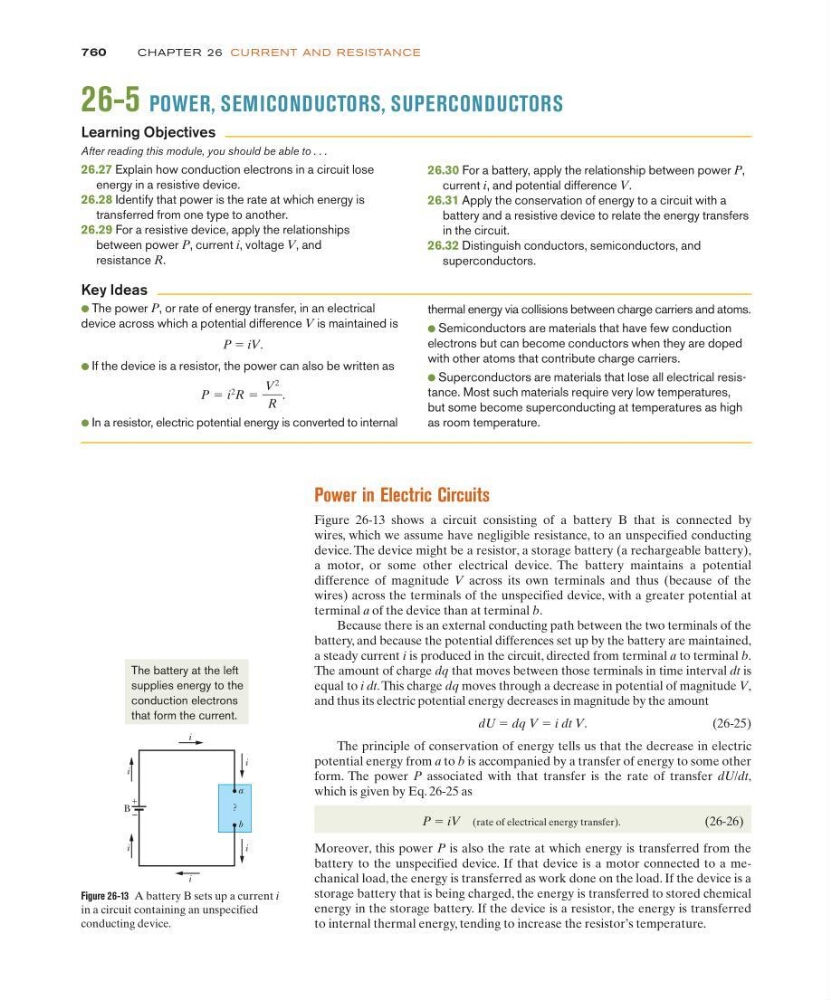
Figure 26-13 shows a circuit consisting of a battery B that is connected by
wires, which we assume have negligible resistance, to an unspecified conducting
device. The device might be a resistor, a storage battery (a rechargeable battery),
a motor, or some other electrical device. The battery maintains a potential
difference of magnitude V across its own terminals and thus (because of the
wires) across the terminals of the unspecified device, with a greater potential at
terminal a of the device than at terminal b.
Because there is an external conducting path between the two terminals of the
battery, and because the potential differences set up by the battery are maintained,
a steady current i is produced in the circuit, directed from terminal a to terminal b.
The amount of charge dq that moves between those terminals in time interval dt is
equal to i dt.This charge dq moves through a decrease in potential of magnitude V,
and thus its electric potential energy decreases in magnitude by the amount
dU ϭ dq V ϭ i dt V.
( 2 6 - 2 5 )
The principle of conservation of energy tells us that the decrease in electric
potential energy from a to b is accompanied by a transfer of energy to some other
form. The power P associated with that transfer is the rate of transfer dU/dt,
which is given by Eq. 26-25 as
P ϭ iV (rate of electrical energy transfer).
(26-26)
Moreover, this power P is also the rate at which energy is transferred from the
battery to the unspecified device. If that device is a motor connected to a mechanical load, the energy is transferred as work done on the load. If the device is a
storage battery that is being charged, the energy is transferred to stored chemical
energy in the storage battery. If the device is a resistor, the energy is transferred
to internal thermal energy, tending to increase the resistor’s temperature.
Figure 26-13 A battery B sets up a current i
in a circuit containing an unspecified
conducting device.
+
–
i
B
i
?
a
b
i
i
i
i
The battery at the left
supplies energy to the
conduction electrons
that form the current.