

convenience, Fig. 26-5 shows the equivalent drift of positive charge carriers in the
direction of the applied electric field
Let us assume that these charge carriers
all move with the same drift speed v d and that the current density J is uniform
across the wire’s cross-sectional area A. The number of charge carriers in a length
L of the wire is nAL, where n is the number of carriers per unit volume. The total
charge of the carriers in the length L, each with charge e, is then
q ϭ (nAL)e.
Because the carriers all move along the wire with speed v d , this total charge
moves through any cross section of the wire in the time interval
Equation 26-1 tells us that the current i is the time rate of transfer of charge
across a cross section, so here we have
(26-6)
Solving for v d and recalling Eq. 26-5 (J ϭ i/A), we obtain
or, extended to vector form,
(26-7)
Here the product ne, whose SI unit is the coulomb per cubic meter (C/m
3
), is the
carrier charge density. For positive carriers, ne is positive and Eq. 26-7 predicts
that and have the same direction. For negative carriers, ne is negative and
and have opposite directions.
v
:
d
J
:
v
:
d
J
:
J
: ϭ (ne)v
:
d .
v d ϭ
i
nAe
ϭ
J
ne
i ϭ
q
t
ϭ
nALe
L/v d
ϭ nAev d .
t ϭ
L
v d
.
E
:
.
750
CHAPTE R 26 CU R R E NT AN D R ESISTANCE
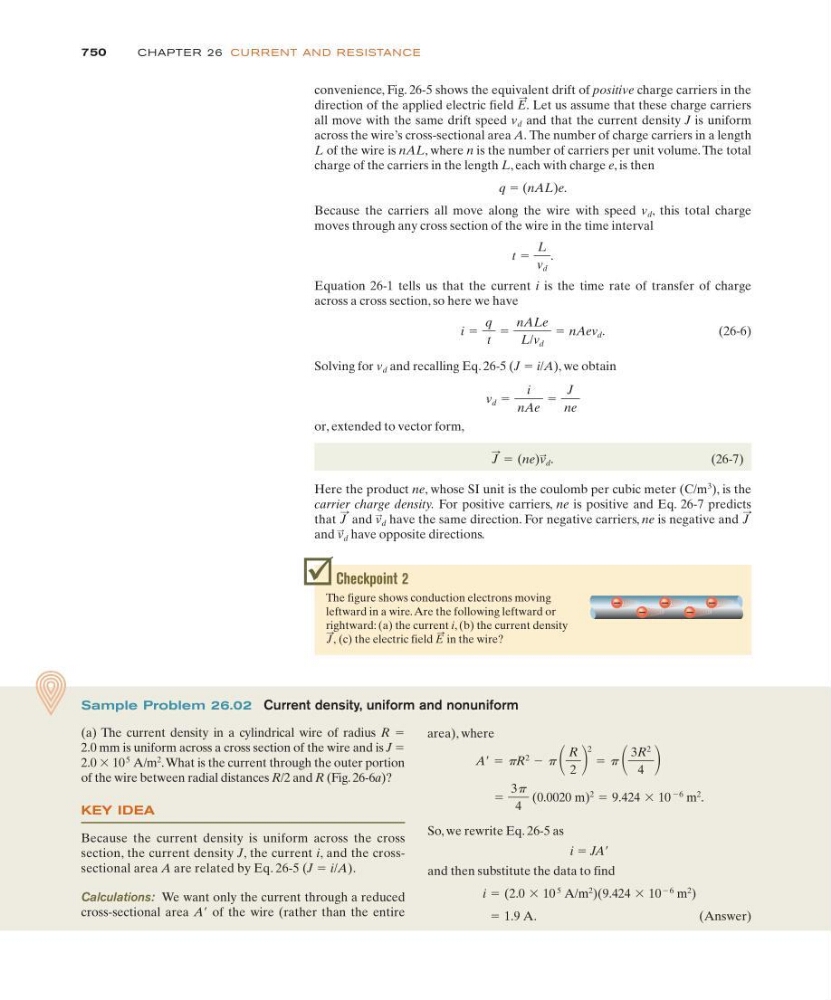
Checkpoint 2
The figure shows conduction electrons moving
leftward in a wire. Are the following leftward or
rightward: (a) the current i, (b) the current density
(c) the electric field in the wire?
E
:
J
:
,
Sample Problem 26.02 Current density, uniform and nonuniform
(a) The current density in a cylindrical wire of radius R
2.0 mm is uniform across a cross section of the wire and is J ϭ
2.0 ϫ 10
5
A/m
2
.What is the current through the outer portion
of the wire between radial distances R/2 and R (Fig. 26-6a)?
KEY IDEA
Because the current density is uniform across the cross
section, the current density J, the current i, and the crosssectional area A are related by Eq. 26-5 (J ϭ i/A).
Calculations: We want only the current through a reduced
cross-sectional area AЈ of the wire (rather than the entire
ϭ
area), where
ϭ
3p
4
(0.0020 m)
2 ϭ 9.424 ϫ 10
Ϫ6
m
2
.
AЈ ϭ pR
2 Ϫ p
R
2
2
ϭ p
3R
2
4
So, we rewrite Eq. 26-5 as
i ϭ JAЈ
and then substitute the data to find
(Answer)
ϭ 1.9 A.
i ϭ (2.0 ϫ 10
5
A/m
2
)(9.424 ϫ 10
Ϫ6
m
2
)