

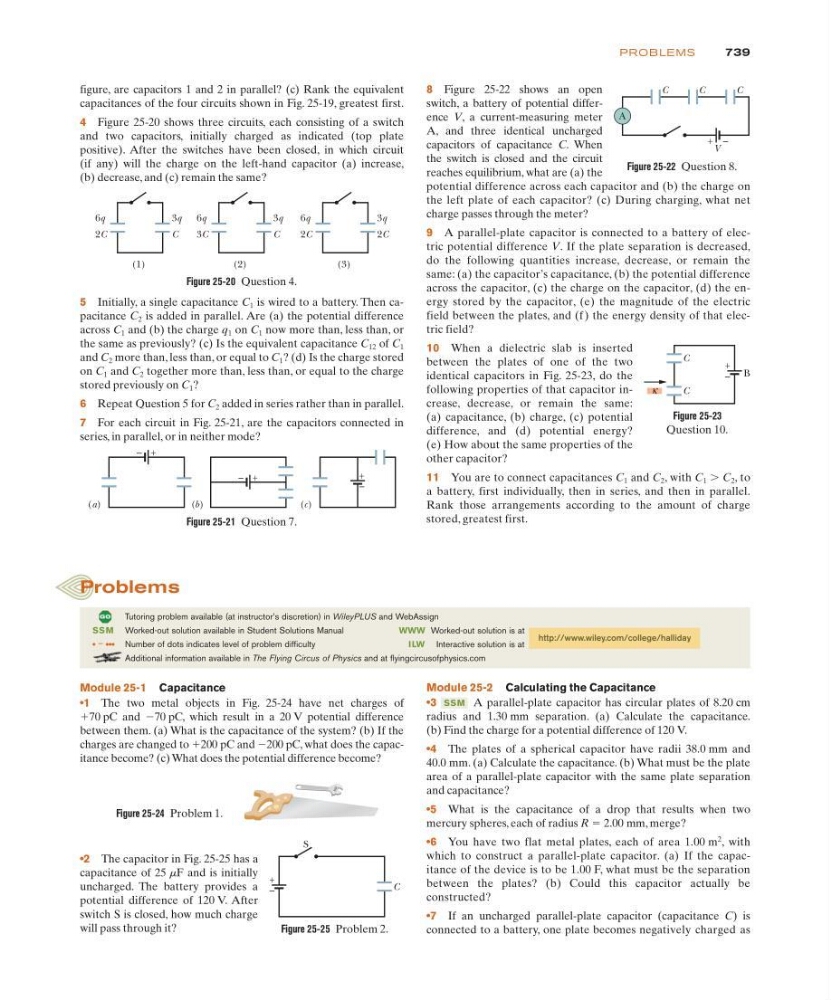
•2 The capacitor in Fig. 25-25 has a
capacitance of 25 mF and is initially
uncharged. The battery provides a
potential difference of 120 V. After
switch S is closed, how much charge
will pass through it?
739
PROB LE M S
figure, are capacitors 1 and 2 in parallel? (c) Rank the equivalent
capacitances of the four circuits shown in Fig. 25-19, greatest first.
4 Figure 25-20 shows three circuits, each consisting of a switch
and two capacitors, initially charged as indicated (top plate
positive). After the switches have been closed, in which circuit
(if any) will the charge on the left-hand capacitor (a) increase,
(b) decrease, and (c) remain the same?
8 Figure 25-22 shows an open
switch, a battery of potential difference V, a current-measuring meter
A, and three identical uncharged
capacitors of capacitance C. When
the switch is closed and the circuit
reaches equilibrium, what are (a) the
potential difference across each capacitor and (b) the charge on
the left plate of each capacitor? (c) During charging, what net
charge passes through the meter?
9 A parallel-plate capacitor is connected to a battery of electric potential difference V. If the plate separation is decreased,
do the following quantities increase, decrease, or remain the
same: (a) the capacitor’s capacitance, (b) the potential difference
across the capacitor, (c) the charge on the capacitor, (d) the energy stored by the capacitor, (e) the magnitude of the electric
field between the plates, and (f ) the energy density of that electric field?
10 When a dielectric slab is inserted
between the plates of one of the two
identical capacitors in Fig. 25-23, do the
following properties of that capacitor increase, decrease, or remain the same:
(a) capacitance, (b) charge, (c) potential
difference, and (d) potential energy?
(e) How about the same properties of the
other capacitor?
11 You are to connect capacitances C 1 and C 2 , with C 1 Ͼ C 2 , to
a battery, first individually, then in series, and then in parallel.
Rank those arrangements according to the amount of charge
stored, greatest first.
Figure 25-20 Question 4.
(1)
6q
2C
3q
C
(3)
6q
2C
3q
2C
(2)
6q
3C
3q
C
A
C
C
V
C
+ –
Figure 25-22 Question 8.
B
κ
+
–
C
C
Figure 25-23
Question 10.
Figure 25-21 Question 7.
+
–
+
–
+
–
(a)
(b)
(c)
5 Initially, a single capacitance C 1 is wired to a battery. Then capacitance C 2 is added in parallel. Are (a) the potential difference
across C 1 and (b) the charge q 1 on C 1 now more than, less than, or
the same as previously? (c) Is the equivalent capacitance C 12 of C 1
and C 2 more than, less than, or equal to C 1 ? (d) Is the charge stored
on C 1 and C 2 together more than, less than, or equal to the charge
stored previously on C 1 ?
6 Repeat Question 5 for C 2 added in series rather than in parallel.
7 For each circuit in Fig. 25-21, are the capacitors connected in
series, in parallel, or in neither mode?
Module 25-2 Calculating the Capacitance
•3
A parallel-plate capacitor has circular plates of 8.20 cm
radius and 1.30 mm separation. (a) Calculate the capacitance.
(b) Find the charge for a potential difference of 120 V.
•4 The plates of a spherical capacitor have radii 38.0 mm and
40.0 mm. (a) Calculate the capacitance. (b) What must be the plate
area of a parallel-plate capacitor with the same plate separation
and capacitance?
•5 What is the capacitance of a drop that results when two
mercury spheres, each of radius R ϭ 2.00 mm, merge?
•6 You have two flat metal plates, each of area 1.00 m
2
, with
which to construct a parallel-plate capacitor. (a) If the capacitance of the device is to be 1.00 F, what must be the separation
between the plates? (b) Could this capacitor actually be
constructed?
•7 If an uncharged parallel-plate capacitor (capacitance C) is
connected to a battery, one plate becomes negatively charged as
SSM
Tutoring problem available (at instructor’s discretion) in WileyPLUS and WebAssign
SSM Worked-out solution available in Student Solutions Manual
• – ••• Number of dots indicates level of problem difficulty
Additional information available in The Flying Circus of Physics and at flyingcircusofphysics.com
WWW Worked-out solution is at
ILW Interactive solution is at
http://www.wiley.com/college/halliday
Problems
Module 25-1 Capacitance
•1 The two metal objects in Fig. 25-24 have net charges of
ϩ70 pC and Ϫ70 pC, which result in a 20 V potential difference
between them. (a) What is the capacitance of the system? (b) If the
charges are changed to ϩ200 pC and Ϫ200 pC, what does the capacitance become? (c) What does the potential difference become?
Figure 25-24 Problem 1.
C
+
–
S
Figure 25-25 Problem 2.