

707
Figure 24-21b shows the variation of electric field with radial distance for the
same shell. Note that E ϭ 0 everywhere inside the shell. The curves of Fig. 24-21b
can be derived from the curve of Fig. 24-21a by differentiating with respect to r,
using Eq. 24-40 (recall that the derivative of any constant is zero). The curve of
Fig. 24-21a can be derived from the curves of Fig. 24-21b by integrating with
respect to r, using Eq. 24-19.
Spark Discharge from a Charged Conductor
On nonspherical conductors, a surface charge does not distribute itself uniformly
over the surface of the conductor. At sharp points or sharp edges, the surface
charge density — and thus the external electric field, which is proportional to it —
may reach very high values. The air around such sharp points or edges may
become ionized, producing the corona discharge that golfers and mountaineers
see on the tips of bushes, golf clubs, and rock hammers when thunderstorms
threaten. Such corona discharges, like hair that stands on end, are often the
precursors of lightning strikes. In such circumstances, it is wise to enclose yourself
in a cavity inside a conducting shell, where the electric field is guaranteed to
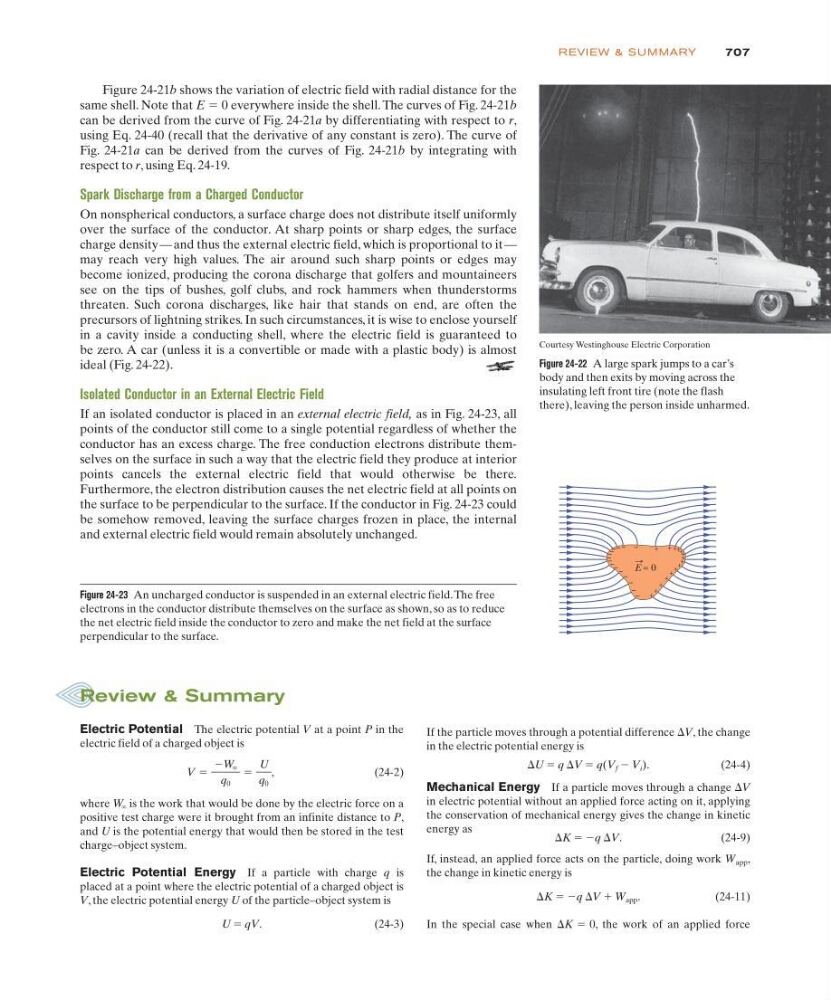
be zero. A car (unless it is a convertible or made with a plastic body) is almost
ideal (Fig. 24-22).
Isolated Conductor in an External Electric Field
If an isolated conductor is placed in an external electric field, as in Fig. 24-23, all
points of the conductor still come to a single potential regardless of whether the
conductor has an excess charge. The free conduction electrons distribute themselves on the surface in such a way that the electric field they produce at interior
points cancels the external electric field that would otherwise be there.
Furthermore, the electron distribution causes the net electric field at all points on
the surface to be perpendicular to the surface. If the conductor in Fig. 24-23 could
be somehow removed, leaving the surface charges frozen in place, the internal
and external electric field would remain absolutely unchanged.
Figure 24-22 A large spark jumps to a car’s
body and then exits by moving across the
insulating left front tire (note the flash
there), leaving the person inside unharmed.
Courtesy Westinghouse Electric Corporation
REVIEW & SUM MARY
Figure 24-23 An uncharged conductor is suspended in an external electric field. The free
electrons in the conductor distribute themselves on the surface as shown, so as to reduce
the net electric field inside the conductor to zero and make the net field at the surface
perpendicular to the surface.
E = 0
+
+
+
+
+
+ +
+ +
+ + ++ +
+
–
–
–
–
–
–
– – – – – – –
–
–
Electric Potential The electric potential V at a point P in the
electric field of a charged object is
(24-2)
where
is the work that would be done by the electric force on a
positive test charge were it brought from an infinite distance to P,
and U is the potential energy that would then be stored in the test
charge–object system.
Electric Potential Energy If a particle with charge q is
placed at a point where the electric potential of a charged object is
V, the electric potential energy U of the particle–object system is
U ϭ qV.
(24-3)
W ϱ
V ϭ
ϪW ϱ
q 0
ϭ
U
q 0
,
Review & Summary
If the particle moves through a potential difference ⌬V, the change
in the electric potential energy is
⌬U ϭ q ⌬V ϭ q(V f Ϫ V i ).
(24-4)
Mechanical Energy If a particle moves through a change ⌬V
in electric potential without an applied force acting on it, applying
the conservation of mechanical energy gives the change in kinetic
energy as
⌬K ϭ Ϫq ⌬V.
( 2 4 - 9 )
If, instead, an applied force acts on the particle, doing work W app ,
the change in kinetic energy is
⌬K ϭ Ϫq ⌬V ϩ W app .
( 2 4 - 1 1 )
In the special case when
, the work of an applied force
⌬K ϭ 0