

704
CHAPTE R 24 ELECTRIC POTENTIAL
Substituting these results into Eq. 24-43 and dropping the subscript f, we find that
the final configuration has a potential energy of
(two-particle system).
(24-46)
Equation 24-46 includes the signs of the two charges. If the two charges have the
same sign, U is positive. If they have opposite signs, U is negative.
If we next bring in a third particle, with charge q 3 , we repeat our calculation,
starting with particle 3 at an infinite distance and then bringing it to a final position at distance r 31 from particle 1 and distance r 32 from particle 2. At the final
position, the potential V f at the location of particle 3 is the algebraic sum of the
potential V 1 due to particle 1 and the potential V 2 of particle 2. When we work
out the algebra, we find that
U ϭ
1
4p´ 0
q 1 q 2
r
place. The work that we must do in this last step is equal to
the sum of the work we must do to bring q 3 near q 1 and the
work we must do to bring it near q 2 . From Eq. 24-46, with d
substituted for r, that sum is
The total potential energy U of the three-charge system is the
sum of the potential energies associated with the three pairs of
charges. This sum (which is actually independent of the order
in which the charges are brought together) is
W 13 ϩ W 23 ϭ U 13 ϩ U 23 ϭ
1
4p´ 0
q 1 q 3
d
ϩ
1
4p´ 0
q 2 q 3
d
.
Sample Problem 24.06 Potential energy of a system of three charged particles
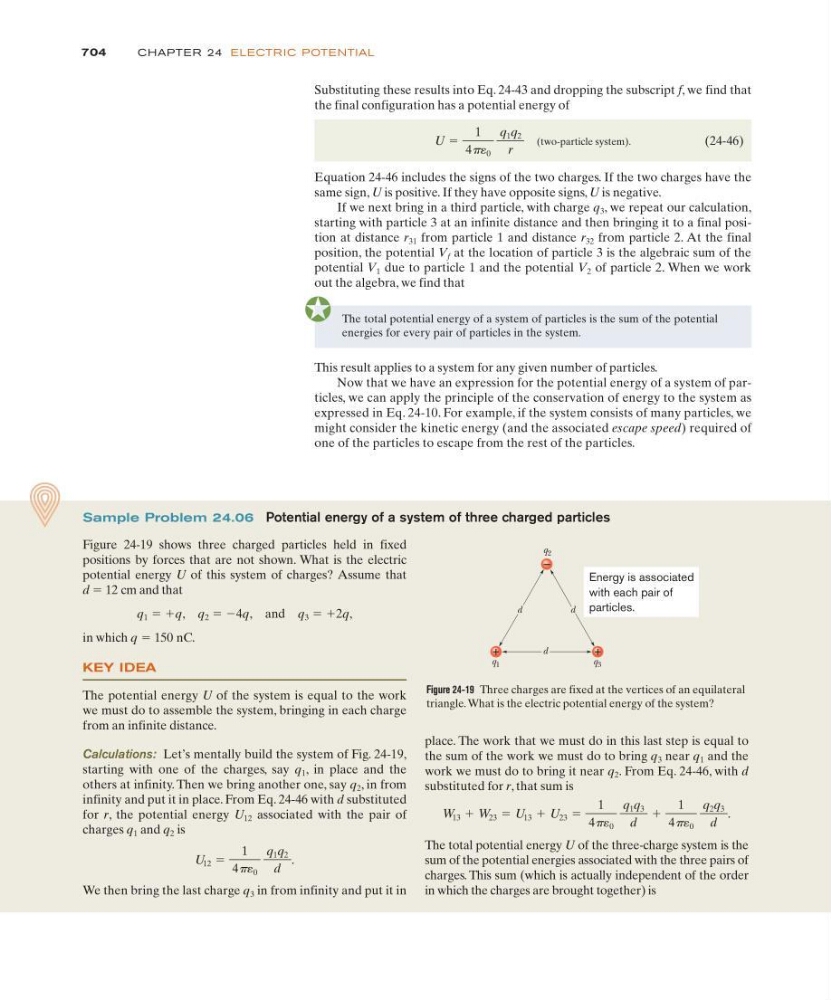
Figure 24-19 shows three charged particles held in fixed
positions by forces that are not shown. What is the electric
potential energy U of this system of charges? Assume that
d ϭ 12 cm and that
q 1 ϭ ϩq, q 2 ϭ Ϫ4q, and q 3 ϭ ϩ2q,
in which q ϭ 150 nC.
KEY IDEA
The potential energy U of the system is equal to the work
we must do to assemble the system, bringing in each charge
from an infinite distance.
Calculations: Let’s mentally build the system of Fig. 24-19,
starting with one of the charges, say q 1 , in place and the
others at infinity. Then we bring another one, say q 2 , in from
infinity and put it in place. From Eq. 24-46 with d substituted
for r, the potential energy U 12 associated with the pair of
charges q 1 and q 2 is
We then bring the last charge q 3 in from infinity and put it in
U 12 ϭ
1
4p´ 0
q 1 q 2
d
.
Figure 24-19 Three charges are fixed at the vertices of an equilateral
triangle. What is the electric potential energy of the system?
d
q 1
q 3
d
d
q 2
+
+
Energy is associated
with each pair of
particles.
The total potential energy of a system of particles is the sum of the potential
energies for every pair of particles in the system.
This result applies to a system for any given number of particles.
Now that we have an expression for the potential energy of a system of particles, we can apply the principle of the conservation of energy to the system as
expressed in Eq. 24-10. For example, if the system consists of many particles, we
might consider the kinetic energy (and the associated escape speed) required of
one of the particles to escape from the rest of the particles.