

697
24-4 POTE NTIAL DU E TO AN E LECTR IC DI POLE
24-4 POTENTIAL DUE TO AN ELECTRIC DIPOLE
After reading this module, you should be able to . . .
24.19 Calculate the potential V at any given point due to an
electric dipole, in terms of the magnitude p of the dipole
moment or the product of the charge separation d and the
magnitude q of either charge.
24.20 For an electric dipole, identify the locations of positive
potential, negative potential, and zero potential.
24.21 Compare the decrease in potential with increasing distance for a single charged particle and an electric dipole.
Learning Objectives
● At a distance r from an electric dipole with dipole moment magnitude p qd, the electric potential of the dipole is
for
; the angle u lies between the dipole moment vector and a line extending from the dipole midpoint to the point of
measurement.
r ӷ d
V ϭ
1
4p´ 0
p cos u
r
2
ϭ
Key Idea
z
d O
θ
+q
–q
r (–) – r (+)
r (–)
r (+)
r
P
(a)
+
z
d
θ
r (–) – r (+)
r (–)
r (+)
(b)
+
+q
–q
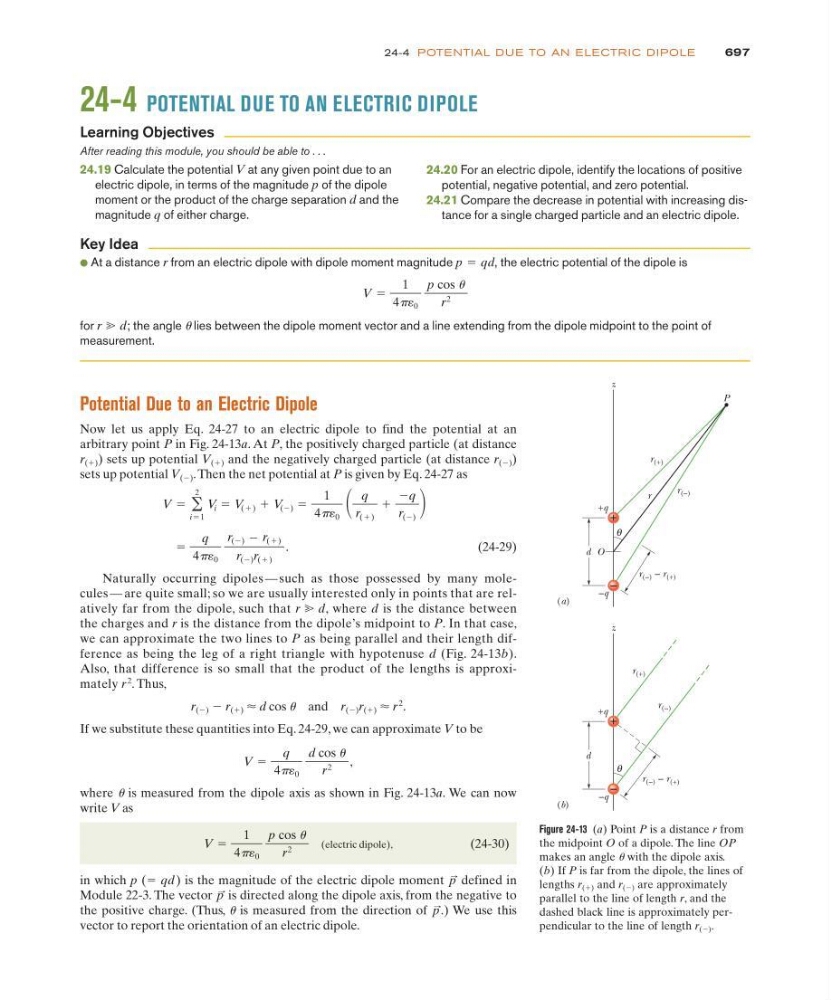
Figure 24-13 (a) Point P is a distance r from
the midpoint O of a dipole. The line OP
makes an angle u with the dipole axis.
(b) If P is far from the dipole, the lines of
lengths r (ϩ) and r (Ϫ) are approximately
parallel to the line of length r, and the
dashed black line is approximately perpendicular to the line of length r (Ϫ) .
Potential Due to an Electric Dipole
Now let us apply Eq. 24-27 to an electric dipole to find the potential at an
arbitrary point P in Fig. 24-13a. At P, the positively charged particle (at distance
r (ϩ) ) sets up potential V (ϩ) and the negatively charged particle (at distance r (Ϫ) )
sets up potential V (Ϫ) .Then the net potential at P is given by Eq. 24-27 as
(24-29)
Naturally occurring dipoles — such as those possessed by many molecules — are quite small; so we are usually interested only in points that are relatively far from the dipole, such that
, where d is the distance between
the charges and r is the distance from the dipole’s midpoint to P. In that case,
we can approximate the two lines to P as being parallel and their length difference as being the leg of a right triangle with hypotenuse d (Fig. 24-13b).
Also, that difference is so small that the product of the lengths is approximately r
2
. Thus,
r (Ϫ) Ϫ r (ϩ) Ϸ d cos u and r (Ϫ) r (ϩ) Ϸ r
2
.
If we substitute these quantities into Eq. 24-29, we can approximate V to be
where u is measured from the dipole axis as shown in Fig. 24-13a. We can now
write V as
(electric dipole),
(24-30)
in which p (ϭ qd) is the magnitude of the electric dipole moment defined in
Module 22-3. The vector is directed along the dipole axis, from the negative to
the positive charge. (Thus, u is measured from the direction of .) We use this
vector to report the orientation of an electric dipole.
p
:
p
:
p
:
V ϭ
1
4p´ 0
p cos u
r
2
V ϭ
q
4p´ 0
d cos
r
2
,
r ӷ d
ϭ
q
4p´ 0
r (Ϫ) Ϫ r (ϩ)
r (Ϫ) r (ϩ)
.
V ϭ ͚
2
iϭ1
V i ϭ V (ϩ) ϩ V (Ϫ) ϭ
1
4p´ 0
q
r (ϩ)
ϩ
Ϫq
r (Ϫ)