

693
24-2 EQU I POTE NTIAL SU R FACES AN D TH E E LECTR IC FI E LD
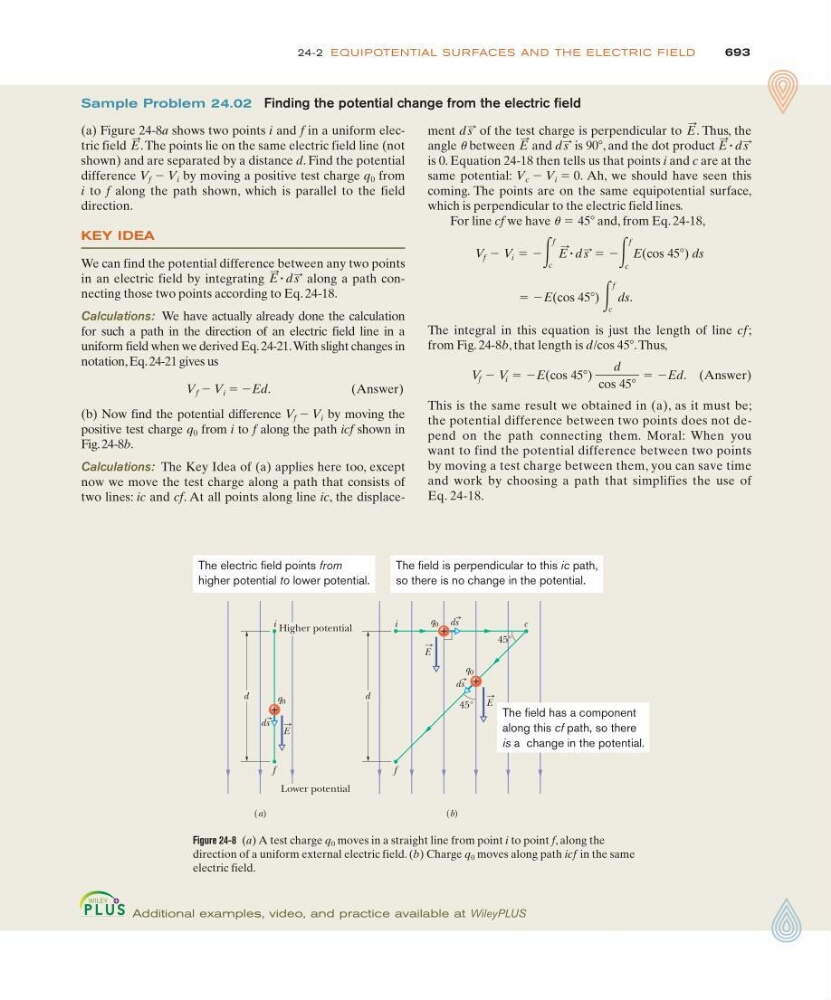
Figure 24-8 (a) A test charge q 0 moves in a straight line from point i to point f, along the
direction of a uniform external electric field. (b) Charge q 0 moves along path icf in the same
electric field.
ment
of the test charge is perpendicular to . Thus, the
angle u between and
is 90 , and the dot product
is 0. Equation 24-18 then tells us that points i and c are at the
same potential: V c Ϫ V i ϭ 0. Ah, we should have seen this
coming. The points are on the same equipotential surface,
which is perpendicular to the electric field lines.
For line cf we have u 45 and, from Eq. 24-18,
The integral in this equation is just the length of line cf;
from Fig. 24-8b, that length is d/cos 45Њ.Thus,
(Answer)
This is the same result we obtained in (a), as it must be;
the potential difference between two points does not depend on the path connecting them. Moral: When you
want to find the potential difference between two points
by moving a test charge between them, you can save time
and work by choosing a path that simplifies the use of
Eq. 24-18.
V f Ϫ V i ϭ ϪE(cos 45Њ)
d
cos 45Њ
ϭ ϪEd.
ϭ ϪE(cos 45Њ) ͵
f
c
ds.
V f Ϫ V i ϭ Ϫ͵
f
c
E
: ؒ d s
: ϭ Ϫ͵
f
c
E(cos 45Њ) ds
Њ
ϭ
E
: ؒ d s
:
Њ
d s
:
E
:
E
:
d s
:
Sample Problem 24.02 Finding the potential change from the electric field
(a) Figure 24-8a shows two points i and f in a uniform electric field . The points lie on the same electric field line (not
shown) and are separated by a distance d. Find the potential
difference V f Ϫ V i by moving a positive test charge q 0 from
i to f along the path shown, which is parallel to the field
direction.
KEY IDEA
We can find the potential difference between any two points
in an electric field by integrating
along a path connecting those two points according to Eq. 24-18.
Calculations: We have actually already done the calculation
for such a path in the direction of an electric field line in a
uniform field when we derived Eq. 24-21.With slight changes in
notation, Eq. 24-21 gives us
V f Ϫ V i ϭ ϪEd.
(Answer)
(b) Now find the potential difference V f Ϫ V i by moving the
positive test charge q 0 from i to f along the path icf shown in
Fig. 24-8b.
Calculations: The Key Idea of (a) applies here too, except
now we move the test charge along a path that consists of
two lines: ic and cf. At all points along line ic, the displaceE
: ؒ d s
:
E
:
(a)
( b)
d
i
f
q 0
d
i
f
q 0
q 0
c
45°
45°
+
+
+
ds
ds
ds
E
E
E
The electric field points from
higher potential to lower potential.
The field is perpendicular to this ic path,
so there is no change in the potential.
The field has a component
along this cf path, so there
is a change in the potential.
Higher potential
Lower potential
Additional examples, video, and practice available at WileyPLUS