

689
24-1 ELECTRIC POTENTIAL
where u is the angle between the directions of
and .
The field is directed downward and the displacement
is directed upward; so u ϭ 180Њ. We can now evaluate the
work as
Equation 24-5 then yields
⌬U ϭ ϪW ϭ Ϫ1.2 ϫ 10
Ϫ14
J.
(Answer)
This result tells us that during the 520 m ascent, the electric
potential energy of the electron decreases by 1.2 ϫ 10
Ϫ14
J.
To find the change in electric potential, we apply Eq. 24-4:
(Answer)
This tells us that the electric force does work to move the
electron to a higher potential.
ϭ 4.5 ϫ 10
4
V ϭ 45 kV.
⌬V ϭ
⌬U
Ϫq
ϭ
Ϫ1.2 ϫ 10
Ϫ14
J
Ϫ1.6 ϫ 10
Ϫ19
C
ϭ 1.2 ϫ 10
Ϫ14
J.
W ϭ (Ϫ1.6 ϫ 10
Ϫ19
C)(150 N/C)(520 m) cos 180Њ
d
:
E
:
d
:
E
:
Sample Problem 24.01 Work and potential energy in an electric field
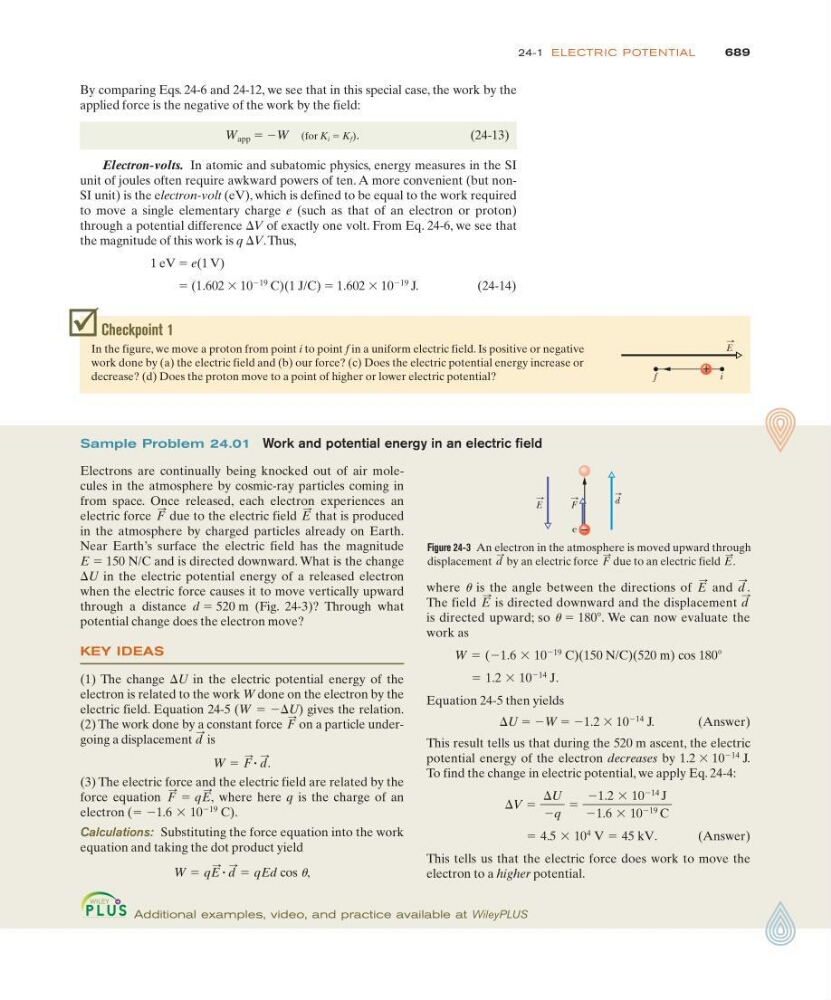
Electrons are continually being knocked out of air molecules in the atmosphere by cosmic-ray particles coming in
from space. Once released, each electron experiences an
electric force due to the electric field that is produced
in the atmosphere by charged particles already on Earth.
Near Earth’s surface the electric field has the magnitude
E ϭ 150 N/C and is directed downward. What is the change
⌬U in the electric potential energy of a released electron
when the electric force causes it to move vertically upward
through a distance d ϭ 520 m (Fig. 24-3)? Through what
potential change does the electron move?
KEY IDEAS
(1) The change ⌬U in the electric potential energy of the
electron is related to the work W done on the electron by the
electric field. Equation 24-5 (W
⌬U) gives the relation.
(2) The work done by a constant force on a particle undergoing a displacement is
(3) The electric force and the electric field are related by the
force equation
where here q is the charge of an
electron (
1.6 10
Ϫ19
C).
Calculations: Substituting the force equation into the work
equation and taking the dot product yield
W ϭ qE
: ؒ d
: ϭ qEd cos u,
ϫ
ϭ Ϫ
F
: ϭ qE
:
,
W ϭ F
: ؒ d
:
.
d
:
F
:
ϭ Ϫ
E
:
F
:
Additional examples, video, and practice available at WileyPLUS
By comparing Eqs. 24-6 and 24-12, we see that in this special case, the work by the
applied force is the negative of the work by the field:
W app ϭ ϪW (for K i ϭ K f ).
( 2 4 - 1 3 )
Electron-volts. In atomic and subatomic physics, energy measures in the SI
unit of joules often require awkward powers of ten. A more convenient (but nonSI unit) is the electron-volt (eV), which is defined to be equal to the work required
to move a single elementary charge e (such as that of an electron or proton)
through a potential difference ⌬V of exactly one volt. From Eq. 24-6, we see that
the magnitude of this work is q ⌬V.Thus,
1 eV ϭ e(1 V)
ϭ (1.602 ϫ 10
Ϫ19
C)(1 J/C) ϭ 1.602 ϫ 10
Ϫ19
J.
(24-14)
Checkpoint 1
In the figure, we move a proton from point i to point f in a uniform electric field. Is positive or negative
work done by (a) the electric field and (b) our force? (c) Does the electric potential energy increase or
decrease? (d) Does the proton move to a point of higher or lower electric potential?
E
+
f
i
Figure 24-3 An electron in the atmosphere is moved upward through
displacement by an electric force due to an electric field .
E
:
F
:
d
:
–
e
E
F
d