

683
PROB LE M S
••50
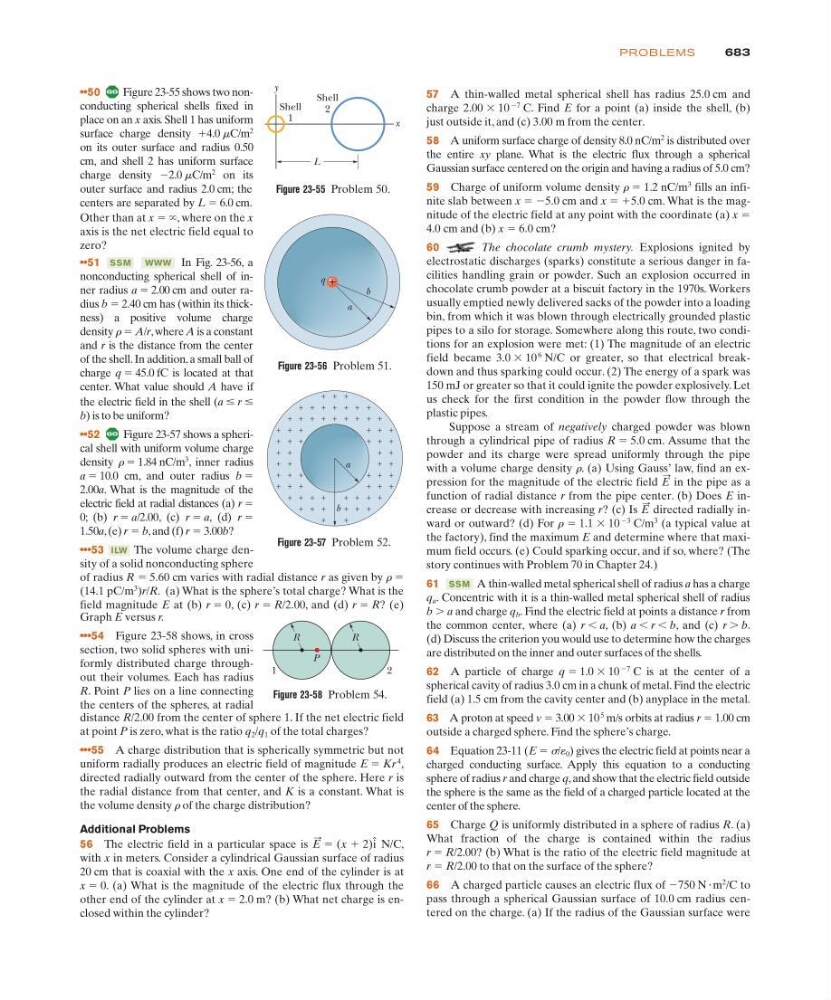
Figure 23-55 shows two nonconducting spherical shells fixed in
place on an x axis. Shell 1 has uniform
surface charge density ϩ4.0 mC/m
2
on its outer surface and radius 0.50
cm, and shell 2 has uniform surface
charge density Ϫ2.0 mC/m
2
on its
outer surface and radius 2.0 cm; the
centers are separated by L ϭ 6.0 cm.
57 A thin-walled metal spherical shell has radius 25.0 cm and
charge 2.00 ϫ 10
Ϫ7
C. Find E for a point (a) inside the shell, (b)
just outside it, and (c) 3.00 m from the center.
58 A uniform surface charge of density 8.0 nC/m
2
is distributed over
the entire xy plane. What is the electric flux through a spherical
Gaussian surface centered on the origin and having a radius of 5.0 cm?
59 Charge of uniform volume density r ϭ 1.2 nC/m
3
fills an infinite slab between x ϭ Ϫ5.0 cm and x ϭ ϩ5.0 cm. What is the magnitude of the electric field at any point with the coordinate (a) x ϭ
4.0 cm and (b) x ϭ 6.0 cm?
60
The chocolate crumb mystery. Explosions ignited by
electrostatic discharges (sparks) constitute a serious danger in facilities handling grain or powder. Such an explosion occurred in
chocolate crumb powder at a biscuit factory in the 1970s. Workers
usually emptied newly delivered sacks of the powder into a loading
bin, from which it was blown through electrically grounded plastic
pipes to a silo for storage. Somewhere along this route, two conditions for an explosion were met: (1) The magnitude of an electric
field became 3.0 ϫ 10
6
N/C or greater, so that electrical breakdown and thus sparking could occur. (2) The energy of a spark was
150 mJ or greater so that it could ignite the powder explosively. Let
us check for the first condition in the powder flow through the
plastic pipes.
Suppose a stream of negatively charged powder was blown
through a cylindrical pipe of radius R ϭ 5.0 cm. Assume that the
powder and its charge were spread uniformly through the pipe
with a volume charge density r. (a) Using Gauss’ law, find an expression for the magnitude of the electric field in the pipe as a
function of radial distance r from the pipe center. (b) Does E increase or decrease with increasing r? (c) Is directed radially inward or outward? (d) For r ϭ 1.1 ϫ 10
Ϫ3
C/m
3
(a typical value at
the factory), find the maximum E and determine where that maximum field occurs. (e) Could sparking occur, and if so, where? (The
story continues with Problem 70 in Chapter 24.)
61
A thin-walled metal spherical shell of radius a has a charge
q a . Concentric with it is a thin-walled metal spherical shell of radius
b Ͼ a and charge q b . Find the electric field at points a distance r from
the common center, where (a) r Ͻ a, (b) a Ͻ r Ͻ b, and (c) r Ͼ b.
(d) Discuss the criterion you would use to determine how the charges
are distributed on the inner and outer surfaces of the shells.
62 A particle of charge q ϭ 1.0 ϫ 10
Ϫ7
C is at the center of a
spherical cavity of radius 3.0 cm in a chunk of metal. Find the electric
field (a) 1.5 cm from the cavity center and (b) anyplace in the metal.
63 A proton at speed v ϭ 3.00 ϫ 10
5
m/s orbits at radius r ϭ 1.00 cm
outside a charged sphere. Find the sphere’s charge.
64 Equation 23-11 (E ϭ s/´ 0 ) gives the electric field at points near a
charged conducting surface. Apply this equation to a conducting
sphere of radius r and charge q, and show that the electric field outside
the sphere is the same as the field of a charged particle located at the
center of the sphere.
65 Charge Q is uniformly distributed in a sphere of radius R. (a)
What fraction of the charge is contained within the radius
r ϭ R/2.00? (b) What is the ratio of the electric field magnitude at
r ϭ R/2.00 to that on the surface of the sphere?
66 A charged particle causes an electric flux of Ϫ750 N ?m
2
/C to
pass through a spherical Gaussian surface of 10.0 cm radius centered on the charge. (a) If the radius of the Gaussian surface were
SSM
E
:
E
:
Other than at x ϭ ϱ, where on the x
axis is the net electric field equal to
zero?
••51
In Fig. 23-56, a
nonconducting spherical shell of inner radius a ϭ 2.00 cm and outer radius b ϭ 2.40 cm has (within its thickness) a positive volume charge
density r ϭ A/r, where A is a constant
and r is the distance from the center
of the shell. In addition, a small ball of
charge q ϭ 45.0 fC is located at that
center. What value should A have if
WWW
SSM
x
Shell
1
Shell
2
y
L
Figure 23-55 Problem 50.
b
a
q +
Figure 23-56 Problem 51.
a
b
+
+
+
+
+
+
+
+
+
+
+
+
+
+
+
+
+
+
+
+
+
+
+
+
+
+
+
+
+
+
+
+
+
+
+
+
+
+
+
+
+
+
+
+
+
+
+
+
+
+
+
+
+
+
+
+
+
+
+
+
+
+
+
+
+
+
+
Figure 23-57 Problem 52.
of radius R ϭ 5.60 cm varies with radial distance r as given by r ϭ
(14.1 pC/m
3
)r/R. (a) What is the sphere’s total charge? What is the
field magnitude E at (b) r ϭ 0, (c) r ϭ R/2.00, and (d) r ϭ R? (e)
the electric field in the shell (a Յ r Յ
b) is to be uniform?
••52
Figure 23-57 shows a spherical shell with uniform volume charge
density r ϭ 1.84 nC/m
3
, inner radius
a ϭ 10.0 cm, and outer radius b ϭ
2.00a. What is the magnitude of the
electric field at radial distances (a) r ϭ
0; (b) r ϭ a/2.00, (c) r ϭ a, (d) r ϭ
1.50a,(e) r ϭ b,and (f) r ϭ 3.00b?
•••53
The volume charge density of a solid nonconducting sphere
ILW
R
R
P
1
2
Figure 23-58 Problem 54.
Graph E versus r.
•••54 Figure 23-58 shows, in cross
section, two solid spheres with uniformly distributed charge throughout their volumes. Each has radius
R. Point P lies on a line connecting
the centers of the spheres, at radial
distance R/2.00 from the center of sphere 1. If the net electric field
at point P is zero, what is the ratio q 2 /q 1 of the total charges?
•••55 A charge distribution that is spherically symmetric but not
uniform radially produces an electric field of magnitude E ϭ Kr
4
,
directed radially outward from the center of the sphere. Here r is
the radial distance from that center, and K is a constant. What is
the volume density r of the charge distribution?
Additional Problems
56 The electric field in a particular space is
N/C,
with x in meters. Consider a cylindrical Gaussian surface of radius
20 cm that is coaxial with the x axis. One end of the cylinder is at
x ϭ 0. (a) What is the magnitude of the electric flux through the
other end of the cylinder at x ϭ 2.0 m? (b) What net charge is enclosed within the cylinder?
E
: ϭ (x ϩ 2)i ˆ