

681
PROB LE M S
•35
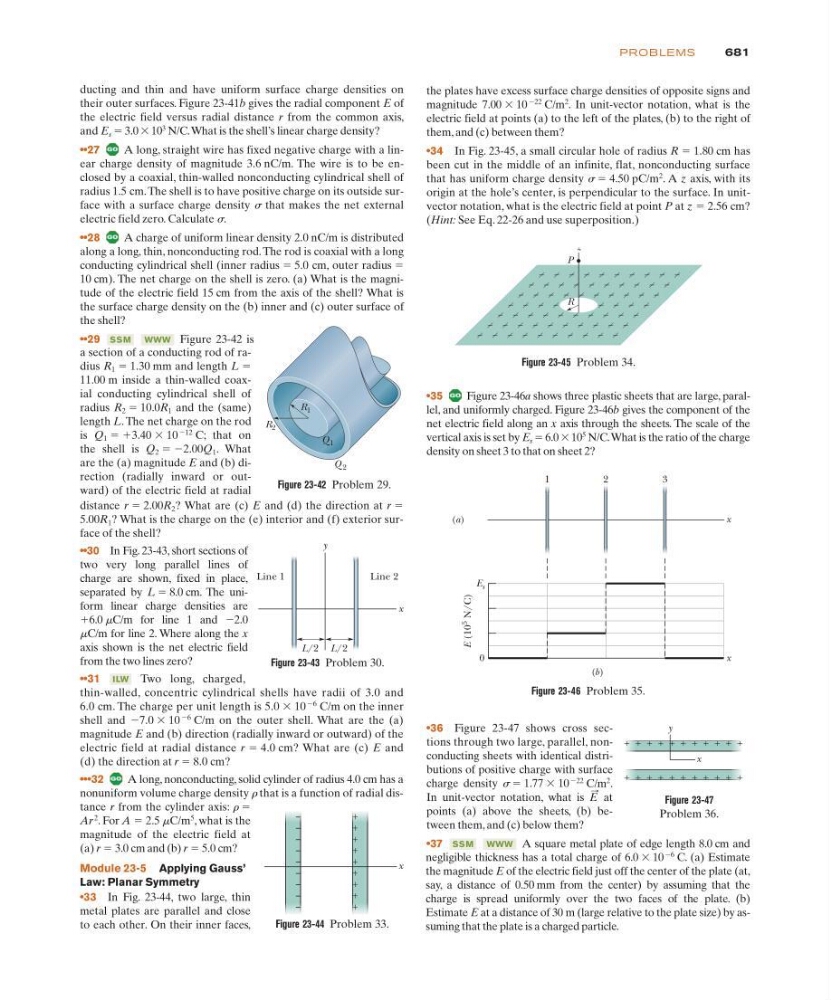
Figure 23-46a shows three plastic sheets that are large, parallel, and uniformly charged. Figure 23-46b gives the component of the
net electric field along an x axis through the sheets. The scale of the
vertical axis is set by E s ϭ 6.0 ϫ 10
5
N/C.What is the ratio of the charge
density on sheet 3 to that on sheet 2?
ducting and thin and have uniform surface charge densities on
their outer surfaces. Figure 23-41b gives the radial component E of
the electric field versus radial distance r from the common axis,
and E s ϭ 3.0 ϫ 10
3
N/C.What is the shell’s linear charge density?
••27
A long, straight wire has fixed negative charge with a linear charge density of magnitude 3.6 nC/m. The wire is to be enclosed by a coaxial, thin-walled nonconducting cylindrical shell of
radius 1.5 cm. The shell is to have positive charge on its outside surface with a surface charge density s that makes the net external
electric field zero. Calculate s.
••28
A charge of uniform linear density 2.0 nC/m is distributed
along a long, thin, nonconducting rod. The rod is coaxial with a long
conducting cylindrical shell (inner radius ϭ 5.0 cm, outer radius ϭ
10 cm). The net charge on the shell is zero. (a) What is the magnitude of the electric field 15 cm from the axis of the shell? What is
the surface charge density on the (b) inner and (c) outer surface of
the shell?
••29
Figure 23-42 is
WWW
SSM
the plates have excess surface charge densities of opposite signs and
magnitude 7.00 ϫ 10
Ϫ22
C/m
2
. In unit-vector notation, what is the
electric field at points (a) to the left of the plates, (b) to the right of
them, and (c) between them?
•34 In Fig. 23-45, a small circular hole of radius R ϭ 1.80 cm has
been cut in the middle of an infinite, flat, nonconducting surface
that has uniform charge density s ϭ 4.50 pC/m
2
. A z axis, with its
origin at the hole’s center, is perpendicular to the surface. In unitvector notation, what is the electric field at point P at z ϭ 2.56 cm?
(Hint: See Eq. 22-26 and use superposition.)
•36 Figure 23-47 shows cross sections through two large, parallel, nonconducting sheets with identical distributions of positive charge with surface
charge density s ϭ 1.77 ϫ 10
Ϫ22
C/m
2
.
In unit-vector notation, what is
at
points (a) above the sheets, (b) between them, and (c) below them?
•37
A square metal plate of edge length 8.0 cm and
WWW
SSM
E
:
a section of a conducting rod of radius R 1 ϭ 1.30 mm and length L ϭ
11.00 m inside a thin-walled coaxial conducting cylindrical shell of
radius R 2 ϭ 10.0R 1 and the (same)
length L. The net charge on the rod
is Q 1 ϭ ϩ3.40 ϫ 10
Ϫ12
C; that on
the shell is Q 2 ϭ Ϫ2.00Q 1 . What
are the (a) magnitude E and (b) direction (radially inward or outward) of the electric field at radial
R 1
R 2
Q 1
Q 2
Figure 23-42 Problem 29.
distance r ϭ 2.00R 2 ? What are (c) E and (d) the direction at r ϭ
5.00R 1 ? What is the charge on the (e) interior and (f) exterior surface of the shell?
••30 In Fig. 23-43, short sections of
two very long parallel lines of
charge are shown, fixed in place,
separated by L ϭ 8.0 cm. The uniform linear charge densities are
ϩ6.0 mC/m for line 1 and Ϫ2.0
mC/m for line 2. Where along the x
axis shown is the net electric field
from the two lines zero?
••31
Two long, charged,
thin-walled, concentric cylindrical shells have radii of 3.0 and
6.0 cm. The charge per unit length is 5.0 ϫ 10
Ϫ6
C/m on the inner
shell and Ϫ7.0 ϫ 10
Ϫ6
C/m on the outer shell. What are the (a)
magnitude E and (b) direction (radially inward or outward) of the
electric field at radial distance r ϭ 4.0 cm? What are (c) E and
(d) the direction at r ϭ 8.0 cm?
•••32
A long, nonconducting, solid cylinder of radius 4.0 cm has a
nonuniform volume charge density r that is a function of radial distance r from the cylinder axis: r ϭ
Ar
2
. For A ϭ 2.5 mC/m
5
, what is the
magnitude of the electric field at
(a) r ϭ 3.0 cm and (b) r ϭ 5.0 cm?
Module 23-5 Applying Gauss’
Law: Planar Symmetry
•33 In Fig. 23-44, two large, thin
metal plates are parallel and close
to each other. On their inner faces,
ILW
Figure 23-43 Problem 30.
Line 1
Line 2
x
y
L/2 L/2
–
–
–
–
–
–
–
–
–
+
+
+
+
+
+
+
+
+
x
Figure 23-44 Problem 33.
+ + + + + + + + + +
+ + + + + + + + + +
+ + + + + + + + + +
+ + + +
+ + + +
+ + + + + + + + + +
+ + + + + + + + + +
+ + + + + + + + + +
P
z
R
Figure 23-45 Problem 34.
(a)
(b)
x
x
E s
0
E (10
5
N/C)
1
2
3
Figure 23-46 Problem 35.
+
+
+
+
+
+
+
+
+
+
+
+
+
+
+
+
+
+
+
+
+
+
y
x
Figure 23-47
Problem 36.
negligible thickness has a total charge of 6.0 ϫ 10
Ϫ6
C. (a) Estimate
the magnitude E of the electric field just off the center of the plate (at,
say, a distance of 0.50 mm from the center) by assuming that the
charge is spread uniformly over the two faces of the plate. (b)
Estimate E at a distance of 30 m (large relative to the plate size) by assuming that the plate is a charged particle.