

676
CHAPTE R 23 GAUSS’ L AW
Figure 23-21 The dots represent a spherically
symmetric distribution of charge of radius
R, whose volume charge density r is a
function only of distance from the center.
The charged object is not a conductor, and
therefore the charge is assumed to be
fixed in position. A concentric spherical
Gaussian surface with r Ͼ R is shown in (a).
A similar Gaussian surface with r Ͻ R is
shown in (b).
r
R
ρ
r
R
Gaussian
surface
Gaussian
surface
Enclosed
charge is q'
Enclosed
charge is q
(a)
(b) The flux through the
surface depends on
only the enclosed
charge.
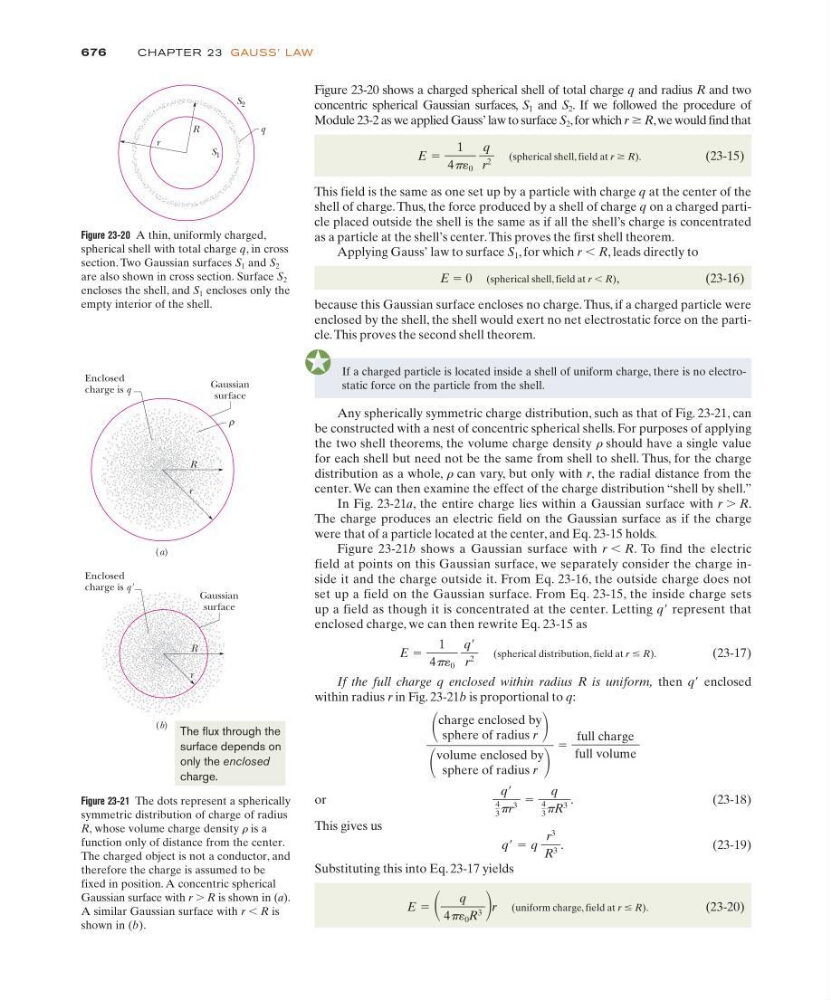
Figure 23-20 shows a charged spherical shell of total charge q and radius R and two
concentric spherical Gaussian surfaces, S 1 and S 2 . If we followed the procedure of
Module 23-2 as we applied Gauss’ law to surface S 2 ,for which r Ն R,we would find that
(spherical shell, field at r Ն R).
(23-15)
This field is the same as one set up by a particle with charge q at the center of the
shell of charge. Thus, the force produced by a shell of charge q on a charged particle placed outside the shell is the same as if all the shell’s charge is concentrated
as a particle at the shell’s center. This proves the first shell theorem.
Applying Gauss’ law to surface S 1 , for which r Ͻ R, leads directly to
E ϭ 0 (spherical shell, field at r Ͻ R),
( 2 3 - 1 6 )
because this Gaussian surface encloses no charge. Thus, if a charged particle were
enclosed by the shell, the shell would exert no net electrostatic force on the particle. This proves the second shell theorem.
E ϭ
1
4p´ 0
q
r
2
If a charged particle is located inside a shell of uniform charge, there is no electrostatic force on the particle from the shell.
Any spherically symmetric charge distribution, such as that of Fig. 23-21, can
be constructed with a nest of concentric spherical shells. For purposes of applying
the two shell theorems, the volume charge density r should have a single value
for each shell but need not be the same from shell to shell. Thus, for the charge
distribution as a whole, r can vary, but only with r, the radial distance from the
center. We can then examine the effect of the charge distribution “shell by shell.”
In Fig. 23-21a, the entire charge lies within a Gaussian surface with r Ͼ R.
The charge produces an electric field on the Gaussian surface as if the charge
were that of a particle located at the center, and Eq. 23-15 holds.
Figure 23-21b shows a Gaussian surface with r Ͻ R. To find the electric
field at points on this Gaussian surface, we separately consider the charge inside it and the charge outside it. From Eq. 23-16, the outside charge does not
set up a field on the Gaussian surface. From Eq. 23-15, the inside charge sets
up a field as though it is concentrated at the center. Letting qЈ represent that
enclosed charge, we can then rewrite Eq. 23-15 as
(spherical distribution, field at r Յ R).
(23-17)
If the full charge q enclosed within radius R is uniform, then qЈ enclosed
within radius r in Fig. 23-21b is proportional to q:
or
(23-18)
This gives us
(23-19)
Substituting this into Eq. 23-17 yields
(uniform charge, field at r Յ R).
(23-20)
E ϭ
q
4p´ 0 R
3 r
qЈ ϭ q
r
3
R
3
.
qЈ
4
3 pr
3
ϭ
q
4
3 pR
3
.
charge enclosed by
sphere of radius r
volume enclosed by
sphere of radius r
ϭ
full charge
full volume
E ϭ
1
4p´ 0
qЈ
r
2
Figure 23-20 A thin, uniformly charged,
spherical shell with total charge q, in cross
section. Two Gaussian surfaces S 1 and S 2
are also shown in cross section. Surface S 2
encloses the shell, and S 1 encloses only the
empty interior of the shell.
r
R
S 1
q
S 2