

667
23-2 GAUSS’ L AW
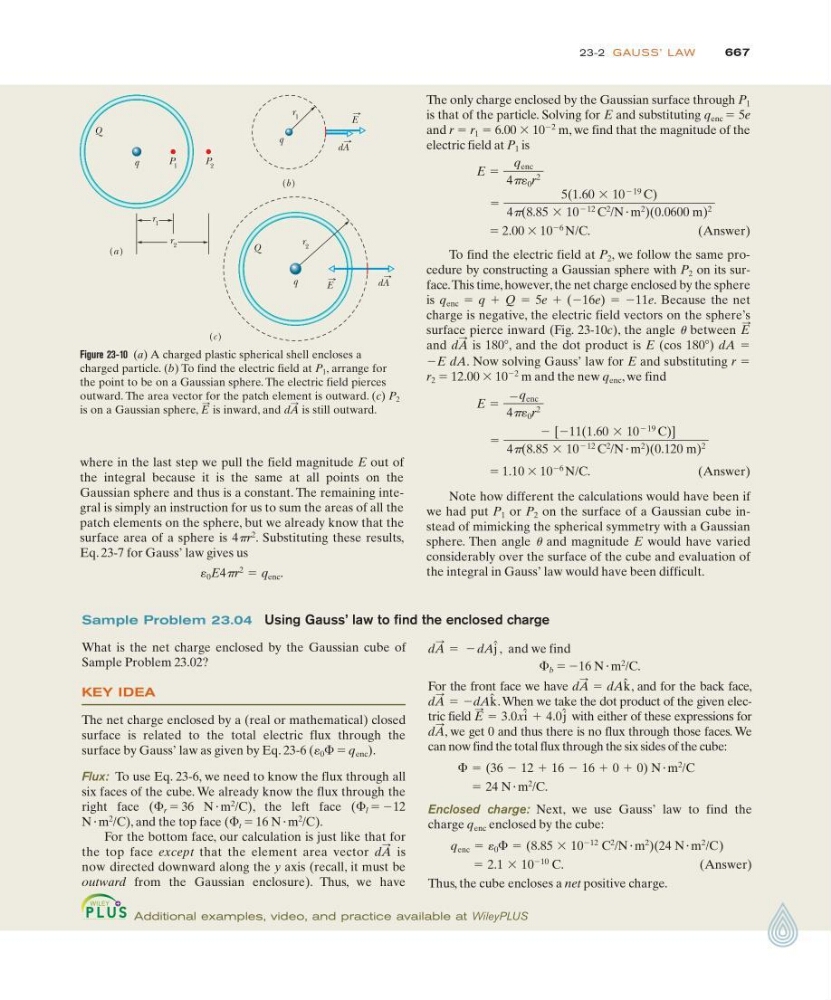
Figure 23-10 (a) A charged plastic spherical shell encloses a
charged particle. (b) To find the electric field at P 1 , arrange for
the point to be on a Gaussian sphere. The electric field pierces
outward. The area vector for the patch element is outward. (c) P 2
is on a Gaussian sphere, is inward, and
is still outward.
dA
:
E
:
The only charge enclosed by the Gaussian surface through P 1
is that of the particle. Solving for E and substituting q enc ϭ 5e
and r ϭ r 1 ϭ 6.00 ϫ 10
Ϫ2
m, we find that the magnitude of the
electric field at P 1 is
ϭ 2.00 ϫ 10
Ϫ6
N/C.
(Answer)
To find the electric field at P 2 , we follow the same procedure by constructing a Gaussian sphere with P 2 on its surface.This time, however, the net charge enclosed by the sphere
is q enc ϭ q ϩ Q ϭ 5e ϩ (Ϫ16e) ϭ Ϫ11e. Because the net
charge is negative, the electric field vectors on the sphere’s
surface pierce inward (Fig. 23-10c), the angle u between
and
is 180Њ, and the dot product is E (cos 180Њ) dA ϭ
dA
:
E
:
ϭ
5(1.60 ϫ 10
Ϫ19
C)
4p(8.85 ϫ 10
Ϫ12
C
2
/Nиm
2
)(0.0600 m)
2
E ϭ
q enc
4p´ 0 r
2
where in the last step we pull the field magnitude E out of
the integral because it is the same at all points on the
Gaussian sphere and thus is a constant. The remaining integral is simply an instruction for us to sum the areas of all the
patch elements on the sphere, but we already know that the
surface area of a sphere is 4pr
2
. Substituting these results,
Eq. 23-7 for Gauss’ law gives us
´ 0 E4pr
2 ϭ q enc .
and we find
⌽ b ϭ Ϫ16 N ?m
2
/C.
For the front face we have
, and for the back face,
. When we take the dot product of the given electric field
with either of these expressions for
, we get 0 and thus there is no flux through those faces. We
can now find the total flux through the six sides of the cube:
Enclosed charge: Next, we use Gauss’ law to find the
charge q enc enclosed by the cube:
(Answer)
Thus, the cube encloses a net positive charge.
ϭ 2.1 ϫ 10
Ϫ10
C.
q enc ϭ 0 ⌽ ϭ (8.85 ϫ 10
Ϫ12
C
2
/Nиm
2
)(24 Nиm
2
/C)
ϭ 24 Nиm
2
/C.
⌽ ϭ (36 Ϫ 12 ϩ 16 Ϫ 16 ϩ 0 ϩ 0) Nиm
2
/C
dA
:
E
: ϭ 3.0xi ˆ ϩ 4.0 j
ˆ
dA
: ϭ ϪdAk ˆ
dA
: ϭ dAk ˆ
dA
: ϭ ϪdAj ˆ ,
Sample Problem 23.04 Using Gauss’ law to find the enclosed charge
What is the net charge enclosed by the Gaussian cube of
Sample Problem 23.02?
KEY IDEA
The net charge enclosed by a (real or mathematical) closed
surface is related to the total electric flux through the
surface by Gauss’ law as given by Eq. 23-6 (´ 0 ⌽ ϭ q enc ).
Flux: To use Eq. 23-6, we need to know the flux through all
six faces of the cube. We already know the flux through the
right face (⌽ r ϭ 36 N иm
2
/C), the left face (⌽ l ϭ Ϫ12
N ?m
2
/C), and the top face (⌽ t ϭ 16 N ?m
2
/C).
For the bottom face, our calculation is just like that for
the top face except that the element area vector
is
now directed downward along the y axis (recall, it must be
outward from the Gaussian enclosure). Thus, we have
dA
:
Additional examples, video, and practice available at WileyPLUS
ϪE dA. Now solving Gauss’ law for E and substituting r ϭ
r 2 ϭ 12.00 ϫ 10
Ϫ2
m and the new q enc , we find
ϭ 1.10 ϫ 10
Ϫ6
N/C.
(Answer)
Note how different the calculations would have been if
we had put P 1 or P 2 on the surface of a Gaussian cube instead of mimicking the spherical symmetry with a Gaussian
sphere. Then angle u and magnitude E would have varied
considerably over the surface of the cube and evaluation of
the integral in Gauss’ law would have been difficult.
ϭ
Ϫ [Ϫ11(1.60 ϫ 10
Ϫ19
C)]
4p(8.85 ϫ 10
Ϫ12
C
2
/Nиm
2
)(0.120 m)
2
E ϭ
Ϫ q enc
4p´ 0 r
2
r 1
P 1
P 2
q
Q
r 2
(a )
q
Q
r 2
E
dA
(c )
r 1
q
E
dA
(b )