

Gauss’ Law
Gauss’ law relates the net flux ⌽ of an electric field through a closed surface
(a Gaussian surface) to the net charge q enc that is enclosed by that surface. It tells us that
´ 0 ⌽ ϭ q enc (Gauss’ law).
(23-6)
664
CHAPTE R 23 GAUSS’ L AW
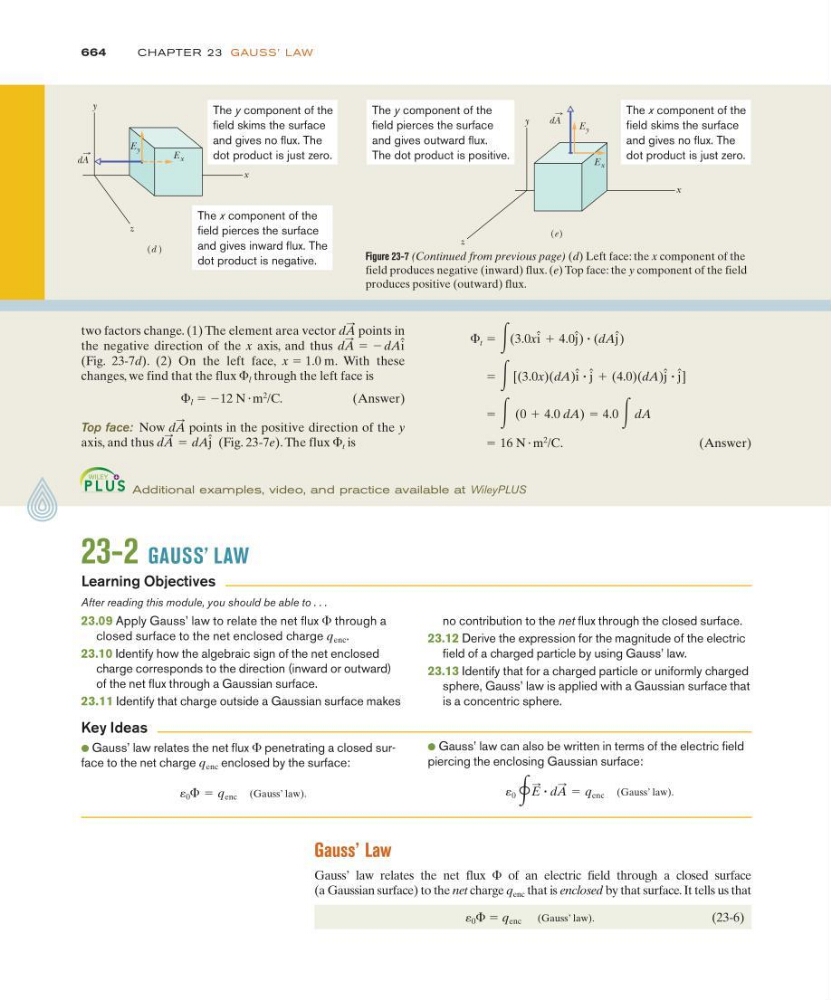
Figure 23-7 (Continued from previous page) (d) Left face: the x component of the
field produces negative (inward) flux. (e) Top face: the y component of the field
produces positive (outward) flux.
23-2 GAUSS’ LAW
Learning Objectives
no contribution to the net flux through the closed surface.
23.12 Derive the expression for the magnitude of the electric
field of a charged particle by using Gauss’ law.
23.13 Identify that for a charged particle or uniformly charged
sphere, Gauss’ law is applied with a Gaussian surface that
is a concentric sphere.
● Gauss’ law relates the net flux ⌽ penetrating a closed surface to the net charge q enc enclosed by the surface:
(Gauss’ law).
´ 0 ⌽ ϭ q enc
● Gauss’ law can also be written in terms of the electric field
piercing the enclosing Gaussian surface:
(Gauss’ law).
´ 0 ͶE
: ؒ dA
: ϭ q enc
After reading this module, you should be able to . . .
23.09 Apply Gauss’ law to relate the net flux ⌽ through a
closed surface to the net enclosed charge q enc .
23.10 Identify how the algebraic sign of the net enclosed
charge corresponds to the direction (inward or outward)
of the net flux through a Gaussian surface.
23.11 Identify that charge outside a Gaussian surface makes
Key Ideas
Additional examples, video, and practice available at WileyPLUS
two factors change. (1) The element area vector
points in
the negative direction of the x axis, and thus
(Fig. 23-7d). (2) On the left face, x ϭ 1.0 m. With these
changes, we find that the flux through the left face is
⌽ l ϭ Ϫ12 N иm
2
/C.
(Answer)
Top face: Now
points in the positive direction of the y
axis, and thus
(Fig. 23-7e). The flux is
⌽ t
dA
: ϭ dAj ˆ
dA
:
⌽ l
dA
: ϭ ϪdAi ˆ
dA
:
(Answer)
ϭ 16 N и m
2
/C.
ϭ ͵ (0 ϩ 4.0 dA) ϭ 4.0 ͵dA
ϭ ͵ [(3.0x)(dA)i ˆ ؒ j ˆ ϩ (4.0)(dA)j ˆ ؒ j ˆ ]
⌽ t ϭ ͵(3. 0xi ˆ ϩ 4.0j ˆ ) ؒ (dAj ˆ )
y
x
z
dA
E x
E y
The y component of the
field pierces the surface
and gives outward flux.
The dot product is positive.
The x component of the
field skims the surface
and gives no flux. The
dot product is just zero.
(e )
y
x
z
dA
E x
E y
The y component of the
field skims the surface
and gives no flux. The
dot product is just zero.
The x component of the
field pierces the surface
and gives inward flux. The
dot product is negative.
(d )