

3-1 VECTORS AN D TH E I R COM PON E NTS
in Fig. 3-7a. The z axis comes directly out of the page at the origin; we ignore it for
now and deal only with two-dimensional vectors.
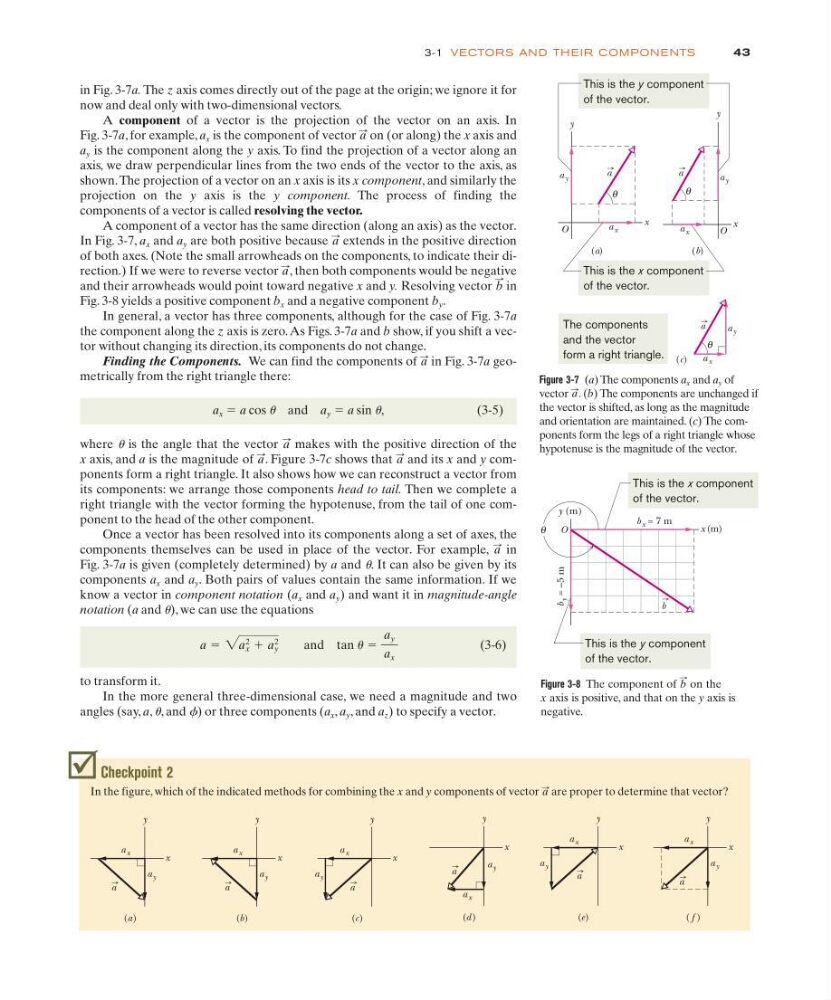
A component of a vector is the projection of the vector on an axis. In
Fig. 3-7a, for example, a x is the component of vector on (or along) the x axis and
a y is the component along the y axis. To find the projection of a vector along an
axis, we draw perpendicular lines from the two ends of the vector to the axis, as
shown. The projection of a vector on an x axis is its x component, and similarly the
projection on the y axis is the y component. The process of finding the
components of a vector is called resolving the vector.
A component of a vector has the same direction (along an axis) as the vector.
In Fig. 3-7, a x and a y are both positive because extends in the positive direction
of both axes. (Note the small arrowheads on the components, to indicate their direction.) If we were to reverse vector , then both components would be negative
and their arrowheads would point toward negative x and y. Resolving vector in
Fig. 3-8 yields a positive component b x and a negative component b y .
In general, a vector has three components, although for the case of Fig. 3-7a
the component along the z axis is zero. As Figs. 3-7a and b show, if you shift a vector without changing its direction, its components do not change.
Finding the Components. We can find the components of in Fig. 3-7a geometrically from the right triangle there:
a x ϭ a cos u and a y ϭ a sin u,
( 3 - 5 )
where u is the angle that the vector makes with the positive direction of the
x axis, and a is the magnitude of . Figure 3-7c shows that and its x and y components form a right triangle. It also shows how we can reconstruct a vector from
its components: we arrange those components head to tail. Then we complete a
right triangle with the vector forming the hypotenuse, from the tail of one component to the head of the other component.
Once a vector has been resolved into its components along a set of axes, the
components themselves can be used in place of the vector. For example, in
Fig. 3-7a is given (completely determined) by a and u. It can also be given by its
components a x and a y . Both pairs of values contain the same information. If we
know a vector in component notation (a x and a y ) and want it in magnitude-angle
notation (a and u), we can use the equations
and tan
(3-6)
to transform it.
In the more general three-dimensional case, we need a magnitude and two
angles (say, a, u, and f) or three components (a x , a y , and a z ) to specify a vector.
ϭ
a y
a x
a ϭ 2a
2
x ϩ a y
2
a
:
a
:
a
:
a
:
a
:
b
:
a
:
a
:
a
:
Figure 3-8 The component of on the
x axis is positive, and that on the y axis is
negative.
b
:
O
y (m)
θ
x (m)
b x = 7 m
b
y = –5 m
b
This is the x component
of the vector.
This is the y component
of the vector.
43
Figure 3-7 (a) The components a x and a y of
vector . (b) The components are unchanged if
the vector is shifted, as long as the magnitude
and orientation are maintained. (c) The components form the legs of a right triangle whose
hypotenuse is the magnitude of the vector.
a
:
y
x
O
a x
a y
θ
θ
(a)
(b)
y
x
O
a x
a y
a
a
θ
(c)
a y
a x
a
This is the y component
of the vector.
This is the x component
of the vector.
The components
and the vector
form a right triangle.
Checkpoint 2
In the figure, which of the indicated methods for combining the x and y components of vector are proper to determine that vector?
a
:
y
x
a x
a y
(a)
a
y
x
a x
a y
(d)
a
y
x
a x
a y
(e)
a
x
a x
a y
y
( f )
a
y
x
a x
a y
(b)
a
y
x
a x
a y
(c)
a
in Fig. 3-7a. The z axis comes directly out of the page at the origin; we ignore it for
now and deal only with two-dimensional vectors.
A component of a vector is the projection of the vector on an axis. In
Fig. 3-7a, for example, a x is the component of vector on (or along) the x axis and
a y is the component along the y axis. To find the projection of a vector along an
axis, we draw perpendicular lines from the two ends of the vector to the axis, as
shown. The projection of a vector on an x axis is its x component, and similarly the
projection on the y axis is the y component. The process of finding the
components of a vector is called resolving the vector.
A component of a vector has the same direction (along an axis) as the vector.
In Fig. 3-7, a x and a y are both positive because extends in the positive direction
of both axes. (Note the small arrowheads on the components, to indicate their direction.) If we were to reverse vector , then both components would be negative
and their arrowheads would point toward negative x and y. Resolving vector in
Fig. 3-8 yields a positive component b x and a negative component b y .
In general, a vector has three components, although for the case of Fig. 3-7a
the component along the z axis is zero. As Figs. 3-7a and b show, if you shift a vector without changing its direction, its components do not change.
Finding the Components. We can find the components of in Fig. 3-7a geometrically from the right triangle there:
a x ϭ a cos u and a y ϭ a sin u,
( 3 - 5 )
where u is the angle that the vector makes with the positive direction of the
x axis, and a is the magnitude of . Figure 3-7c shows that and its x and y components form a right triangle. It also shows how we can reconstruct a vector from
its components: we arrange those components head to tail. Then we complete a
right triangle with the vector forming the hypotenuse, from the tail of one component to the head of the other component.
Once a vector has been resolved into its components along a set of axes, the
components themselves can be used in place of the vector. For example, in
Fig. 3-7a is given (completely determined) by a and u. It can also be given by its
components a x and a y . Both pairs of values contain the same information. If we
know a vector in component notation (a x and a y ) and want it in magnitude-angle
notation (a and u), we can use the equations
and tan
(3-6)
to transform it.
In the more general three-dimensional case, we need a magnitude and two
angles (say, a, u, and f) or three components (a x , a y , and a z ) to specify a vector.
ϭ
a y
a x
a ϭ 2a
2
x ϩ a y
2
a
:
a
:
a
:
a
:
a
:
b
:
a
:
a
:
a
:
Figure 3-8 The component of on the
x axis is positive, and that on the y axis is
negative.
b
:
O
y (m)
θ
x (m)
b x = 7 m
b
y = –5 m
b
This is the x component
of the vector.
This is the y component
of the vector.
43
Figure 3-7 (a) The components a x and a y of
vector . (b) The components are unchanged if
the vector is shifted, as long as the magnitude
and orientation are maintained. (c) The components form the legs of a right triangle whose
hypotenuse is the magnitude of the vector.
a
:
y
x
O
a x
a y
θ
θ
(a)
(b)
y
x
O
a x
a y
a
a
θ
(c)
a y
a x
a
This is the y component
of the vector.
This is the x component
of the vector.
The components
and the vector
form a right triangle.
Checkpoint 2
In the figure, which of the indicated methods for combining the x and y components of vector are proper to determine that vector?
a
:
y
x
a x
a y
(a)
a
y
x
a x
a y
(d)
a
y
x
a x
a y
(e)
a
x
a x
a y
y
( f )
a
y
x
a x
a y
(b)
a
y
x
a x
a y
(c)
a